

By Amanda Reeds, Content Researcher at Acecalculator |
📋 Quick Summary
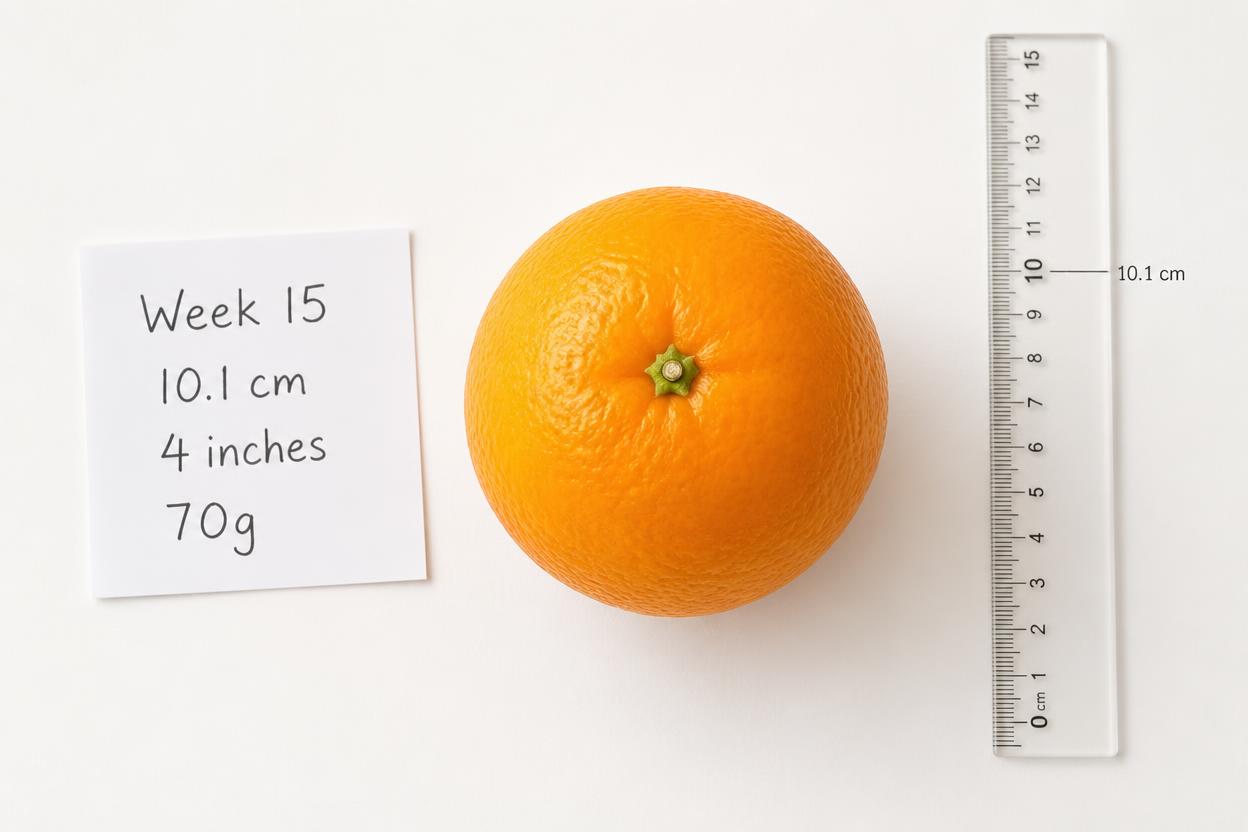
- Key takeaway: At 15 weeks, your baby is about 10.1 cm (4 inches) long — roughly the size of a navel orange — and weighing around 70 grams.
- Who this is for: Parents in their second trimester wanting to track fetal development milestones.
- Why it matters: Week 15 is when several organs start functioning and early fetal movement begins.
- Reading time: ~11 minutes
You’re 15 Weeks Pregnant — And You Probably Have a Lot of Questions
If you’ve been staring at your ultrasound picture wondering what exactly your baby looks like at 15 weeks, you’re not alone. It’s one of those weeks where things are really starting to move — pun intended — but the numbers on the screen don’t always mean much without context.
At 15 weeks, the fetus is approximately 10.1 cm (4 inches) long from crown to rump and weighs around 70 grams (2.5 oz) — about the size of a navel orange. The body proportions are becoming more human-like, fingers and toes are fully formed, and the fetus can make sucking movements and respond to light.
This guide covers the 15 week fetus size in centimetres, millimetres, and inches, what the baby actually looks like at this stage, what you can and can’t feel yet, and answers to the questions that keep coming up on pregnancy forums — from the toughest month of pregnancy to what babies can sense in the womb.
Want to track your measurements and calculate weekly milestones?
See Where My Baby’s Growth Falls on the Chart →📖 Table of Contents
- 15 Week Fetus Size: The Numbers
- Fruit Size Comparison at 15 Weeks
- What Does a 15 Week Fetus Look Like?
- Is the Baby Fully Developed at 15 Weeks?
- Can You Feel a Baby at 15 Weeks?
- Will My Belly Start Showing at 15 Weeks?
- Can My Baby Feel Me Touch My Belly?
- Which Is the Toughest Month of Pregnancy?
- How to Calm a Baby in the Womb
- What Is the Riskiest Week of Pregnancy?
- When Can You Feel the Baby Move?
- Who Kicks First — Girl or Boy?
- Can Babies Kick at 4 Months?
- Is Early Pregnancy Belly Hard or Soft?
- What Is Forbidden During Pregnancy?
- Is Belly Size an Indicator of Baby Size?
- What Is a 2 Finger Test in Pregnancy?
- FAQ
- Conclusion
15 Week Fetus Size: The Numbers in CM, MM, and Inches
The standard measurement used in obstetrics for fetal size during the first and second trimesters is crown-to-rump length (CRL) — that’s head to bottom, not head to toe. At 15 weeks, the 15 week fetus size is typically:
| Measurement | Value |
|---|---|
| Crown-to-rump length (cm) | ~10.1 cm |
| 15 week fetus size in mm | ~101 mm |
| 15 week fetus size in inches | ~4 inches |
| Approximate weight | ~70 g (2.5 oz) |
These numbers come from the National Library of Medicine’s fetal growth reference data, which tracks average CRL by gestational week. Keep in mind there’s normal variation — some babies measure slightly smaller or larger at this stage and that’s completely fine. What matters more is consistent growth at each scan.
15 Week Baby Size Fruit Comparison
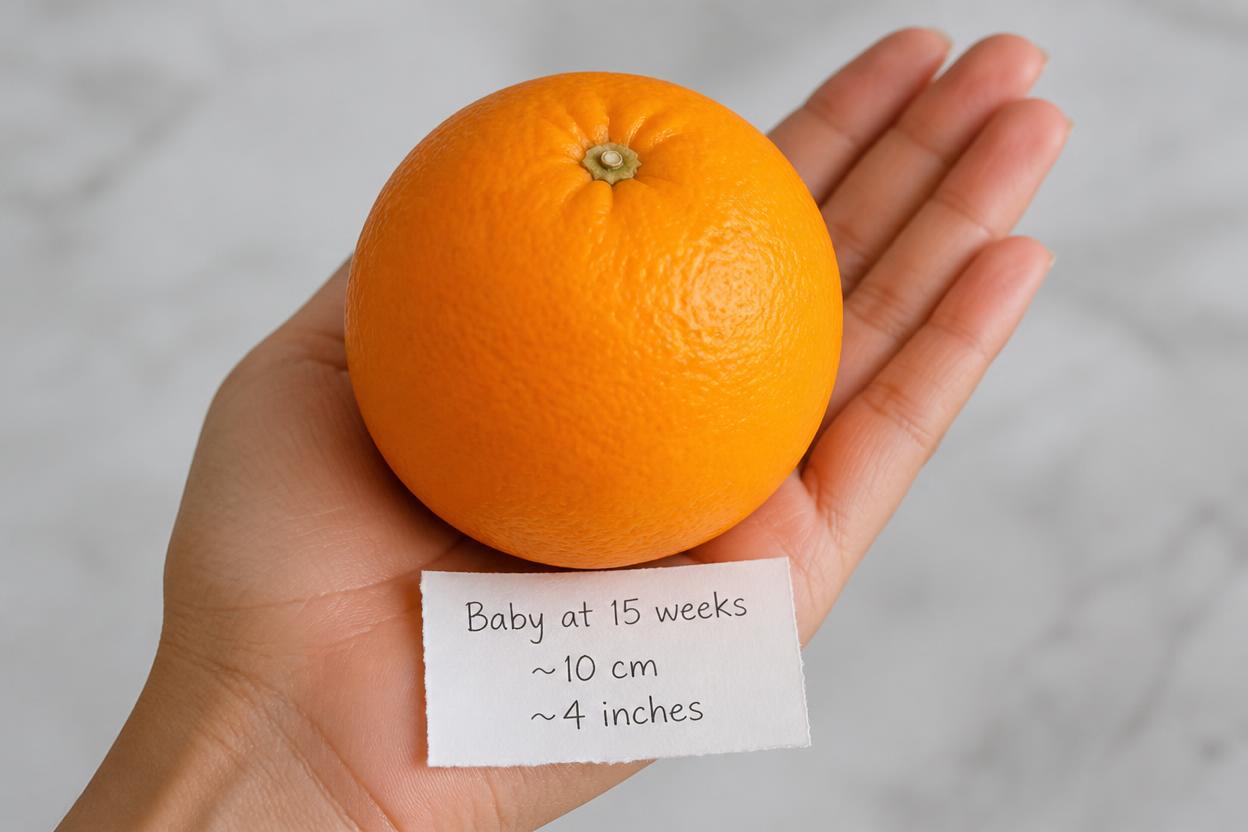
The classic way to visualise fetal size — because “101 millimetres” doesn’t paint much of a picture. At 15 weeks, your baby is the size of a navel orange. That’s roughly 4 inches across and fits comfortably in the palm of your hand.
Here’s a quick size comparison chart across the second trimester to give you a sense of the progression:
| Week | Fruit Comparison | Approx. Size |
|---|---|---|
| 13 weeks | Lemon | 7.4 cm |
| 15 weeks | Navel orange | 10.1 cm |
| 17 weeks | Pear | 13 cm |
| 20 weeks | Banana | 16.4 cm |
📐 Quick Action Steps: Track Your Baby’s Growth
- Note the CRL measurement from your ultrasound report (usually listed in cm or mm).
- Compare it against the average range for your gestational week.
- If your measurement is within 1–2 weeks of the average, that’s typically normal.
- Bring any concerns to your OB or midwife — they can assess growth velocity over multiple scans.
What Does a 15 Week Fetus Look Like?
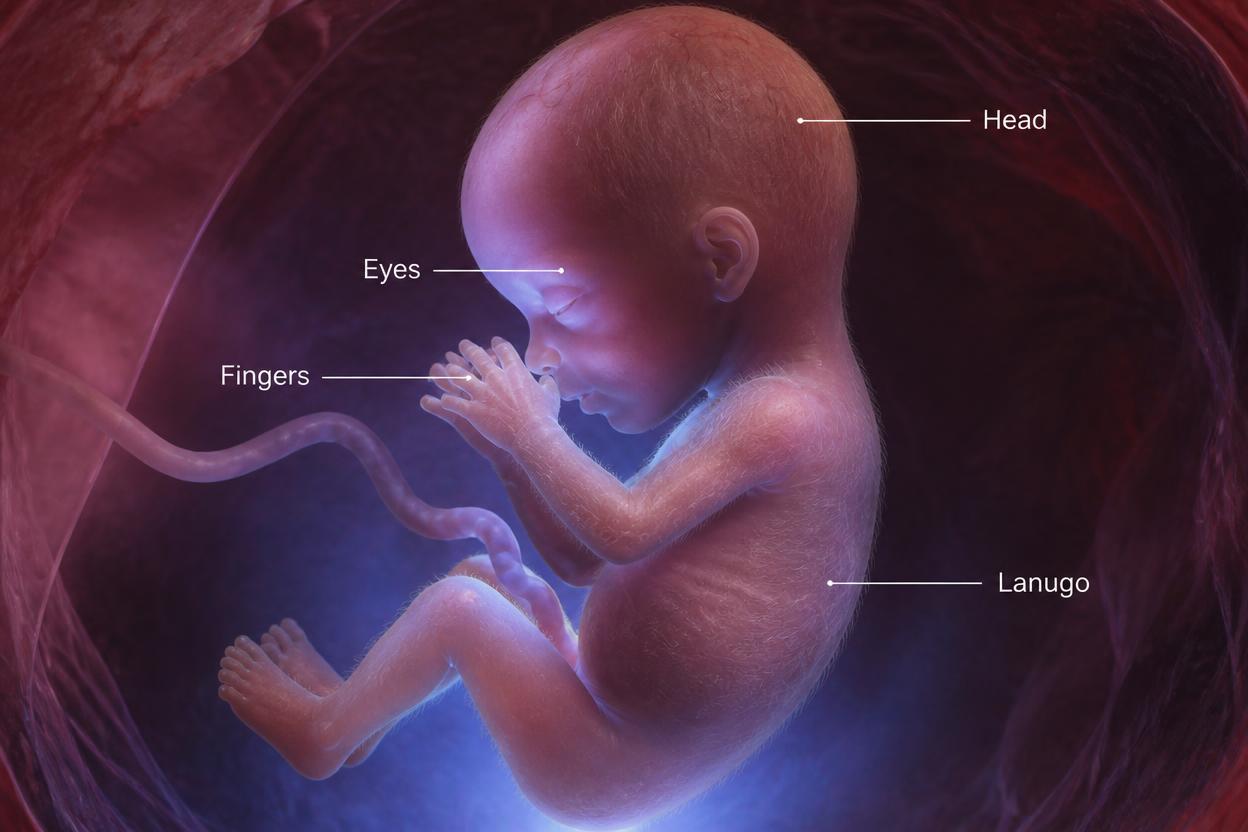
At 15 weeks, the fetus looks significantly more like a baby than it did even four weeks ago. The head is still proportionally large — about one-third of the body length — but the limbs have caught up considerably. Here’s what’s happening:
- Face: Eyes are fully formed but still fused shut. The ears have moved from the neck area to their final position on the sides of the head. Taste buds are developing.
- Limbs: Arms and legs are proportionate. Fingers and toes are fully separated with tiny nails beginning to form.
- Skin: Still translucent — you can see blood vessels through it on an ultrasound. Fine hair called lanugo is starting to grow over the body.
- Movement: The baby moves frequently, although most mothers don’t feel it yet. These movements include hiccupping, sucking, and stretching.
- Genitals: External genitalia are often visible on ultrasound at this point, though clarity varies.
Is the Baby Fully Developed at 15 Weeks?
No — not by a long way. All the major organs and body systems are present and structurally formed, but most are still in the early stages of actual function. Think of it like a house that’s been framed but not yet wired or plumbed.
At 15 weeks, the fetus has a beating heart (has had one since around week 6), functioning kidneys that produce urine (which goes into the amniotic fluid), and a liver that’s producing bile. But the lungs won’t be capable of supporting breathing outside the womb until around 24 weeks at the very earliest, and full maturation of the brain and lungs continues right up to 40 weeks — and even beyond.
According to the CDC’s fetal development guidance, the second trimester (weeks 13–26) is when most organ systems mature enough to begin functioning, but the third trimester is when the baby gains the majority of its weight and the lungs fully develop.
Can You Feel a Baby at 15 Weeks Pregnant?
Possibly — but probably not yet, and it depends a lot on whether this is your first pregnancy. First-time mothers typically feel fetal movement (called quickening) between weeks 18 and 25. If you’ve been pregnant before, you might notice it earlier — sometimes as early as 16 weeks — because you know what you’re looking for.
At 15 weeks, the baby is moving constantly, but the movements are small and the amniotic sac provides plenty of cushioning. What some women describe feeling at this stage is often described as a faint flutter, a light tapping, or “bubbles” in the lower abdomen. Many write it off as gas at first.
If you’re not feeling anything at 15 weeks, don’t worry. That is completely normal for a first pregnancy.
⚠️ When to Contact Your Doctor
If you have previously felt movement and it suddenly stops or significantly decreases after 20 weeks, contact your midwife or OB right away. Before 20 weeks, movement is too irregular to track meaningfully.
Will My Belly Start Showing at 15 Weeks?
Some women have a visible bump at 15 weeks; others still look the same as before pregnancy. Both are normal. The size of your belly at this stage depends on several factors: your pre-pregnancy weight, whether this is your first pregnancy, the position of your uterus, and how much bloating you’re experiencing.
The uterus at 15 weeks is about the size of a large grapefruit and sits just below your navel. For most first-time mothers, the bump becomes clearly visible somewhere between weeks 16 and 20. Second-time mums often show earlier because the abdominal muscles have already been stretched once before.
Can My Baby Feel Me Touch My Belly at 15 Weeks?
This is a popular question, and the answer is nuanced. At 15 weeks, the baby has developed basic touch receptors, but the sensory pathways to the brain that process touch as a conscious experience aren’t fully developed yet. So while the baby can detect pressure, it doesn’t “feel” it the way you feel someone tap your shoulder.
What is true: the baby can sense changes in the fluid environment around it, and some research suggests fetuses respond to external pressure on the uterus with movement. So if you press gently on your belly and the baby happens to move, that’s a real response — just not the same as a toddler reacting to a tickle.

Which Is the Toughest Month of Pregnancy?
Most women say the first trimester (months 1–3) is the hardest — and the numbers back that up. Nausea, fatigue, food aversions, and the anxiety of the first 12 weeks (when miscarriage risk is highest) make it physically and emotionally draining. Many women are exhausted but not visibly pregnant yet, which adds its own kind of isolation.
The second trimester — where you are at 15 weeks — is often called the “honeymoon phase” of pregnancy. Energy typically returns, nausea fades, and the bump is small enough to still be comfortable. The third trimester (months 7–9) brings its own challenges: back pain, sleep disruption, and the physical weight of a full-term baby.
That said, every pregnancy is different. Some women sail through the first trimester and struggle in the second. It’s not a competition, and there’s no “right” way to experience it.
💡 Tip: Use the Second Trimester Well
Weeks 14–27 are when most women feel their best. Use this window to exercise (with medical clearance), prepare the nursery, attend prenatal classes, and schedule key appointments. Your energy won’t always be this reliable.
How to Calm a Baby in the Womb
Fetuses respond to their environment — and by the second trimester, some techniques can help settle an active baby, particularly useful if you’re trying to sleep:
- Gentle music or singing: Babies begin to recognise sounds from the external environment around 18 weeks. Soft, rhythmic sounds can have a calming effect.
- Warm bath: The change in temperature and the relaxation of your muscles can transfer to the baby.
- Your own stress reduction: When you’re anxious, cortisol is released into the bloodstream and crosses the placenta. Deep breathing, meditation, or simply resting can lower this.
- Lying on your left side: This improves blood flow to the uterus and can reduce fetal agitation.
At 15 weeks specifically, the baby isn’t yet in a pattern you’d need to manage — that typically starts later in the second trimester. But building calming habits now is worth it.
What Is the Riskiest Week of Pregnancy?
The first 12 weeks carry the highest statistical risk of pregnancy loss. According to research published in the National Library of Medicine, approximately 80% of miscarriages occur in the first trimester, with the highest risk in weeks 5–9 when the embryo is undergoing the most critical stages of development.
By 15 weeks, you’re well past the highest-risk period. The second trimester miscarriage rate drops to around 1–2%. That said, this doesn’t mean everything is without risk — preterm labour, placental complications, and other issues can arise throughout pregnancy. Regular prenatal care is the best way to catch and manage risks early.
When Can You Feel the Baby Move?
First-time mothers most commonly feel fetal movement for the first time between weeks 18 and 22. Women who have been pregnant before often notice it earlier, sometimes from week 16. The medical term for this first sensation is quickening.
Early movements are often described as fluttering, bubbling, or a very light tapping sensation in the lower abdomen. As the pregnancy progresses, the movements become kicks, rolls, and jabs that are unmistakable.
You can use a health tracking tool at AceCalculator to log fetal movement patterns later in pregnancy and monitor changes over time.
Who Kicks First — a Girl or a Boy?
There is no medically established difference in how early boys versus girls begin to kick. The timing of fetal movement depends on the baby’s position, the mother’s anatomy, the amount of amniotic fluid, and individual fetal activity levels — not sex.
Despite popular belief that boys are more active or kick earlier, there’s no robust clinical data to support this. Your baby’s individual personality plays a bigger role than gender in how active they seem in the womb.
Can Babies Kick at 4 Months Pregnant?
Four months pregnant corresponds to around weeks 16–17, so you’re just past 15 weeks. Technically, the baby is physically capable of movement well before this — limb movements have been detectable on ultrasound since around week 8. What changes at 4 months is whether the baby is large enough and positioned correctly for you to feel those movements.
Some women do feel movement at 4 months, particularly those who have been pregnant before. For first-time mothers, it’s more common to notice it at around 18–20 weeks. Either way, both are normal.
Is Early Pregnancy Belly Hard or Soft?
In early pregnancy (first trimester and into the second), the belly typically feels softer than later in pregnancy. The uterus is still relatively small and cushioned by the surrounding abdominal muscles and fat. By 15 weeks, you might notice a firmer area just below your navel where the uterus has risen.
The characteristic rock-hard pregnancy belly usually develops in the third trimester, when the uterus is fully expanded and there’s less soft tissue between the uterine wall and your skin. If your belly feels hard at 15 weeks, it may be due to uterine contractions (which are normal and usually painless at this stage), a full bladder, or the positioning of the baby.
What Is Forbidden During Pregnancy?
There’s a long list of things to avoid during pregnancy, and it can feel overwhelming. Here are the main categories:
| Category | What to Avoid |
|---|---|
| Alcohol | No safe level has been established — avoid entirely |
| Raw or undercooked food | Sushi, rare meat, raw eggs, unpasteurised dairy |
| High-mercury fish | Shark, swordfish, king mackerel, tilefish |
| Smoking | Increases risk of preterm birth and low birth weight |
| Certain medications | Always check with your OB before taking anything new |
| Excessive caffeine | Limit to 200mg/day (roughly one 12 oz coffee) |
| Hot tubs / very hot baths | Raising core body temperature significantly can harm fetal development |
Is Belly Size an Indicator of Baby Size?
Not reliably — and this is a misconception worth addressing. A larger belly doesn’t necessarily mean a larger baby. Belly size is influenced by muscle tone, amount of amniotic fluid, the baby’s position, the mother’s height and torso length, and how much the abdominal muscles have separated (diastasis recti).
The clinical tool used to estimate fetal size is symphysis-fundal height (SFH) measurement, where a midwife measures from the pubic bone to the top of the uterus. Combined with growth tracking tools and regular ultrasounds, this gives a much more accurate picture of actual baby size than visual bump assessment.
What Is a 2 Finger Test in Pregnancy?
The “two finger test” is a phrase used in two distinct contexts, and it’s worth clarifying both:
1. Cervical examination: A digital cervical exam, where a midwife or doctor inserts two fingers to assess cervical dilation, effacement, and position. This is typically done during labour, not routine prenatal visits early in pregnancy.
2. Diastasis recti check: Some sources refer to a “two finger test” as a way to check for abdominal muscle separation — placing fingers into the midline gap above the navel while contracting the abdominal muscles. A gap wider than two fingers is considered significant and may require physiotherapy.
Neither is something you’d do routinely at 15 weeks, but both are worth knowing about. If your midwife mentions a cervical check, it’s typically because there are concerns about early labour risk.
Frequently Asked Questions
What is the 15 week fetus size in cm?
At 15 weeks, the fetus measures approximately 10.1 cm (crown-to-rump). This is about 4 inches in imperial measurements, or 101 mm. The baby weighs around 70 grams at this stage.
What fruit represents 15 week fetus size?
A navel orange is the standard fruit comparison for a 15 week fetus. It’s roughly 4 inches across and around 70 grams — which matches the typical crown-to-rump length and weight at this gestational age.
Is the baby fully developed at 15 weeks?
No. All major organs are structurally formed, but most are still developing functionality. Lungs are particularly immature at 15 weeks and won’t be capable of sustaining breathing independently until around 24 weeks at the earliest. Brain development continues well past birth.
When can you feel the baby move for the first time?
Most first-time mothers feel fetal movement between weeks 18 and 22. Women with previous pregnancies may notice it earlier — sometimes at 16 weeks. Early movement feels like light fluttering or bubbles rather than distinct kicks.
What is the riskiest week of pregnancy?
The highest risk period is the first trimester, particularly weeks 5–9. Around 80% of miscarriages occur in the first 12 weeks. By 15 weeks, the risk of loss has dropped significantly to around 1–2%.
Does 15 week fetus size vary between pregnancies?
Yes. There is normal variation of 1–2 weeks in either direction, particularly for CRL measurements. What matters clinically is consistent growth between scans, not whether a single measurement matches the average precisely.
Which is the toughest month of pregnancy?
Most women find the first trimester (months 1–3) hardest due to nausea, fatigue, and early pregnancy anxiety. The third trimester can also be physically challenging due to size and discomfort. The second trimester — where 15 weeks falls — tends to be the most comfortable period for most women.
Who kicks first in the womb — a girl or a boy?
There is no clinical evidence that either sex kicks earlier than the other. Movement timing depends on the baby’s position, the amount of amniotic fluid, and maternal anatomy — not the baby’s sex.
About the Author
Amanda Reeds — Content Researcher, Acecalculator.com
Amanda specialises in health and science content, with a focus on making clinical information accessible to general readers. She researches obstetric data, fetal development timelines, and pregnancy health tools regularly, cross-referencing NHS, CDC, and peer-reviewed sources. Her work on AceCalculator covers health calculators, BMI tools, and medical reference guides used by thousands of readers each month.
Where Things Stand at 15 Weeks
The 15 week fetus size — around 10.1 cm, the size of a navel orange — represents a stage where the baby is unmistakably human in form but still has a long road of development ahead. All major body structures are present, the heart is beating, movement is constant (even if you can’t feel it yet), and the risk of pregnancy loss has dropped dramatically from the first trimester.
You’re in the second trimester now. For most women, this is where pregnancy starts to feel more real and a lot more manageable. Use the energy, stay consistent with prenatal appointments, and don’t stress too much about whether your bump looks “right” — there’s enormous variation in what’s normal.
Want to calculate your baby’s estimated weight, understand your own health metrics during pregnancy, or track your numbers week by week?
Calculate My Pregnancy Health Numbers Now →