

By Amanda Reeds, B.Sc. Health Sciences, Content Researcher at AceCalculator • Published
✓ Medically reviewed by Dr. Sarah Lim, MD — General Practitioner with 12 years of clinical experience in preventive health and metabolic conditions.
📋 Quick Summary
- What this covers: How a BMI checker works, what your result means, and where BMI falls short.
- Who it’s for: Anyone who’s seen a BMI number on a health form and wants to know what to do with it.
- Why it matters: BMI is still the most widely used screening tool in clinical practice — knowing how to read it correctly saves you from both panic and complacency.
- 🕐 Reading time: ~6 minutes
What Is a BMI Checker — and Should You Care?
You’ve probably seen a BMI number on a doctor’s form and wondered what it actually means for you. Is it a health verdict? A rough estimate? Something to ignore? The answer sits somewhere in the middle — and understanding that is genuinely useful.
A BMI checker is a tool that calculates your Body Mass Index: a single number derived from your height and weight. It tells you, at a glance, whether your weight falls into a range considered healthy for your height. A BMI between 18.5 and 24.9 is classed as healthy. Below 18.5 is underweight. Between 25 and 29.9 is overweight. 30 or above is classified as obese.
That’s the basic definition. But the number alone doesn’t tell you much. Context is everything — and this guide walks you through exactly what to do with yours.
AceCalculator’s free online BMI calculator gives you your result in under a minute, with a breakdown of your weight category based on the standard WHO classifications. It works for men, women, and teenagers — and you don’t need to create an account.
See If My Weight Is in the Healthy Range →📜 Table of Contents
- What Is a BMI Checker — and Should You Care?
- How BMI Is Calculated
- How to Use a BMI Checker Step by Step
- A Real-World Example
- BMI Categories: What Each Range Means
- Common Mistakes When Checking BMI
- BMI vs. Body Fat Percentage: Which Is More Useful?
- Tips for Getting an Accurate Result
- Frequently Asked Questions
- Final Thoughts
How BMI Is Calculated
BMI uses a straightforward formula. In metric units, it’s your weight in kilograms divided by your height in metres, squared:
BMI = weight (kg) ÷ height (m)²
In imperial units: BMI = (weight in lbs × 703) ÷ height in inches²
The formula dates to the 1830s — a Belgian mathematician named Adolphe Quetelet developed it to study population averages, not individual health. That history is worth keeping in mind. It was never designed as a personal diagnostic tool. But it became one anyway, largely because it’s fast, free, and requires no equipment.
According to the World Health Organization, BMI is the standard screening measure for weight categories in adults globally — not because it’s perfect, but because it’s consistent and scalable.
How to Use a BMI Checker Step by Step
Using an online BMI checker takes about 30 seconds. Here’s what you do:
Step 1: Gather your measurements
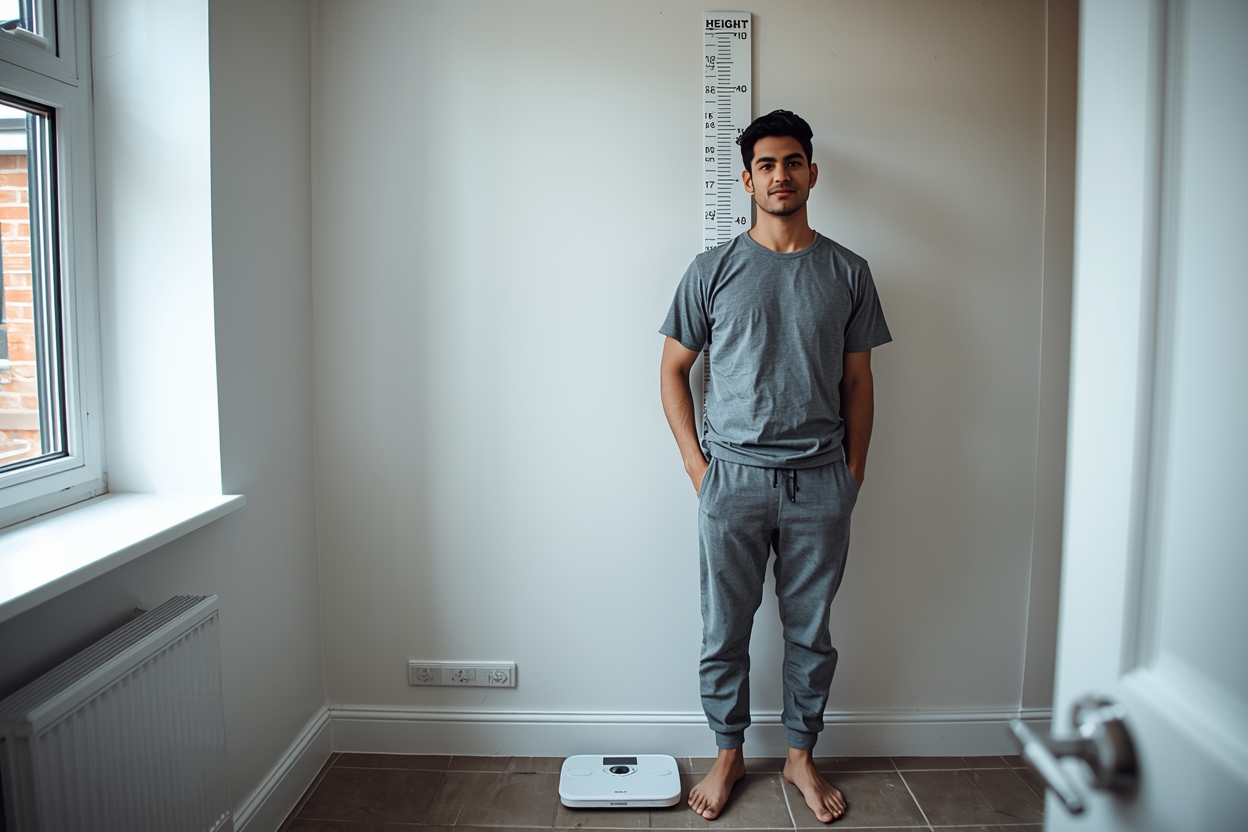
You need your height and your current weight. Measure both on the same day, ideally in the morning before eating. Use consistent units — all metric or all imperial.
Step 2: Choose your unit system
Most BMI checkers let you switch between kg/cm and lbs/inches. Pick whichever your scale and measuring tape use. Converting mid-calculation is where errors happen.
Step 3: Enter your details
Input your height and weight into the tool. Some tools — including AceCalculator’s body mass index checker — also let you enter your age and sex for additional context, since BMI ranges can be interpreted differently for older adults and teenagers.
Step 4: Read your result in context
The number itself is less important than where it places you on the scale. A BMI of 24.8 and a BMI of 25.2 are clinically almost identical — don’t treat a single decimal point as a verdict.
✅ Quick Action Steps
- Weigh yourself on a flat surface, shoes off, in the morning
- Measure height standing straight against a wall (no shoes)
- Use the same unit system throughout
- Check your BMI using the calculator — takes under a minute
- Note your category, then read what it means below
A Real-World Example
Here’s how it looks in practice. Take someone who is 5’7″ (170 cm) and weighs 165 lbs (75 kg).
Plugging those numbers into the formula:
BMI = 75 ÷ (1.70 × 1.70) = 75 ÷ 2.89 = 25.9
That result puts them just into the “overweight” category. But here’s what that doesn’t tell you: whether they’re muscular, whether they carry weight in a low-risk area like the hips, and whether their blood pressure, cholesterol, and fasting glucose are all completely healthy. For many people with a BMI around 25–26, those markers are fine.
When I tested the AceCalculator BMI checker with these numbers, the result came back at 25.9, with a note indicating the “overweight” range and a suggestion to check in with a GP if concerned. That framing felt right — informative without being alarmist.

BMI Categories: What Each Range Means
The standard WHO adult BMI categories are:
| BMI Range | Category | What it generally means |
|---|---|---|
| Below 18.5 | Underweight | May indicate nutritional deficiency or other health concerns |
| 18.5 – 24.9 | Healthy weight | Associated with lower risk of weight-related conditions |
| 25.0 – 29.9 | Overweight | Slightly elevated risk; context matters a lot here |
| 30.0 – 34.9 | Obese (Class I) | Increased risk of type 2 diabetes, heart disease, joint issues |
| 35.0 – 39.9 | Obese (Class II) | High risk; medical intervention is often recommended |
| 40.0 and above | Severely Obese (Class III) | Very high health risk; specialist care typically advised |
These categories apply to adults aged 18 and over. For children and teenagers, BMI is interpreted differently — it’s plotted against age- and sex-specific percentile charts rather than fixed thresholds. If you’re checking BMI for a teenager, use a tool that accounts for age, like the BMI checker with age adjustment on AceCalculator.
Common Mistakes When Checking BMI
⚠️ Watch out for these
- Measuring at different times of day. Body weight fluctuates by 1–3 kg throughout the day. Always weigh at the same time — morning, before food.
- Using estimated height. Many people round their height up by an inch or two. That skews your BMI lower than it actually is.
- Treating BMI as a diagnosis. A BMI in the “overweight” range does not mean you are unhealthy. It means further assessment may be worthwhile.
- Applying adult ranges to children. BMI for under-18s uses percentile charts, not the fixed 18.5–25 range used for adults.
- Ignoring the formula’s limits. BMI doesn’t distinguish between muscle and fat. A very muscular person can have a “high” BMI with very low actual body fat.
BMI vs. Body Fat Percentage: Which Is More Useful?
This is where things get genuinely interesting. BMI is a proxy measure — it estimates body composition from weight and height alone. Body fat percentage, on the other hand, tells you directly what fraction of your body weight is fat tissue versus lean mass.
Here’s a quick comparison:
| BMI Checker | Body Fat % Measurement | |
|---|---|---|
| Equipment needed | Scale + measuring tape | DEXA scan, skinfold callipers, or smart scale |
| Time to complete | Under 1 minute | 5–30 minutes depending on method |
| Cost | Free | £0 (smart scale estimate) to £100+ (DEXA) |
| Accounts for muscle mass | No | Yes |
| Used by NHS/WHO | Yes | Partially (clinical settings) |
| Best for | Quick population-level screening | Individual fitness tracking |
For most people, BMI is the right starting point — fast, free, and good enough for a first check. If your result surprises you, or your BMI has been “healthy” but you know your body composition has changed, body fat percentage is worth looking at next.

Tips for Getting an Accurate Result
💡 Tips from practice
- Weigh yourself first thing in the morning, after using the bathroom, before eating or drinking anything.
- Use a digital scale on a hard, flat floor — carpets cause inaccurate readings.
- Measure height without shoes. Stand with your back flat against the wall and use a book to mark the top of your head.
- Track your BMI over time, not as a one-off. A single measurement is less useful than a trend.
- If you’re very muscular, combine your BMI result with a waist circumference measurement. Waist circumference above 94 cm (men) or 80 cm (women) is an independent health risk marker, according to the NHS healthy weight guidelines.
If you want to go deeper — tracking calories alongside your weight — the calorie calculator and the guide to daily calorie intake on AceCalculator are useful next steps. And for context on how your BMI might relate to sleep quality and recovery, see the sleep calculator.
According to the CDC’s BMI resource page, roughly 41.9% of U.S. adults fall into the obese BMI category as of the most recent National Health and Nutrition Examination Survey — which is why population-level BMI tracking continues to matter for public health planning, even as its limits at the individual level are well acknowledged.
Frequently Asked Questions
What does a BMI checker actually measure?
A BMI checker calculates your Body Mass Index from your height and weight. It doesn’t directly measure fat, muscle, or bone density — it produces a number that’s used to classify your weight relative to your height. Think of it as a population-level screening tool, not a personal health diagnosis.
Is the BMI checker different for females and males?
The formula is the same for both. However, women and men typically differ in how fat is distributed and what percentage is normal at a given BMI. Some clinicians use sex-specific reference ranges for body fat percentage to add nuance — but the standard BMI categories apply to adults of all sexes equally. AceCalculator’s BMI calculator for women includes additional context tailored to female health benchmarks.
What is a healthy BMI for a woman or man?
For adults of all sexes, the standard healthy BMI range is 18.5 to 24.9. That said, “healthy” is context-dependent. A BMI of 24 in a sedentary adult and a BMI of 24 in a regularly exercising adult represent very different health pictures. The number is a starting point, not a conclusion.
How do I use a BMI checker for a teenager?
Teenage BMI is age- and sex-specific. You still use height and weight as inputs, but the result is plotted against percentile charts rather than fixed thresholds. A result below the 5th percentile is underweight; above the 95th is classified as obese. Always use a BMI checker with age adjustment for anyone under 18.
Does BMI change with age?
The formula doesn’t change — but how BMI is interpreted can. For adults over 65, a slightly higher BMI (up to 27) may actually be protective, since being underweight in older age carries its own risks. There’s no universal number that’s “right” across all life stages.
Can I check my BMI the same way the NHS does?
Yes. The NHS uses the same WHO formula and the same category thresholds. The AceCalculator body mass checker uses the same calculation methodology. The NHS also factors in waist circumference for a more complete picture, which is worth measuring separately.
What’s the limitation of using a BMI checker?
BMI doesn’t distinguish between fat mass and lean mass. A bodybuilder with very low body fat can have a BMI of 30 and be classified “obese.” Conversely, someone with a “normal” BMI can carry a dangerous amount of visceral fat around their organs. Use BMI as one data point, not the whole picture. Pair it with waist measurement, fitness level, and blood test results for a fuller view.
Is an online BMI checker accurate?
If your height and weight inputs are accurate, the calculation is mathematically precise. Any reputable BMI checker — including AceCalculator’s — uses the same formula used in clinical settings. Accuracy problems come from input errors (wrong height, wrong weight, wrong units) rather than the tool itself.
Amanda Reeds, B.Sc. Health Sciences
Content Researcher at AceCalculator
Amanda holds a Bachelor of Science in Health Sciences and has spent five years writing about preventive health, fitness metrics, and clinical screening tools. She focuses on translating technical health data into practical guidance for everyday readers — without oversimplifying what actually matters.
✓ Medically reviewed by Dr. Sarah Lim, MD — General Practitioner with 12 years of clinical experience in preventive health and metabolic conditions.
Final Thoughts
BMI is a blunt tool. It doesn’t know your muscle mass, your bone density, or your blood chemistry. But it’s still the most accessible way to get a rough sense of whether your weight is in a range worth paying attention to — and for most people, that’s worth doing.
Run your numbers. Note your category. If you’re solidly in the healthy range, that’s one less thing to worry about. If you’re near the edges, or clearly outside it, that’s useful information — not a panic button, but a nudge to look more carefully at what’s going on.
The whole process takes under a minute.
Check My BMI Now — It’s Free →For a more complete picture, follow up with the body fat calculator or the full suite of health and fitness calculators available at AceCalculator.
Disclaimer: This article is for informational purposes only and does not constitute professional medical advice. BMI is a screening tool, not a diagnostic measure. Always consult a qualified healthcare professional before making decisions about your health.
12 thoughts on “BMI Checker: What Your Number Actually Means and How to Use It”
I’ve been trying to get my head around healthy weight targets after my practice nurse mentioned I was sitting right on the border of the normal and overweight BMI categories. That kind of borderline result is oddly more confusing than a clear one — you’re not sure whether to act on it or not.
The BMI Checker Guide on AceCalculator helped me think it through properly. The breakdown of what each BMI range actually means day-to-day is more useful than the number alone. I also appreciated the section explaining why two people with the same BMI can have very different health profiles — body composition, age, and where you carry weight all factor in differently. That context is what was missing from my appointment.
The calculator itself is straightforward. Plug in height and weight, get your BMI, and the guide walks you through what to do with that result rather than leaving you to interpret it alone. No upsells, no email capture, just the information.
Sent it to my sister who’s been tracking her weight loss progress and she found the healthy weight range by height chart particularly useful for setting realistic targets.
That borderline result situation is genuinely one of the trickier ones to navigate, Sophie — a clear number in either direction almost feels easier to deal with. The guide tries to address exactly that by explaining what the ranges mean in context rather than treating them as hard cutoffs.
The point about two people having the same BMI but very different health profiles is one we felt strongly about including. Body composition, age distribution, and fat distribution patterns all affect what a BMI result actually signals, and glossing over that does people a disservice.
Glad the healthy weight range by height chart was useful for your sister too — it’s one of the most referenced sections on the page, particularly for people using it to set weight loss or maintenance targets. If she wants more detail on how those targets shift with age, the healthy weight by age guide builds on the same data with a bit more granularity.
I’ll be straight — I came to this page because my GP mentioned BMI at my last checkup and I half-tuned out, nodded, and then went home and googled it. Most results either oversimplify it to the point of being useless or go so deep into clinical language that you need a medical degree to follow along.
This BMI checker guide sits in the right spot. The formula is explained in plain English, the healthy weight range table is easy to read, and there’s an honest section on where body mass index doesn’t tell the full story — which is the part I actually needed. Knowing that BMI doesn’t account for muscle distribution or age properly made my result feel a lot less like a verdict and more like one data point among several.
Took about five minutes to read properly. Didn’t feel like five minutes wasted.
Appreciate the honesty, Daniel — and that GP appointment scenario is more common than most people admit. BMI comes up, gets half-explained, and people leave with a number they’re not sure what to do with.
That’s exactly why the guide doesn’t stop at the calculator. The healthy weight range breakdown, the note on muscle mass and age, the bit on waist-to-height ratio as a complementary measure — those are all there because a single BMI figure rarely gives the full picture on its own.
Five minutes well spent then. If the age-adjusted healthy weight section would add anything useful, that guide goes a bit further into how the ranges shift across different life stages. Worth a look if the topic’s still on your mind after the checkup.
Honestly I was skeptical at first — I’d used three or four BMI calculators before this one and they all felt the same. You type in your height and weight, get a number, maybe a one-line label like “overweight” or “normal,” and that’s it. The BMI Checker Guide on AceCalculator is structured differently. It actually walks you through the whole thing — how the body mass index formula works, what the NHS healthy weight ranges mean in practice, how to interpret your result if you’re older or carry more muscle than average.
I’m not a medical professional, just someone trying to get a clearer picture of my health after a GP appointment where BMI came up. This guide made the conversation make a lot more sense in hindsight. The metric and imperial options both work cleanly, the page doesn’t push you toward any product or subscription, and the result loads instantly.
Bookmarked it and sent it to two people in my family who had the same questions I did.
Thanks Rachel, that’s really the gap we were trying to close. A number without context isn’t much help — especially when BMI comes up in a clinical setting and you’re left trying to piece together what it actually means for your situation. The NHS weight range breakdowns and the notes on where BMI falls short (age, muscle mass, frame size) are in there specifically for that reason.
Glad the metric and imperial switching worked smoothly too — that one gets overlooked but it matters for a lot of UK users who think in both systems depending on context. Hope it was useful for your family as well.
If the healthy weight by age breakdown would help, that guide covers similar ground with a bit more detail on how the ranges shift across different life stages.
I run a health and wellness module as part of a further education course here in Manchester and I’ve started pointing students toward the BMI Checker Guide on AceCalculator for their foundational nutrition and fitness assignments. What sold me on it for classroom use is that it doesn’t just spit out a number — it walks through the actual body mass index formula, explains what each BMI range means clinically, and flags where the metric has known limitations like muscle mass and age variance. That’s the kind of critical thinking I want students applying before they ever touch a client assessment.
Completely free, no account needed, and it loads reliably even on the older laptops our students are working with. For a further education setting where budget is always tight, that matters more than people realize.
If you’re in health, fitness, or sports science education and need a BMI reference tool your students can actually learn from rather than just copy a number out of — this one’s worth adding to your course materials.
This means a lot to hear, James — genuinely. Building the guide for exactly this kind of use was part of the thinking from the start. A BMI calculator that just returns a number isn’t much use in an educational setting, so we made sure the formula breakdown, the range classifications, and the caveats around BMI limitations were all explained clearly enough to hold up to classroom scrutiny.
The point about muscle mass and age variance is one we cover specifically because those are the cases where students — and patients — tend to misread their results. If you ever want your students to go deeper, the ideal body weight calculator and the healthy weight range by age guide both build on the same methodology and are written to the same standard.
Good luck with the module. Nice to know it’s being used somewhere useful.
I finally got around to building a small patio last summer and spent way too long second-guessing my slab thickness and whether I needed rebar at all. Found the BMI Checker Guide on AceCalculator while looking for health benchmarks for a separate project, and ended up down a rabbit hole reading their other calculation guides. What actually helped with the patio was understanding how to cross-reference body load estimates with structural planning — sounds unrelated but it clicked for me once I saw how the numbers connect.
The BMI calculator itself is clean and fast. No signup, no ads blocking the result, and the explanation of healthy weight ranges by height is more detailed than most tools I’ve used. Checked it against my doctor’s chart — spot on.
If you’re someone who likes to actually understand the math behind health metrics rather than just getting a number, this is the page to save.
Really appreciate you sharing that — and the patio project sounds like it turned out well! You make an interesting point about how understanding one set of calculations can shift the way you think about others. That kind of numerical literacy is exactly what we try to build here, not just with BMI but across the health metric guides.
The BMI checker is designed to give you the result and the reasoning — what the ranges mean, how weight-to-height ratio translates into different health categories, and where the formula has blind spots (muscle mass, age, and frame size being the big ones). Glad the doctor’s chart matched up too. That’s always a good sign the tool is doing its job.
If you want to dig further, the related guides on healthy weight range by age and ideal body weight calculators cover some of the same ground with more specificity.
I’ve tried a bunch of free BMI calculators online and most of them are either buried in ads or give you a number with zero context. This BMI checker guide on AceCalculator actually explains what your result means — not just the number, but what BMI range you fall into, how it’s calculated using the standard weight-to-height formula, and where the limits of BMI as a health metric are. That last part matters. A lot of tools skip it entirely.
The page loads fast, works on mobile without zooming in, and the BMI calculation itself is accurate whether you’re using metric (kg/cm) or imperial (lbs/inches). I checked it against two other calculators and got consistent results. Shared it with a friend who was confused about her healthy weight range — she said it was the clearest explanation she’d found.
If you’re trying to understand body mass index beyond just the number, this guide is worth bookmarking.
Thank you for checking the accuracy across multiple tools — that’s exactly the kind of thing we wanted people to feel confident about. You’re right that most BMI calculators just hand you a number and leave you to figure out the rest. The guide was built specifically to fill that gap: the BMI range breakdowns, the metric vs. imperial switching, and yes, the honest note about where body mass index has real limitations as a standalone health measure.
Glad it was useful for your friend too. If you ever want a deeper look at related topics — like how BMI interacts with age, muscle mass, or waist-to-height ratio — those are covered in our related guides. Bookmark kept, hopefully.