

By Amanda Reeds, BSc Nutrition & Dietetics, Certified Health Coach | Published:
Quick Summary
- Key takeaway: Calculating your macros lets you eat toward fat loss — not just calorie restriction — while keeping muscle and energy intact.
- Who this is for: Anyone in the UK or US trying to lose weight with more precision — whether you’re a woman tracking macros for the first time, a man aiming to lose fat while building muscle, or someone following keto, low-carb, or a balanced approach.
- Why it matters: Generic calorie cuts often backfire. Macros tell you what to eat, not just how much.
- Reading time: About 9–11 minutes
Why You’re Probably Eating the Wrong Amounts of the Right Foods
You’ve been eating less and moving more — and the scale barely shifts. The problem might not be your total calories. It might be your macro balance. When you learn to calculate macros for weight loss, you stop guessing and start eating in a way that tells your body to burn fat rather than muscle.
How to calculate macros for weight loss: Find your Basal Metabolic Rate (BMR) using the Mifflin-St Jeor formula, multiply it by your activity level to get your Total Daily Energy Expenditure (TDEE), then apply a 15-20% calorie deficit. Divide the remaining calories across protein (40%), carbohydrates (35%), and fat (25%) — adjusting based on your diet style. Protein and carbs provide 4 calories per gram; fat provides 9 calories per gram.
A macro calculator for weight loss is a free tool that converts your height, weight, age, and activity level into daily gram targets for protein, carbohydrates, and fat. It works whether you’re in the UK or US, following a balanced diet or keto, and for men and women alike.
Table of Contents
- What Are Macros and Why Do They Matter for Weight Loss?
- How to Calculate Macros for Weight Loss: Step by Step
- Real-World Examples for Men and Women (UK and US)
- Common Mistakes When Counting Macros
- Why Macro Tracking Beats Calorie Counting Alone
- Macro Ratios Compared: Keto vs Low-Carb vs Balanced
- Frequently Asked Questions
- Putting It All Together
What Are Macros and Why Do They Actually Matter?
Macronutrients — protein, carbohydrates, and fat — are the three nutrients that supply your body with energy. Every calorie you eat comes from at least one of them. But beyond calories, each macro does a distinct job in how your body looks and performs.
Protein rebuilds and preserves muscle tissue. Cut calories without enough of it and your body starts breaking down muscle for fuel — which slows your metabolism and leaves you softer, not just smaller. Carbohydrates are your primary energy source, especially during exercise. Fats support hormone production, including the hormones that regulate where and how your body stores fat.
Both the NHS Eatwell Guide and the US Dietary Guidelines for Americans recommend adults get 10-35% of calories from protein, 45-65% from carbohydrates, and 20-35% from fat. Those are healthy maintenance ranges. When the goal is fat loss with muscle retention, the protein end of that range needs to shift higher — considerably.

How to Calculate Macros for Weight Loss: Step by Step
There are four steps. Each feeds directly into the next — work through them in order.
Quick Action Steps
- Calculate your BMR using the Mifflin-St Jeor formula
- Multiply by your activity multiplier to get TDEE
- Subtract 15-20% to set your daily calorie target
- Split those calories across protein, carbs, and fat
- Convert percentages to grams and plan your meals around them
Step 1: Calculate Your Basal Metabolic Rate (BMR)
Your BMR is the number of calories your body burns just to keep you alive at rest — breathing, circulation, cell repair. The most widely validated formula is the Mifflin-St Jeor equation, used by dietitians in both the UK and US:
For men: BMR = (10 × weight in kg) + (6.25 × height in cm) − (5 × age) + 5
Quick conversions: lbs ÷ 2.205 = kg | inches × 2.54 = cm
You can skip the manual maths entirely and run this through the free BMR calculator on AceCalculator — it accepts lbs/inches or kg/cm, no sign-up needed.
Step 2: Calculate Your TDEE (Total Daily Energy Expenditure)
Your TDEE is what you actually burn once daily life is factored in. Multiply your BMR by the activity level that best reflects your typical week:
| Activity Level | What That Looks Like | Multiplier |
|---|---|---|
| Sedentary | Desk job, little or no exercise | × 1.2 |
| Lightly active | Walking or light exercise 1-3 days/week | × 1.375 |
| Moderately active | Gym or sport 3-5 days/week | × 1.55 |
| Very active | Hard training 6-7 days/week | × 1.725 |
| Extremely active | Physical job plus hard daily training | × 1.9 |
For a worked example of how activity level shifts your calorie burn, the calorie calculator guide walks through each scenario in detail.
Step 3: Apply a Calorie Deficit
A sustainable fat-loss deficit sits at 15-20% below your TDEE — roughly 300-600 calories per day for most people. That’s enough to lose about 0.5-1 lb (0.25-0.45 kg) per week without tanking your energy. A 20% deficit is the standard starting point:
Step 4: Split Your Calories Into Macros
With your daily calorie target set, divide it across the three macros. For a balanced approach that suits most people aiming at fat loss and muscle retention:
- Protein: 40% of calories → divide by 4 to get grams
- Carbohydrates: 35% of calories → divide by 4 to get grams
- Fat: 25% of calories → divide by 9 to get grams
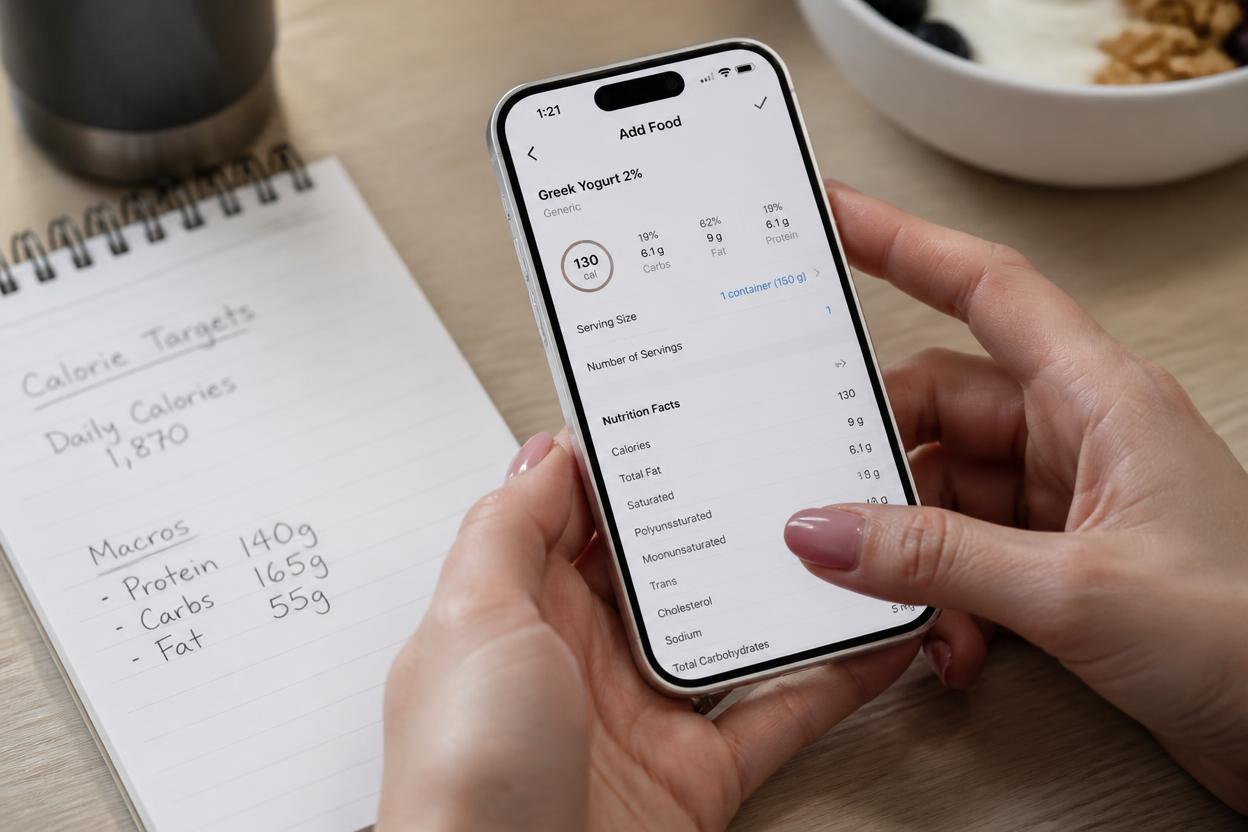
At a 1,800-calorie target, that gives you 180g protein, 157g carbs, and 50g fat per day. Those are the numbers you track — not a calorie total.
Before you start, it helps to know where your body composition currently stands. The free BMI calculator and body fat calculator both accept imperial (lbs/inches) and metric (kg/cm) inputs and give you a useful baseline to track against.
Real-World Macro Examples for Men and Women (UK and US)
The formula is the same whether you’re in Manchester or Miami. Here are three worked examples with real numbers.
Example 1 — Woman, 34, Lightly Active, Fat Loss Goal
Sarah is 34, 5’5″ (165 cm), weighs 165 lbs (75 kg). She has a desk job and goes for daily walks but doesn’t currently train in a gym.
- BMR (female): (10 × 75) + (6.25 × 165) − (5 × 34) − 161 = 1,519 kcal
- TDEE (× 1.375 lightly active): 2,089 kcal
- 20% deficit (x 0.80): 1,671 kcal/day
- Protein (40%): 668 ÷ 4 = 167g
- Carbs (35%): 585 ÷ 4 = 146g
- Fat (25%): 418 ÷ 9 = 46g
Example 2 — Man, 28, Moderately Active, Fat Loss + Muscle Gain
James is 28, 5’10” (178 cm), weighs 195 lbs (88 kg). He trains four days per week and wants to lose fat while keeping — and building — muscle.
- BMR (male): (10 × 88) + (6.25 × 178) − (5 × 28) + 5 = 1,962 kcal
- TDEE (× 1.55 moderately active): 3,041 kcal
- 20% deficit (x 0.80): 2,433 kcal/day
- Protein (40%): 973 ÷ 4 = 243g
- Carbs (35%): 852 ÷ 4 = 213g
- Fat (25%): 608 ÷ 9 = 68g
For fat loss and muscle gain simultaneously — body recomposition — protein should sit at 0.8-1g per lb (1.75-2.2g per kg) of bodyweight at minimum. James’ 243g lands at around 1.25g per lb, appropriate for his training frequency. For more detail on this, the BMR for weight loss guide covers the adjustment.
Example 3 — Woman, 30, Breastfeeding
If you’re breastfeeding, the standard deficit rules don’t apply. Both the NHS and the American College of Obstetricians and Gynecologists (ACOG) advise against dropping below 1,800 kcal per day while nursing. Milk production typically needs an additional 300-500 kcal above your maintenance TDEE. Run your calculation as normal, add those calories back before applying any deficit, and confirm the plan with your midwife, GP, or OB-GYN before changing your diet.

Common Mistakes People Make When Counting Macros
Most first-time macro trackers run into the same set of problems. Here’s what they are — and how to avoid them before they cost you weeks of progress.
⚠ Watch Out For These
- Setting protein too low. Many free calculators default to 0.4-0.5g of protein per lb of bodyweight. For anyone trying to hold on to muscle during a deficit, that isn’t enough. Target 0.7-1g per lb (1.5-2.2g per kg) of your goal body weight.
- Forgetting oils and condiments. A tablespoon of olive oil is 120 kcal and 14g of fat. Carefully weighing chicken and rice but eyeballing the cooking oil throws your fat macro off daily — and the numbers stop adding up.
- Overestimating activity level. Most people click “moderately active” when “lightly active” is more accurate. That single choice can add 200-400 phantom calories to your daily target, silently eliminating your deficit.
- Switching ratios every two weeks. Give any macro split at least 3-4 weeks before deciding it isn’t working. Your body needs time to adapt to a different fuel balance before changes show up on the scale or in the mirror.
- Counting total carbs instead of net carbs on keto or low-carb. Total carbs and net carbs (total minus fibre) are not the same. On a low-carb or keto approach, net carbs are what matter. Use a tracker that separates them.
Why Macro Tracking Works Better Than Just Cutting Calories
Calorie restriction alone leads to a mix of fat and muscle loss. Muscle is metabolically expensive — losing it slows your resting metabolism and makes long-term weight maintenance harder. Research published in the Journal of the International Society of Sports Nutrition found that higher protein intakes during calorie-restricted periods significantly preserve lean body mass compared to standard protein targets. That’s the core case for tracking macros, not just calories.
- You lose primarily fat rather than a blend of fat and muscle
- Protein and fat slow digestion — you stay fuller between meals
- Energy levels stay steadier throughout the day, with fewer blood sugar dips
- No prescribed meal plan — the goal is hitting your gram targets, not following specific recipes
- Works across dietary styles: balanced eating, Mediterranean, keto, low-carb, and plant-based
If you want a reference point for where your body weight should be heading, the ideal weight for height guide gives healthy target ranges for both men and women — in lbs and kg — which feeds directly into how you set your protein goals.
Macro Ratios Compared: Keto vs Low-Carb vs Balanced vs High-Protein
There’s no single “best” macro split for weight loss. The right ratio depends on your dietary preferences, how your body handles carbohydrates, and whether your goal is purely fat loss or fat loss alongside muscle building. Here’s how the main approaches compare:
| Diet Style | Protein | Carbs | Fat | Works Best For |
|---|---|---|---|---|
| Balanced (40/35/25) | 40% | 35% | 25% | Most people; active UK and US lifestyles |
| 40/30/30 (Zone-style) | 40% | 30% | 30% | Muscle retention + fat loss; strong satiety |
| High-Protein (45/30/25) | 45% | 30% | 25% | Body recomposition; high training volume |
| Low-Carb (35/25/40) | 35% | 25% | 40% | Insulin sensitivity; stable blood sugar |
| Keto (25/5/70) | 25% | 5% | 70% | Strong appetite suppression; carb intolerance |
The 40/30/30 split is worth flagging separately. With equal protein and carbs and 30% fat, it gives you more dietary flexibility day-to-day while still protecting muscle. It’s also the easiest to sustain long-term, which — for most people — matters more than picking the theoretically “optimal” ratio. To see how any of these ratios affect your body fat alongside BMI, the BMI and body fat calculator covers both in one place.
💡 Practical Tip
On keto or low-carb, track net carbs — not total carbs. Net carbs = total carbs minus dietary fibre. So 50g total carbs with 20g fibre gives you 30g net carbs, which keeps most people in ketosis. Both UK and US food labels list fibre separately, making this easy to calculate at a glance. Use a tracking app that shows net carbs automatically.

Frequently Asked Questions About Calculating Macros for Weight Loss
How do you calculate your macros to lose weight?
Calculate your BMR using the Mifflin-St Jeor formula, multiply by your activity level multiplier to get TDEE, reduce by 15-20% for a deficit, then split the calories: 40% protein, 35% carbohydrates, 25% fat. Divide protein and carbs by 4 (kcal per gram) and fat by 9 (kcal per gram) to get daily gram targets.
What is the best macro ratio for losing weight?
For most people, 40% protein / 35% carbs / 25% fat is a reliable starting point. It protects muscle, fuels exercise, and keeps you full. Low-carb (35/25/40) and keto (25/5/70) are both valid alternatives depending on personal preference and how your body handles carbohydrates. The best ratio is the one you can maintain consistently.
Is 40/30/30 good macros for weight loss?
Yes — 40% protein, 30% carbs, 30% fat is a well-researched ratio that works well for people who also train. High protein preserves muscle, moderate carbs sustain gym performance, and 30% fat provides strong satiety and supports hormone function. It’s sometimes called the Zone Diet ratio and holds up well in body recomposition research in both the UK and US.
What is the best free macro calculator for weight loss?
A good free macro calculator takes your age, sex, weight (in lbs or kg), height (in inches or cm), and activity level, then outputs daily gram targets for protein, carbs, and fat. The calories calculator and BMR calculator on AceCalculator handle both imperial and metric and need no account to use.
How do I calculate macros for weight loss and muscle gain at the same time?
Body recomposition requires high protein — at least 0.8g per lb (1.75g per kg), ideally up to 1g per lb (2.2g per kg) — combined with a smaller deficit of 10-15% below TDEE rather than 20%. This allows your body to burn stored fat while muscle protein synthesis continues. Progress is slower than a straight fat-loss cut, but the result is both leaner and stronger.
How do I calculate macros for weight loss on keto?
Calculate your TDEE as normal, apply your deficit, then use keto ratios: 70% fat, 25% protein, 5% carbohydrates — roughly 20-50g of net carbs per day for most people. Track net carbs (total carbs minus fibre), not total carbs. Both UK and US food labels list fibre separately, making this straightforward to calculate.
Are macro targets different for women than for men?
The calculation method is the same, but the resulting numbers differ because women typically have lower BMRs. Women also tend to use more fat as fuel during moderate-intensity exercise, which is one reason some women do well on slightly higher fat allocations. Hormonal phases — menstrual cycle, perimenopause, pregnancy, breastfeeding — can shift daily energy needs by 100-350 kcal and should be factored into targets.
Do I need to recalculate my macros as I lose weight?
Yes. As your bodyweight drops, your BMR falls — roughly 7-10 kcal per kg (3-5 kcal per lb) lost. Recalculate every 4-6 weeks, or after every 10 lbs (4.5 kg) lost. Without updating your numbers, you can drift into a maintenance intake without realising it and stall completely.
Amanda Reeds, BSc Nutrition & Dietetics, Certified Health Coach
Amanda is a qualified nutritionist and health writer with over eight years of experience helping clients across the UK and US build sustainable fat-loss strategies using protein targets, calorie deficits, and macro tracking. She holds a BSc in Nutrition and Dietetics and a Health Coaching certification from the National Academy of Sports Medicine (NASM). Her work is regularly reviewed against guidance from the NHS, the British Dietetic Association (BDA), and the US Dietary Guidelines.
Putting It All Together
Calculating your macros for weight loss comes down to four steps: BMR, TDEE, deficit, and split. Whether you’re in the UK or the US, following a balanced approach, going low-carb, or trying keto, the maths is the same — only the ratios change.
The most impactful thing you can do is get protein right first. Hit that number, then build carbs and fat around it based on what fits your lifestyle. And revisit your targets every few weeks — your body changes, and your numbers should change with it.
If you want a clear baseline before you start, the free BMI calculator and body fat calculator both support imperial and metric inputs and give you numbers worth tracking against as your macros do their job.