
By Amanda Reeds, BSc Mathematics & Data Science, Content Researcher at AceCalculator | Published
📋 Quick Summary
- Key takeaway: Multiply length × width × height (in metres), then multiply by 1,000 to get litres.
- Who this is for: Homeowners, plumbers, farmers, students, and anyone sizing a tank or pond.
- Why it matters: Getting the wrong capacity means running out of water — or overflowing.
- Reading time: About 9 minutes
You Measured the Tank. Now What?
You’re standing in front of a water tank with a tape measure in your hand, and you’ve got three numbers — but no idea what to do with them. Sound familiar? Most people can measure length, width, and height just fine. The bit that trips everyone up is turning those dimensions into actual litres.
To calculate volume in litres: measure the length, width, and height of your container in metres, multiply all three together to get cubic metres (m³), then multiply by 1,000. One cubic metre equals exactly 1,000 litres. For cylindrical tanks, use the formula π × radius² × height × 1,000. This method works for water tanks, ponds, fuel drums, and any rectangular or round container.
This guide covers every tank shape — rectangular, cylindrical, square — with real formulas and worked numbers so you’re never guessing. Whether you’re figuring out how many litres your overhead tank holds, sizing a pond, or working out oil drum capacity, this is your reference.
📑 Table of Contents
What Does “Volume in Litres” Actually Mean?
Volume is simply how much three-dimensional space something takes up. When we talk about litres, we’re measuring liquid capacity — how much water, oil, or fuel a container can hold. The litre is the standard unit of liquid volume used across the UK, Europe, and most of the world.
One litre is defined as exactly one cubic decimetre (dm³), or 0.001 cubic metres. That’s the official definition from the International Bureau of Weights and Measures (BIPM), and it’s the link between your tape measure and your tank capacity. To translate: one cubic metre = 1,000 litres, always, no exceptions.
A millilitre (mL) is one-thousandth of a litre. So 1 litre = 1,000 mL, and 1 cubic centimetre (cm³) = 1 mL. These conversions underpin every calculation in this guide. According to the US National Institute of Standards and Technology (NIST), the litre is the internationally accepted unit for measuring liquid volume in scientific, commercial, and domestic contexts.
How to Calculate Volume in Litres — Step by Step
The approach varies slightly by tank shape. Here’s how to handle each one.
⚡ Quick Reference Formulas
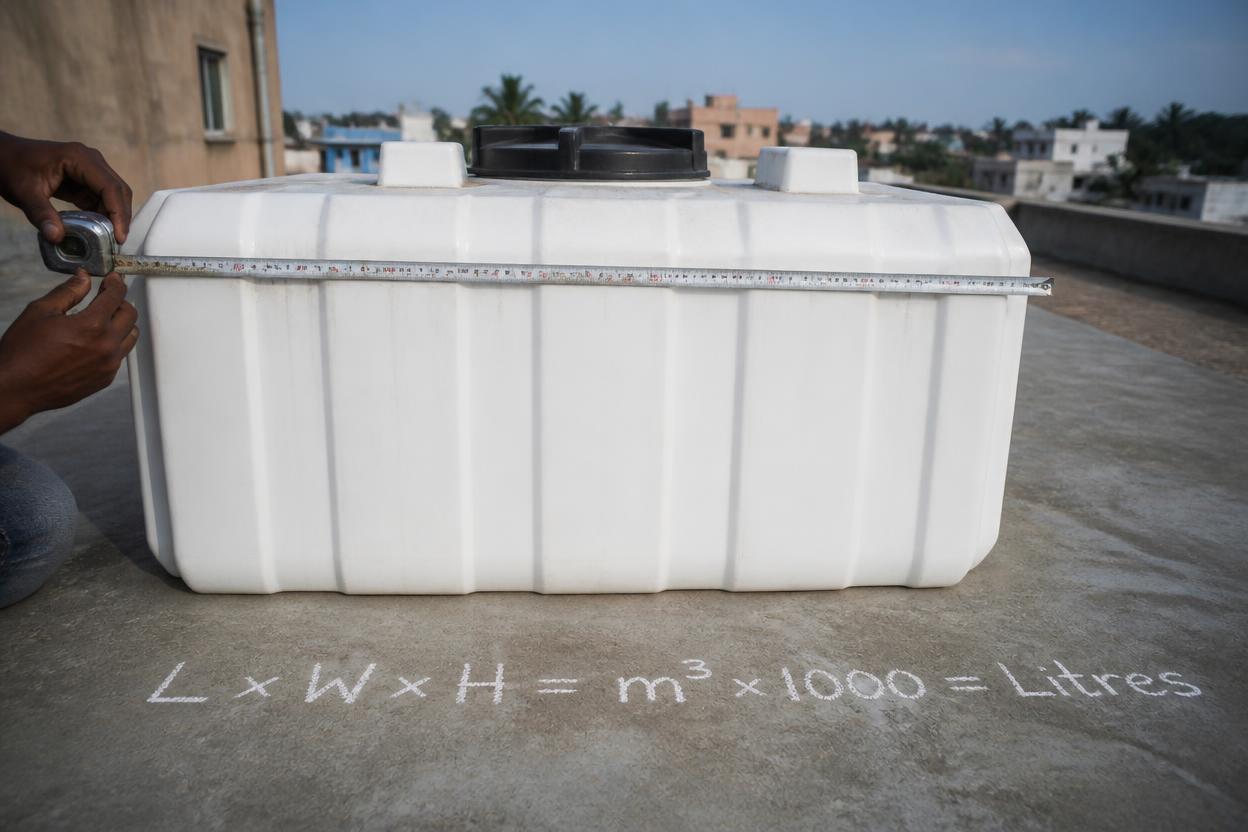
- Rectangular/Square tank: L (m) × W (m) × H (m) × 1,000 = litres
- Cylindrical tank: π × r² (m) × H (m) × 1,000 = litres
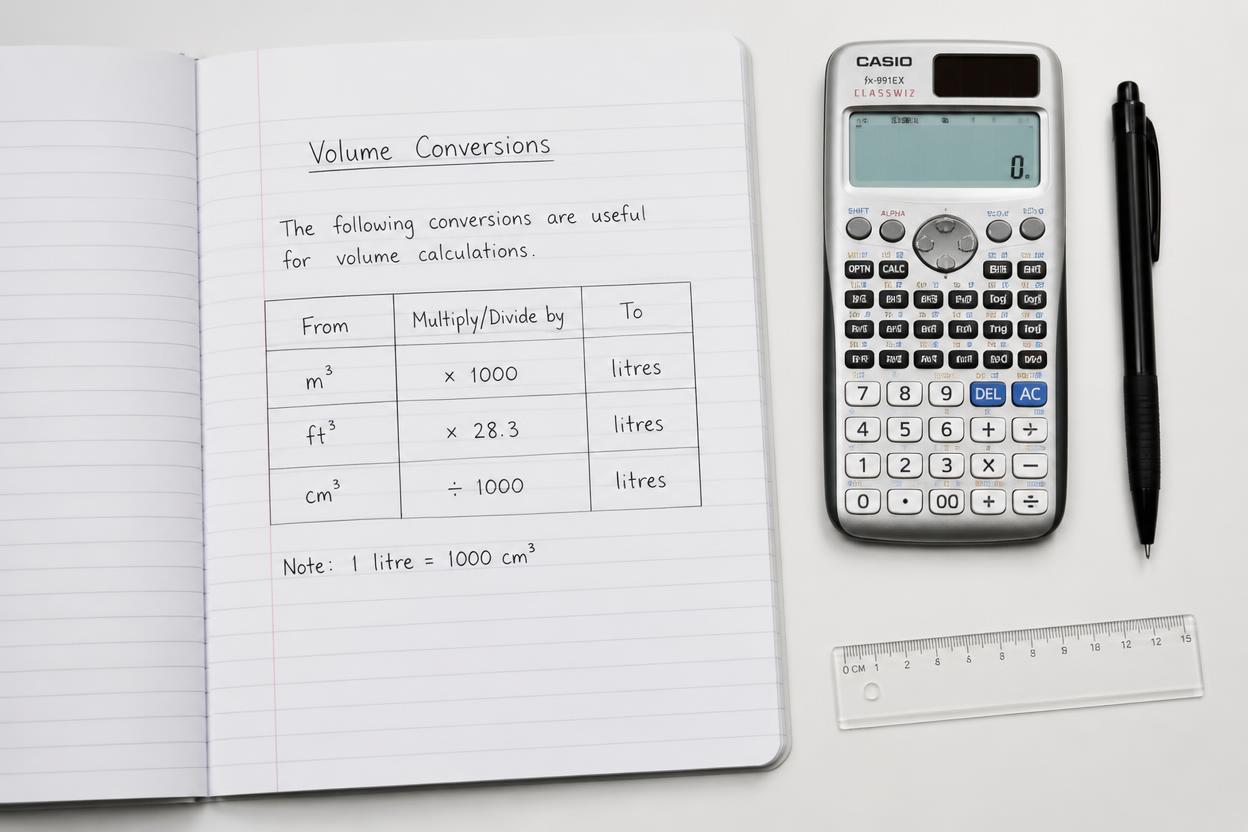
- Cubic metres to litres: m³ × 1,000
- Cubic feet to litres: ft³ × 28.3168
- Cubic centimetres to litres: cm³ ÷ 1,000
Step 1: Measure Your Tank Dimensions
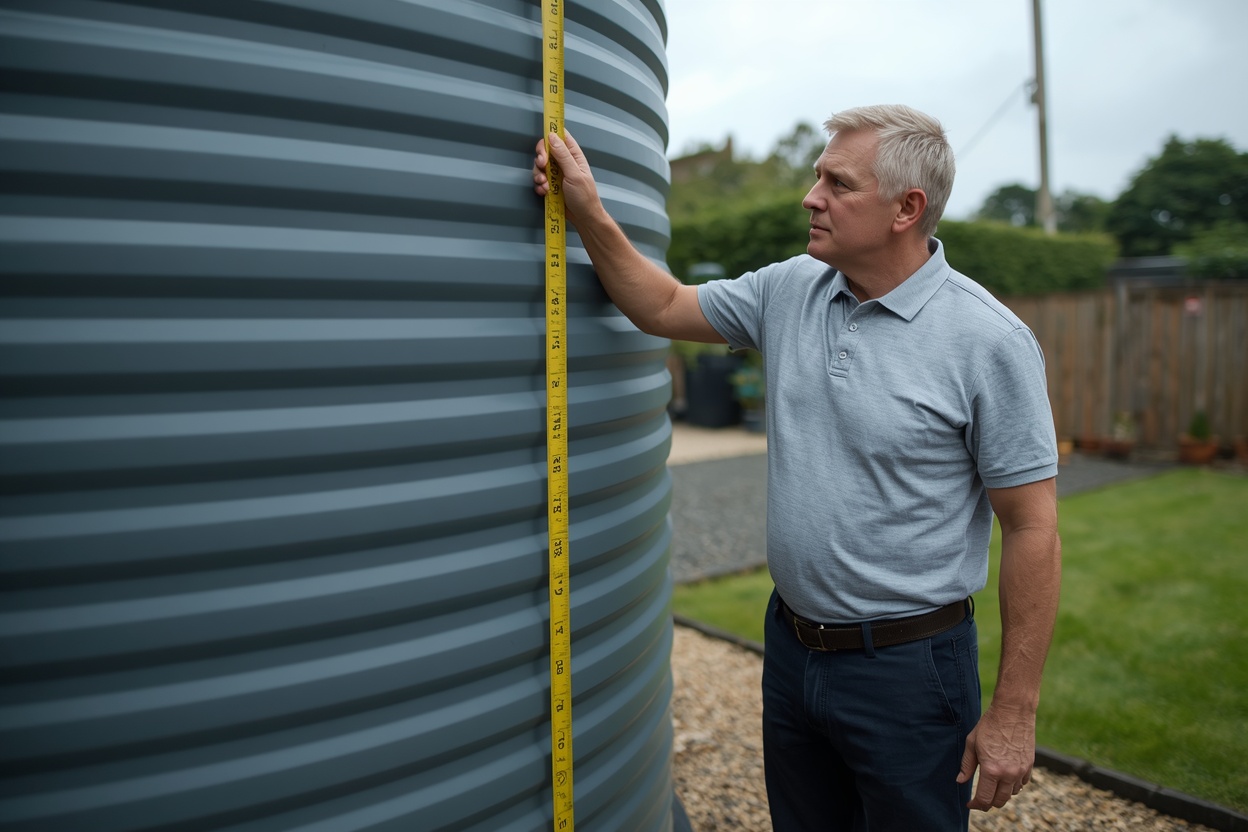
Use a tape measure and record length, width, and height (or depth) in metres. If your measurements are in centimetres, divide each by 100 before you calculate. If they’re in feet, multiply each by 0.3048 to convert to metres. Consistency of units matters — mixing metres with feet will give you a useless answer.
Step 2: Choose the Right Formula
For a rectangular or square tank, multiply: Volume (m³) = L × W × H. For a round (cylindrical) tank, the formula is: Volume (m³) = π × r² × H, where r is the radius (half the diameter). For tanks measured in feet, use the cubic feet result and then multiply by 28.3168 to get litres — a route many plumbers take when dealing with older installations.
Step 3: Multiply by 1,000 to Convert m³ to Litres
This is the step people most often forget. Your formula gives cubic metres, not litres. Multiply the m³ result by 1,000 and you have your tank capacity in litres. That’s it. No special table needed.
Step 4: Adjust for Fill Level (Optional)
Tanks are rarely full. If you want to calculate the litres of water currently in a tank — not the maximum capacity — measure the actual water depth rather than the tank height, and use that depth in your formula. The rest of the calculation stays the same. This matters a lot when you’re calculating water volume for irrigation or livestock supply.
Real-World Examples with Actual Numbers
Let’s run through four common scenarios. These are the questions I get asked most often, and working through them properly makes the formula stick.
Example 1: Rectangular Overhead Water Tank
A typical household overhead tank measures 1.5m long × 1m wide × 1m tall.
- Volume = 1.5 × 1 × 1 = 1.5 m³
- In litres = 1.5 × 1,000 = 1,500 litres
That’s enough water for a family of four for roughly 3–4 days, based on the UN’s guideline of 50–100 litres per person per day for domestic needs.
Example 2: Cylindrical Round Tank
A round plastic tank is 0.6m in radius and 1.2m tall.
- Volume = π × 0.6² × 1.2 = 3.14159 × 0.36 × 1.2 = 1.357 m³
- In litres = 1.357 × 1,000 = ≈ 1,357 litres
Round tanks are common on farms and in industrial settings. Getting the radius right matters — if you accidentally use the diameter instead of the radius, you’ll be off by a factor of four.
Example 3: A 10×10×10 Foot Water Tank in Litres
Many people search for this specific size. 10 feet = 3.048 metres.
- Volume = 3.048 × 3.048 × 3.048 = 28.317 m³
- In litres = 28.317 × 1,000 = 28,317 litres
Or you can use the shortcut: 10 × 10 × 10 = 1,000 ft³, then multiply by 28.3168 = 28,317 litres. Same answer, faster route when you’re already working in feet.
Example 4: How Many Litres Does a 3-Foot Tank Hold?
Let’s say it’s a cube: 3 ft × 3 ft × 3 ft.
- Volume = 27 ft³ × 28.3168 = 764.5 litres
Good to know if you’re sizing a small water butt, aquarium stand, or garden reservoir. The online volume calculator on AceCalculator handles this in one step if you’d rather skip the arithmetic.
Common Mistakes When Calculating Tank Volume
These trip up even careful people. Know them before you start.
⚠️ Watch Out For These
- Using diameter instead of radius in the cylinder formula — this makes your answer 4× too large.
- Forgetting to multiply by 1,000 — leaving your result in m³ instead of litres.
- Mixing units — some measurements in cm, others in metres. Always convert first.
- Calculating full capacity vs actual fill level — measure water depth, not tank height, for current volume.
- Ignoring tank wall thickness — the internal dimensions (not external) determine capacity.
The diameter/radius error is the most painful one. I’ve seen it cause a farm tank to be ordered at half the required size because the buyer entered the full diameter into the formula as the radius. The tank had to be replaced before the dry season. Measure twice, calculate once.
Why Getting This Right Actually Matters
Volume calculations affect real decisions. Here’s where errors cost money or safety:
- Water supply planning: Undersizing your household water storage means running dry mid-summer.
- Dosing and treatment: Pool chemical dosing, water purification tablets, and fertiliser mixing all depend on accurate litre counts.
- Fuel storage: Oil tank capacity errors lead to over-ordering or running empty in cold months.
- Aquarium and pond health: Wrong water volume leads to incorrect fish stocking density and failed filtration.
- Construction and engineering: Concrete mixing, water-filled ballasts, and septic tanks all carry liability for getting it wrong.
According to the World Health Organization, a minimum of 20 litres per person per day is needed for basic survival, and 50–100 litres per day for comfortable domestic use. Knowing your tank capacity in litres tells you exactly how many days of water you’re storing — useful for both emergency planning and everyday management.
Rectangular vs Cylindrical: Which Formula When?
People often ask whether the calculation method changes the result significantly. With the same general size, the two shapes hold different amounts. Here’s a direct comparison:
| Feature | Rectangular Tank | Cylindrical Tank |
|---|---|---|
| Formula | L × W × H × 1,000 | π × r² × H × 1,000 |
| Measurement needed | Length, Width, Height | Radius (or diameter ÷ 2), Height |
| Common use | Overhead tanks, ponds, fish tanks | Round farm tanks, oil drums, water butts |
| Example (1m × 1m × 1m footprint) | 1,000 litres | ~785 litres (π × 0.5² × 1) |
| Space efficiency | More litres per footprint | 21.5% less volume for same footprint |
| Structural strength | Needs reinforced corners | Better pressure distribution |
💡 Pro Tip
If you’re buying a round tank, manufacturers list capacity by diameter and height on the spec sheet. Don’t recalculate from scratch — just cross-reference their stated capacity, then verify with the formula if needed. Discrepancies of more than 5% suggest a measurement error somewhere.
Quick Unit Conversion Reference
| Convert From | Multiply By | To Get |
|---|---|---|
| Cubic metres (m³) | × 1,000 | Litres |
| Cubic feet (ft³) | × 28.3168 | Litres |
| Cubic centimetres (cm³) | ÷ 1,000 | Litres |
| Gallons (UK) | × 4.54609 | Litres |
| Gallons (US) | × 3.78541 | Litres |
| Kilolitres (kL) | × 1,000 | Litres |
| Millilitres (mL) | ÷ 1,000 | Litres |
Frequently Asked Questions
How do I calculate volume in litres for a rectangular tank?
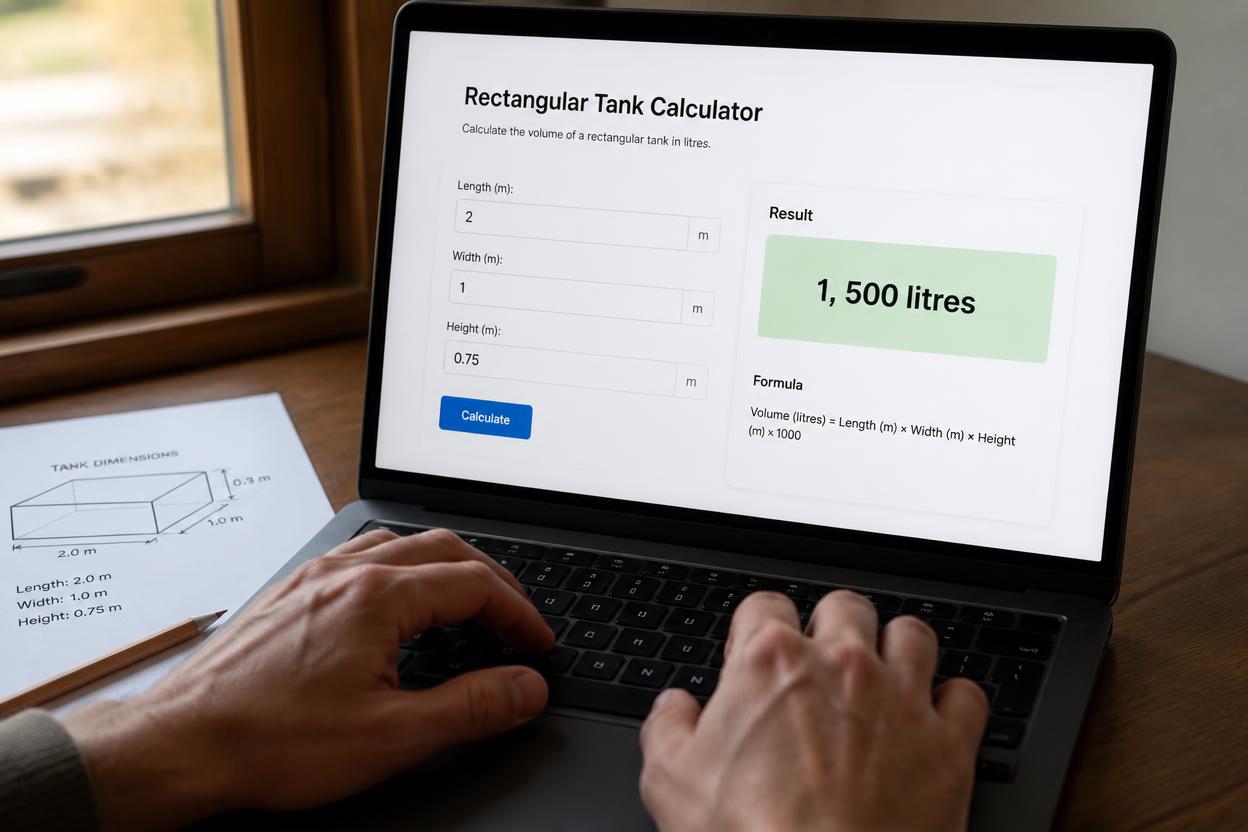
Measure the length, width, and height in metres, then multiply all three together to get cubic metres (m³). Finally, multiply by 1,000 to convert to litres. For example, a tank that’s 2m × 1m × 0.75m = 1.5 m³ = 1,500 litres.
How do you calculate tank volume in litres for a round (cylindrical) tank?
Use the formula: π × radius² × height × 1,000. Measure the diameter and halve it to get the radius. A tank with a 1m diameter and 1.5m height has a radius of 0.5m. Calculation: 3.14159 × 0.25 × 1.5 = 1.178 m³ = 1,178 litres.
How many litres are in 1 cubic metre?
Exactly 1,000 litres. One cubic metre (m³) equals 1,000 litres by definition. This is the core conversion you need for all tank volume calculations.
How many millilitres are in a litre?
There are exactly 1,000 millilitres (mL) in one litre. One millilitre equals one cubic centimetre (cm³). So if you’re calculating small volumes in cm³, divide by 1,000 to get litres.
What is the capacity of a 10×10×10 water tank in litres?
If the 10×10×10 dimensions are in feet, the tank holds 28,317 litres (1,000 ft³ × 28.3168). If the measurements are in metres, the capacity is exactly 1,000,000 litres — a very large cistern. Always confirm your unit of measurement first.
How do I convert cubic metres to litres?
Simply multiply by 1,000. For example, 2.5 m³ = 2,500 litres. To go the other direction (litres to m³), divide by 1,000.
How do I work out how many litres my pond holds?
For a roughly rectangular pond, measure the average length, average width, and average depth in metres, multiply together, then × 1,000. For irregular shapes, break the pond into sections and add them up. You can also use the AceCalculator volume tools for oddly shaped containers.
How do you calculate litres in a tank measured in centimetres?
Multiply length × width × height, all in centimetres, to get cubic centimetres (cm³). Then divide by 1,000 to get litres. For example, a tank that’s 100cm × 50cm × 40cm = 200,000 cm³ ÷ 1,000 = 200 litres.
Amanda Reeds
BSc Mathematics & Data Science | Content Researcher, AceCalculator
Amanda specialises in making mathematical and scientific concepts accessible to everyday readers. With a background in applied mathematics, she has written over 120 data-driven guides covering measurement, finance, and health calculations for digital audiences. At AceCalculator, she focuses on helping users understand the “why” behind the formulas — not just the answers.
The Short Version
Calculating volume in litres boils down to one rule: measure your dimensions in metres, multiply them together, and then multiply by 1,000. Rectangular tanks use L × W × H. Cylindrical tanks use π × r² × H. Everything else — converting feet, centimetres, kilolitres — is just that same core formula adjusted for starting unit.
Whether you’re planning water storage for a dry season, sizing a pond, calculating an oil drum, or working out your overhead tank capacity, the formula doesn’t change. What changes is how careful you are with the inputs. Use internal dimensions, double-check your radius, and always confirm your unit of measurement before you start.
If you’d rather not do the arithmetic at all, run your dimensions through the free volume calculator at AceCalculator. It handles rectangular, cylindrical, and irregular shapes — you put in the numbers, it gives you the litres.