
By Amanda Reeds, Content Researcher ·
Quick Summary
- Key Takeaway: Measure the liquid’s depth, not the container’s height, multiply by the base area, then convert to litres or gallons.
- Who This Is For: Homeowners sizing tanks and pools, plumbers pricing pipe runs, and students meeting the ultrasound bladder formula.
- Why It Matters: A tank at 65% fill holds 624 litres, not the 960 on the label, and one wrong gallon definition shifts a 1,000-gallon tank by 761 litres.
- Reading Time: ~13 minutes
Why Fluid Volume Is Worth Getting Right
How many litres are in that tank right now, not when it is brim full?
A fluid volume calculator is an online tool that works out how much liquid fills a tank, pool, pipe, or body cavity from its measurements. You enter the shape and dimensions, and it returns the volume in cubic units, litres, or gallons. Homeowners use it for water tanks, plumbers for pipe runs, and clinicians for bladder estimates on ultrasound.
Most calculators quietly assume a full container. Real tanks sit at half, a third, or whatever the last downpour left behind. That gap between capacity and contents is where people order too much pool chemical or drain the wrong amount of water.
Below you will find the formulas for partly filled tanks, pools, and pipes, the gap between US and imperial gallons, and the ultrasound equation clinicians use for bladder volume. I ran every worked example through a short script before publishing, and one result surprised me.
Find Out How Much Is Really in My Tank →Table of Contents
- What a Fluid Volume Calculator Actually Measures
- How to Calculate Fluid Volume in Five Steps
- How Does a Water Volume Calculator in Litres Work?
- How Does a Water Volume Calculator in Gallons Differ?
- How Do You Use a Water Volume Calculator for a Tank?
- How Do You Use a Water Volume Calculator for a Pool?
- How Do You Use a Water Volume Calculator for a Pipe?
- Is a Water Volume Calculator Different in the UK?
- How Does a Fluid Volume Calculator Work for Ultrasound?
- Three Fluid Volume Examples With Real Numbers
- Five Fluid Volume Mistakes That Skew the Result
- What an Accurate Volume Figure Saves You
- Online Fluid Volume Calculator vs Doing It by Hand
- Frequently Asked Questions About Fluid Volume Calculators
- The Bottom Line on Fluid Volume Calculators
What a Fluid Volume Calculator Actually Measures
A fluid volume calculator measures the space a liquid occupies, which is the container’s base area multiplied by the liquid’s depth. That equals the container’s capacity only when the container is full. A liquid volume calculator and a water volume calculator run identical arithmetic, because volume depends on shape and depth, not on what the liquid is.
Density matters only when you convert to weight. Water weighs about 1 kilogram per litre, so a 624-litre tank holds roughly 624 kilograms of water. Fuel oil is lighter, but its volume is calculated the same way. The shape decides the formula, and the formula decides how much room for error you have.
| Shape | Fluid volume formula | What you measure |
|---|---|---|
| Rectangular tank | Length × width × fluid depth | Inside length, width, and wet depth |
| Vertical round tank | π × radius² × fluid depth | Inside radius and wet depth |
| Horizontal round tank, partly full | Length × [r² × arccos((r − h) ÷ r) − (r − h) × √(2rh − h²)] | Radius, length, and wet depth h |
| Pipe | π × (inside diameter ÷ 2)² × length | Inside diameter and run length |
| Pool | Surface area × average depth × 7.48 (US gallons, feet) | Length, width, and depths at both ends |
| Bladder on ultrasound | Length × width × height × 0.52 | Three diameters in centimetres |

Measure the wet mark, not the wall height.
How to Calculate Fluid Volume in Five Steps
Measure the liquid, not the container: multiply the base area by the fluid depth, then convert to the unit you need. Five steps cover almost every tank.
- Pick the shape. Rectangular tanks use length times width. Vertical round tanks use π times the radius squared. Horizontal cylinders need the segment formula covered further down.
- Measure the inside dimensions in one unit. Metres work best. If your tape reads feet, convert first with our meter to feet conversion guide and stay in that unit from then on.
- Measure the fluid depth. Lower a clean stick to the bottom and record the wet mark, not the wall height.
- Multiply. A tank 1.2 m long and 0.8 m wide holding 0.65 m of water gives 1.2 × 0.8 × 0.65 = 0.624 cubic metres.
- Convert. Multiply cubic metres by 1,000 for litres. Here that is 624 L, which equals 164.8 US gallons or 137.3 imperial gallons.
Quick Action Steps
- Write the unit next to every number before you start.
- Check that the tank sits level before you dip it.
- Take the depth reading twice and use the average.
- Decide on litres, US gallons, or imperial gallons before you calculate.
How Does a Water Volume Calculator in Litres Work?
A water volume calculator in litres multiplies your dimensions in metres to get cubic metres, then multiplies by 1,000. One cubic metre holds 1,000 litres, so the 0.624 cubic metres above becomes 624 litres. Centimetre measurements work the other way round: cubic centimetres divided by 1,000 gives litres.
The volume calculator on this site takes its inputs in metres, so read the result as cubic metres and shift the decimal three places. For a full-capacity walkthrough of every tank shape, see our guide to calculating volume in litres. For kitchen-sized amounts, 200 milliliters to cups shows the small end of the same scale.
How Does a Water Volume Calculator in Gallons Differ?
A water volume calculator in gallons has to know which gallon you mean. According to Wikipedia’s entry on the gallon, the US liquid gallon is exactly 231 cubic inches, or 3.785411784 litres, while the imperial gallon is 4.54609 litres. That makes the imperial gallon about 20% larger.
The gap has real consequences. A tank sold as 1,000 gallons holds 3,785 litres in Houston and 4,546 litres in London. Check which gallon a datasheet uses before you size a pump or order treatment.
| Measure | US gallons | Imperial gallons |
|---|---|---|
| 1,000 gallons in litres | 3,785 L | 4,546 L |
| 2,000 litres in gallons | 528.3 gal | 439.9 gal |
| 624 litres in gallons | 164.8 gal | 137.3 gal |
How Do You Use a Water Volume Calculator for a Tank?
For a vertical or rectangular tank, multiply the base area by the fluid depth. A round tank 1.2 m across holding 0.9 m of water contains π × 0.6² × 0.9 = 1.018 cubic metres, or about 1,018 litres. Entering the fluid depth as the height in a full-shape calculator gives you the contents rather than the capacity.
Horizontal cylinders break that shortcut. Fluid depth and volume do not rise together, because the tank is widest in the middle. Take a tank 1 m across and 2 m long. Full, it holds 1,571 litres. At 0.25 m deep it holds 307 litres, which is 19.6% of capacity, and at 0.5 m deep it holds exactly half.
I expected a quarter of the depth to hold about a quarter of the volume. It holds under a fifth. The segment formula is L × [r² × arccos((r − h) ÷ r) − (r − h) × √(2rh − h²)], where r is the radius and h is the fluid depth. A full-shape calculator cannot do this for you, so use the formula or the manufacturer’s dip chart.
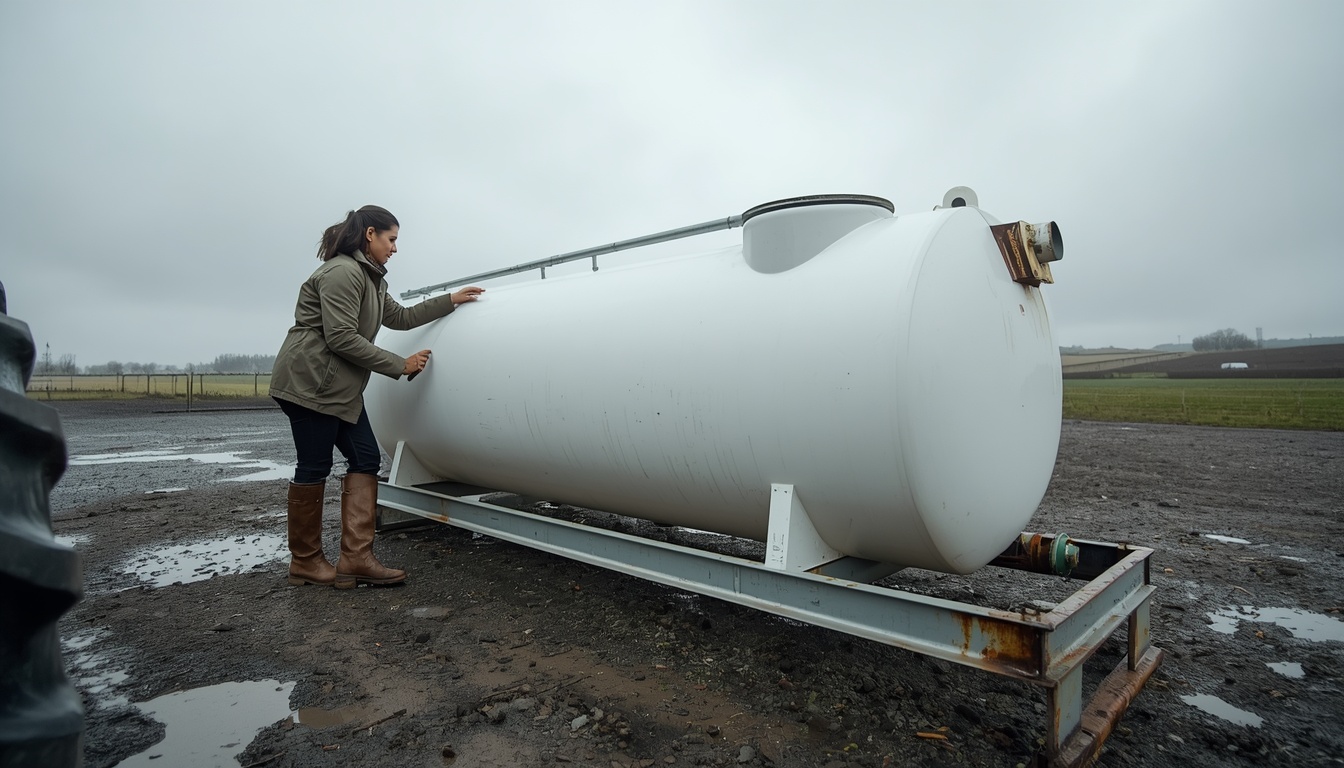
A horizontal tank fills in a curve, not a straight line.
How Do You Use a Water Volume Calculator for a Pool?
For a rectangular pool, multiply length by width by average depth in feet, then multiply by 7.48 to get US gallons. A 28 ft by 14 ft pool with a 3.5 ft shallow end and a 6 ft deep end averages 4.75 ft and holds about 13,929 gallons.
Round pools use π × radius² × average depth × 7.48. A 15 ft round pool averaging 4 ft deep holds about 5,288 gallons. For an oval, swap in the ellipse area, π × (length ÷ 2) × (width ÷ 2). The 7.48 comes from 1,728 cubic inches per cubic foot divided by 231 cubic inches per gallon.
Pool owners in the UK and Europe usually work in metres instead. Multiply length, width, and average depth in metres, then multiply by 1,000 for litres. The Phoenix pool in the examples below comes to about 52.7 cubic metres, which is 52,726 litres.
Averaging depth only works when the floor slopes steadily. A pool with a sudden drop-off should be split into two sections and added together. I would not lean on the shortcut for an oddly shaped pool. The surface area, length times width, is the same figure our square footage calculator returns.

Length, width, and a depth reading at each end.
How Do You Use a Water Volume Calculator for a Pipe?
A pipe is a long, thin cylinder, so its fluid volume is π × (inside diameter ÷ 2)² × length. Fifty metres of pipe with a 25 mm inside diameter holds 24.5 litres. In US units, 100 feet of pipe with a 0.8 inch inside diameter holds about 2.6 gallons.
Use the inside diameter, never the outside figure or the nominal size on the label. In a full-shape cylinder calculator, enter the inside radius and the pipe length. Some tube calculators return the volume of the wall material instead of the water inside, so check the result against a quick hand calculation.
Is a Water Volume Calculator Different in the UK?
A water volume calculator in the UK works the same way, but it normally returns litres and cubic metres, and only older paperwork still quotes imperial gallons. Rainwater butts, oil tanks, and ponds are all sized in litres, so the metric steps above apply directly.
Scale helps here. According to the Environment Agency’s 2025 water usage report, average daily use in England is 136.5 litres per person. The 624-litre rainwater tank from earlier would cover about 4.6 days of that for one person. Drinking is a small slice of the total, and our water intake by weight guide covers the personal side.
How Does a Fluid Volume Calculator Work for Ultrasound?
On ultrasound, clinicians estimate bladder fluid volume with the prolate ellipsoid formula: length × width × height × 0.52, with all three diameters in centimetres and the result in millilitres. A bladder measuring 8 × 6 × 5 cm gives 124.8 mL, because one cubic centimetre equals one millilitre.
A 2020 study in the International Urogynecology Journal by Padilha and colleagues used this equation to test post-void residual measurements and reported excellent agreement between raters. The formula is routine in research and bedside practice.
The 0.52 factor is a shape approximation for an ellipsoid. StatPearls notes that more than one correction factor is acceptable, and dedicated bladder scanners apply their own algorithms, so numbers from different methods are not interchangeable. What a reading means is a clinical decision, and no calculator settles it.
Three Fluid Volume Examples With Real Numbers
Each example below was checked with a script before publication, so the figures hold up if you rerun them.
A rainwater tank in Leeds
Tom keeps a 1.2 m by 0.8 m by 1.0 m rainwater tank behind his allotment shed. After a dry fortnight he dipped it and found 0.65 m of water. That is 624 litres, or 65% of the 960-litre capacity, and about 137 imperial gallons.
A pool in Phoenix
In Phoenix, Maria needed to dose a 28 ft by 14 ft pool with a 3.5 ft shallow end and a 6 ft deep end. The average depth of 4.75 ft gives 1,862 cubic feet, about 13,929 US gallons, or 52,726 litres. Had she used the 6 ft deep end alone, she would have calculated 17,594 gallons, which is 26% too high.
A heating loop in Manchester
Dev, a plumber in Manchester, had to drain a 50 m run of pipe with a 25 mm inside diameter before cutting in a valve. The run holds 24.5 litres, so a single 20-litre bucket would overflow. He lined up two.
Five Fluid Volume Mistakes That Skew the Result
Most wrong answers come from five repeatable slips, and none of them is arithmetic.
1. Using wall height instead of fluid depth
A tank 1 m tall with 0.65 m of water holds 65% of its capacity, not 100%. Measure the wet mark every time.
2. Treating a horizontal tank as a straight line
A quarter of the depth holds 19.6% of the volume in the 1 m example above, not 25%. Use the segment formula or a dip chart.
3. Mixing up gallons
Using 3.785 where a datasheet means imperial gallons understates a 1,000-gallon tank by about 761 litres.
4. Using the outside pipe diameter
Entering a 28 mm outside diameter instead of the 25 mm bore turns 24.5 litres into 30.8 litres, about 25% too high.
5. Mixing units inside one formula
Typing 1.2 (metres) × 80 (centimetres) × 0.65 (metres) returns 62.4, which is off by a factor of 100. Convert everything first.
⚠ Watch Out For This
A tank’s rated capacity is often the brim-full figure, so the usable volume below the overflow outlet is lower. Measure the inside dimensions yourself before trusting a label.
What an Accurate Volume Figure Saves You
An accurate volume figure prevents two expensive errors: ordering too much and treating too little.
- Correct chemical doses. Pool chemicals are dosed by volume. Maria’s 26% overestimate would have meant about a quarter too much product.
- Realistic supply planning. According to EPA WaterSense, the average American family uses more than 300 gallons of water per day at home, about 1,136 litres. A 13,929-gallon pool equals roughly 46 days of that.
- Cleaner maintenance jobs. Knowing a pipe run holds 24.5 litres tells Dev how many buckets to bring. It also tells him whether the job needs a pump or just a hose.
- Consistent clinical readings. Using the same ellipsoid formula at every scan keeps repeat measurements on one patient comparable. Mixing formulas would make a change in the number impossible to interpret.
Online Fluid Volume Calculator vs Doing It by Hand
A calculator wins on speed and unit conversion, while the hand formula still wins for a partly filled horizontal tank.
| Factor | Online fluid volume calculator | Hand formula |
|---|---|---|
| Speed | Seconds once dimensions are entered | A few minutes with a scientific calculator |
| Unit conversion | One step where litres and gallons are offered | You apply each factor yourself |
| Full tank, standard shape | Works well | Works well |
| Partly filled vertical or rectangular tank | Works if you enter fluid depth as the height | Works with the same substitution |
| Partly filled horizontal tank | Usually not covered | Segment formula or dip chart needed |
| Main risk | Wrong units or wrong depth entered | Arithmetic slips and unit mix-ups |
| Best for | Quick checks and repeat jobs | Odd shapes and sanity checks |
Frequently Asked Questions About Fluid Volume Calculators
What is a fluid volume calculator?
A fluid volume calculator is a tool that converts a container’s dimensions and the liquid’s depth into a volume in litres, gallons, or cubic units. It suits rectangular tanks, round tanks, pools, and pipes. Clinicians use a related formula, length times width times height times 0.52, to estimate bladder volume on ultrasound.
How do I use a fluid volume calculator for a partly filled tank?
Enter the depth of the liquid, not the height of the tank. A rectangular tank 1.2 m long and 0.8 m wide holding 0.65 m of water gives 0.624 cubic metres, or 624 litres. This works for vertical and rectangular tanks. A horizontal cylinder needs the circular segment formula instead.
What is the difference between a liquid volume calculator and a water volume calculator?
There is no difference in the arithmetic. Volume depends on the container’s shape and the liquid’s depth, not on the liquid itself. Only weight changes: water is about 1 kilogram per litre, while fuel oil and other liquids weigh more or less for the same volume.
How many litres are in a gallon?
A US liquid gallon is 3.785411784 litres, and an imperial gallon is 4.54609 litres, which is about 20% larger. Check which one a tank datasheet uses. A 1,000-gallon tank holds 3,785 litres by the US definition and 4,546 litres by the imperial one.
How do I calculate pool volume in gallons?
Multiply length by width by average depth, all in feet, then multiply by 7.48. A 28 ft by 14 ft pool averaging 4.75 ft deep gives 1,862 cubic feet, which is about 13,929 US gallons. Round pools use π times the radius squared in place of length times width.
How do I find the volume of liquid in a pipe?
Use π times the inside radius squared times the pipe length. Fifty metres of pipe with a 25 mm inside diameter holds about 24.5 litres. Always use the inside diameter, because the outside diameter or nominal size overstates how much liquid the pipe carries.
What formula does an ultrasound fluid volume calculator use?
Many ultrasound bladder estimates use the prolate ellipsoid formula: length times width times height times 0.52, measured in centimetres, giving millilitres. An 8 by 6 by 5 cm bladder gives 124.8 mL. Other correction factors exist, and reading the result is a clinician’s decision.
Does a water volume calculator in the UK use litres or gallons?
Most UK calculators work in litres and cubic metres, matching how water butts, tanks, and ponds are sold. Some also offer imperial gallons at 4.54609 litres each. Confirm the unit before ordering, because a US gallon is about 17% smaller than an imperial one.
Content Researcher · AceCalculator
Amanda Reeds holds a BSc in Mathematics and Data Science and writes measurement, conversion, and health guides for AceCalculator. Every worked example in her posts is checked with a short script before publication. She writes for readers who want the reasoning behind a formula.
The Bottom Line on Fluid Volume Calculators
Measure the liquid, not the container. That one habit removes most of the errors above. After that, confirm which gallon you are using, take pipe sizes from the inside, and leave the ultrasound formula to the people trained to read a scan.
Write the unit next to every number.
A calculator cannot see dents, sediment, or a floor that dips at one end. No formula replaces a dip chart from the tank’s maker or a clinician’s judgment on a scan. Treat every result as an estimate, and round up when running short would cause trouble.
Convert My Litres to Gallons in Seconds →