
By Amanda Reeds, Content Researcher ·
Quick Summary
- Key Takeaway: The same athlete can read several points apart on DEXA, calipers, BodPod and smart scales, so pick one method and track it.
- Who This Is For: Athletes, coaches and gym-goers who want to interpret body fat numbers for men, women and specific sports.
- Why It Matters: A 2.9-point gap between two devices on a 62 kg runner is 1.8 kg of fat, enough to mislead a training plan.
- Reading Time: ~12 minutes
Why Your Athlete Body Fat Percentage Depends on the Measuring Tool
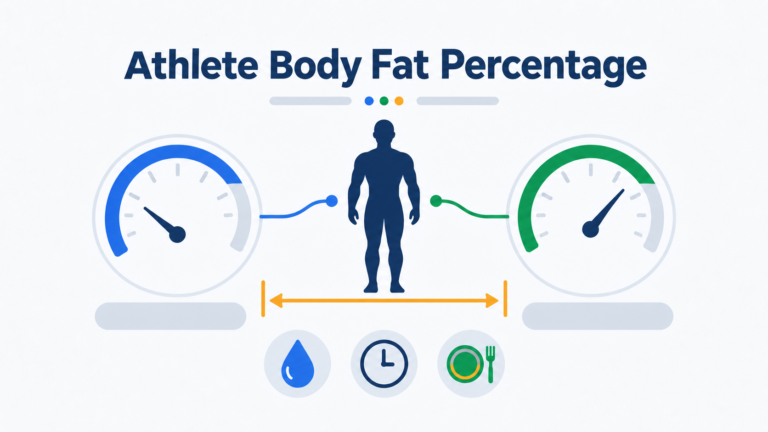
If you have been hunting for one athlete body fat percentage to aim for, you are chasing a moving target. The same person can read 12% on one device and 16% on another in the same afternoon.
Athlete body fat percentage is the share of an athlete’s total body mass that is fat tissue, usually estimated with DEXA scans, skinfold calipers, air displacement chambers or impedance scales. The American Council on Exercise lists 6% to 13% for male athletes and 14% to 20% for female athletes, but each method reads a little differently.
That gap matters because athletes make real decisions from these numbers. They cut weight, change fuelling and judge a training block by them. This guide covers how athletes actually measure body composition, where each method goes wrong and which ranges are worth trusting. It also answers the sport-specific questions people search for most, including soccer players, bodybuilders and CrossFit athletes.
Check My Body Fat Number in Under 60 Seconds →
Five common methods, five different error ranges: the same athlete rarely reads identically on all of them.
Table of Contents
- Why Your Athlete Body Fat Percentage Depends on the Measuring Tool
- What Body Composition Testing Actually Measures
- DEXA vs Skinfolds vs BodPod vs BIA: Which Method Athletes Trust
- How Athletes Measure Body Composition: A Repeatable Protocol
- What Is a Normal Athlete Body Fat Percentage for Men and Women?
- What Is the Ideal Body Fat Percentage for Athletic Performance?
- What Is the Lowest Body Fat Percentage Athletes Reach?
- Athletic Body Fat Percentage Chart by Sport
- Three Real-World Examples of Body Composition Testing
- Common Mistakes When Measuring Athlete Body Fat
- Why Tracking Body Composition the Right Way Pays Off
- Frequently Asked Questions About Athlete Body Fat Percentage
- The Bottom Line on Athlete Body Fat Percentage
What Body Composition Testing Actually Measures
Body composition testing splits your body mass into fat mass and fat-free mass. Body fat percentage is fat mass divided by total mass, multiplied by 100. A 78.4 kg athlete carrying 9.8 kg of fat sits at 12.5%, which leaves 68.6 kg of fat-free tissue.
No device counts fat directly in a living person. Every method infers it from something else, such as X-ray absorption, body density, skin thickness or electrical resistance. That is why two well-made machines can disagree.
According to the American Council on Exercise, a range of 25% to 31% for women or 18% to 24% for men is typical for the average non-athlete. The same source says readings below 14% for women or 6% for men may be dangerously low. Athletes live in the gap between those two lines. ACE’s athlete category runs from 14% to 20% for women and 6% to 13% for men.
This is also why BMI misfires for muscular people. A rugby forward can land in the overweight band on a BMI calculator while carrying very little fat. Body fat percentage fixes that problem, but only if the measurement itself is sound. So which tool deserves your trust?
DEXA vs Skinfolds vs BodPod vs BIA: Which Method Athletes Trust
DEXA is the reference method most sports teams use, but no method is perfect, and every cheaper option trades accuracy for convenience.
A DEXA scan uses low-dose X-rays to separate fat, lean tissue and bone. Alisa Nana and colleagues at the Australian Institute of Sport reviewed the sources of error in athletes in 2014 and proposed a best-practice scanning protocol because hydration, food and positioning all change the result. A 2018 study in the Journal of Sports Medicine used DXA as its yardstick for 131 professional male soccer players in Mexico’s second division.
| Method | What it measures | Main weakness | Access and cost |
|---|---|---|---|
| DEXA scan | X-ray absorption by fat, lean tissue and bone | Sensitive to hydration, food and positioning | Clinic or university lab, highest cost |
| Skinfold calipers | Skin and fat thickness at fixed body sites | Depends on tester skill and the equation chosen | Low cost, portable, used in the field |
| Air displacement (BodPod) | Body volume, converted to density | Assumes a standard density for lean tissue | Specialist unit, moderate to high cost |
| BIA (smart scales, handheld) | Electrical resistance through the body | Moves with hydration, meals and skin temperature | Cheapest, easy to use daily |
| Tape measure (Navy method) | Neck, waist and height, plugged into an equation | Blind to muscle mass and fat distribution | Free, needs only a tape |
Skinfolds deserve a closer look because most athletes meet them first. In the soccer study, equations by Oliver, Ball, Civar and Wilmore estimated body fat best against DXA, according to the 2018 analysis of 131 players. The takeaway is that the equation you pick matters as much as the caliper.
💡 Pro Tip
Pick one method and one time of day, then keep both. A morning DEXA compared with an evening smart scale tells you about the machines, not your training.
Athlete ranges differ by sex and sport, and the leanest bands belong to contest bodybuilders in peak condition.
How Athletes Measure Body Composition: A Repeatable Protocol
Athletes get usable numbers by controlling the conditions, not by buying a fancier device. Sports scientists follow roughly this order.
- Fix the conditions. Measure first thing in the morning after using the toilet, before food, fluids or training. Nana’s group found that fasted, rested scans track change more precisely than scans taken after random activity.
- Match the tool to the question. Use DEXA or a BodPod for a one-off snapshot. Use skinfolds or a consistent scale for tracking week to week.
- Record raw values. A 24-year-old man with a seven-site skinfold sum of 62 mm scores about 8.2% on the Jackson-Pollock equation. A sum of 70 mm moves that to 9.5%, so an 8 mm change shifts the estimate by 1.3 points.
- Keep the same tester and equation. Switching either one adds error that has nothing to do with the athlete.
- Compare trends, not single readings. A one-point change on a 75 kg athlete is 0.75 kg of fat, which can be smaller than the daily swing in body water.
What happened when I tested the tape method
I ran a 34-year-old male rugby player through the Navy tape equation using a height of 180 cm, a neck of 38 cm and a waist of 86 cm. The result was 16.9%. Then I changed only the waist to 90 cm, roughly what a big meal and a full bladder can add. The estimate jumped to 19.8%, a 2.9-point swing from 4 cm of belly. That is why the step-by-step guide to calculating body fat percentage tells you to measure at the same point on the abdomen every time.

A repeatable routine matters more than the device: fix the conditions, then compare like with like.
What Is a Normal Athlete Body Fat Percentage for Men and Women?
Male athletes typically sit between 6% and 13% body fat, and female athletes between 14% and 20%, under the American Council on Exercise athlete category.
Women sit higher because they carry more essential fat, the minimum needed for normal hormonal and reproductive function. ACE puts essential fat at 10% to 13% for women and 2% to 5% for men. That is why a female athlete body fat percentage of 16% and a male reading of 8% can describe similarly lean people.
For a fuller breakdown by age and health category, see the female body fat percentage guide. One honest limit applies to CrossFit. I could not find a peer-reviewed dataset for female CrossFit athletes specifically, so the general athlete range is the safest reference. Anyone who quotes a precise CrossFit number without a source is guessing.
What Is the Ideal Body Fat Percentage for Athletic Performance?
No single ideal exists, because the best body fat percentage for performance depends on the sport, the position and the individual athlete.
Soccer shows the spread. In the 2018 study of 131 professional male players, median DXA body fat was 14.0%, with the middle half between 11.9% and 16.4%. For a 73.2 kg player, the median works out to 10.2 kg of fat.
That range is wider than most coaches expect. It also sits above the male athlete band on many charts. I would not build a training plan around a target taken from a table. Track how a player recovers, sprints and holds muscle, and treat body fat as one input among several.
What Is the Lowest Body Fat Percentage Athletes Reach?
Competitive bodybuilders record the lowest values, from 5.8% to 10.7% for men and 8.1% to 18.3% for women close to competition, according to a systematic review of competitive bodybuilders listed on PubMed in 2023.
The same review found that relative body fat fell by 30% to 60% during contest preparation while lean mass was mostly kept. A man who starts prep at 15% and loses 40% of his relative fat ends near 9%. Stage condition is a short peak, not a year-round target.
Olympic and elite athletes are harder to pin down. I could not find one peer-reviewed figure covering every Olympic event, and a single number would hide the gap between a marathoner and a shot putter. Treat any lone elite figure with suspicion until you see its sport, sex, method and year.
Athletic Body Fat Percentage Chart by Sport
Reference values differ by group, so no single chart fits every athlete. This one collects the figures that have a named source.
| Group | Men | Women | Source and method |
|---|---|---|---|
| General athlete category | 6% to 13% | 14% to 20% | American Council on Exercise |
| Professional soccer players | Median 14.0% (middle half 11.9% to 16.4%) | Not reported in this dataset | 2018 study of 131 players, DXA |
| Contest bodybuilders, near competition | 5.8% to 10.7% | 8.1% to 18.3% | Systematic review, PubMed 2023 |
| CrossFit athletes | No peer-reviewed dataset found | No peer-reviewed dataset found | Use the general athlete range |
Three Real-World Examples of Body Composition Testing
These scenarios are illustrative, built from the numbers above so the arithmetic is easy to follow.
Daniela Ruiz, a 27-year-old distance runner in Portland, weighed 62 kg and scored 17.8% on DEXA. That is 11.0 kg of fat and 51.0 kg of fat-free mass. Her smart scale had read 14.9% the week before, 2.9 points lower and 1.8 kg less fat. She stopped comparing the two and kept the scale purely for weekly trends.
Marcus Bell weighed 76 kg when he wrestled at a college in Ames, Iowa, aged 20. His coach’s caliper equation said 9.0% and a BodPod said 11.5%. The 2.5-point gap equals 1.9 kg of fat, which matters when a weight class leaves little room. The team chose one method for the whole season.
A club analyst once wanted every midfielder under 10% body fat. One 73.2 kg midfielder sat at the 14.0% median, so the request meant losing about 2.9 kg of fat while keeping every gram of muscle. After seeing the numbers, the analyst switched to tracking performance markers instead.
Common Mistakes When Measuring Athlete Body Fat
Most bad readings come from the same four errors.
Comparing numbers across methods
A DEXA result and a smart scale result are different estimates. Only compare readings from the same device, tester and equation.
Measuring at random times
Hydration and food change impedance and scan results. Test in the morning, fasted and rested, every time.
Treating a stage number as a year-round target
Bodybuilders reach single digits for short windows. Copying that number for months can cost recovery and muscle.
Using BMI for a muscular body
BMI counts muscle as if it were fat. Body fat percentage, measured carefully, separates the two.
⚠ Watch Out For This
A 12% from one machine is not the same 12% from another. Never set a target from one device and then check progress on a different one.
Why Tracking Body Composition the Right Way Pays Off
Consistent measurement turns a vague goal into something you can check. Here is what that buys you.
- You see real change. A 1.9 kg gap between two methods is close to a month of fat loss at 0.5 kg per week, so sticking to one method keeps you from chasing noise.
- You protect muscle. Watching fat-free mass alongside fat mass shows whether a cut is costing you tissue you need.
- You fuel with evidence. Pairing body composition with your TDEE and BMR numbers helps set calories from measured data instead of a generic formula.
- You spot risk early. ACE flags readings under 14% for women and 6% for men as potentially dangerous, so a downward trend near those lines is worth a conversation with a professional.
Frequently Asked Questions About Athlete Body Fat Percentage
What is a good athlete body fat percentage?
A good athlete body fat percentage is 6% to 13% for men and 14% to 20% for women, based on the American Council on Exercise athlete category. Sport matters, though. A 2018 study of 131 professional male soccer players recorded a median DXA reading of 14.0%, while contest bodybuilders drop far lower for short periods.
Is DEXA the most accurate way to measure athlete body fat?
DEXA is the reference method in most sports research, including the 2018 soccer study of 131 players, but it still produces an estimate. Hydration, food intake and recent training all shift the result. Australian Institute of Sport researchers recommend fasted, rested scans with consistent positioning so that changes reflect the athlete and not the conditions.
How accurate are skinfold calipers for athletes?
Skinfold accuracy depends on the tester and the equation. In the 2018 soccer study, equations from Oliver, Ball, Civar and Wilmore estimated body fat best against DXA. Many practitioners track the raw skinfold sum in millimetres instead, because the same tester using the same sites shows change more reliably than a single converted percentage.
Can athletes trust a smart scale for body fat percentage?
Use a smart scale for trends, not for a single verdict. Impedance readings move with hydration, meal timing and skin temperature because water carries the electrical current. Measure at the same time each morning before eating or drinking, and compare only against your own earlier readings from the same device.
What is a healthy athlete body fat percentage for women?
Female athletes typically fall between 14% and 20% body fat under the American Council on Exercise athlete category. ACE puts essential fat for women at 10% to 13% and says readings below 14% may be dangerously low. Contest bodybuilders reached 8.1% to 18.3% close to competition, but that range reflects short peak phases.
How often should athletes measure body composition?
A common schedule is one measurement every four to eight weeks, timed to the end of a training block. Daily readings mostly capture water changes. A one-point change on a 75 kg athlete is only 0.75 kg of fat, so wait long enough for real change to build up and keep every condition identical.
Why does my body fat reading change between machines?
Each device estimates fat from a different signal: X-ray absorption for DEXA, body density for a BodPod, skin thickness for calipers and electrical resistance for scales. Each also assumes things about hydration and tissue density. A runner in this guide scored 17.8% on DEXA and 14.9% on a smart scale in the same week.
Is a lower body fat percentage always better for athletic performance?
Lower is not always better, because performance depends on the sport, the position and how well the athlete is fuelled. ACE describes readings under 14% for women and 6% for men as potentially dangerously low. Contest bodybuilders reach single digits only briefly. A leaner reading that costs recovery or muscle usually loses more than it gains.
Content Researcher · AceCalculator
Amanda Reeds is a Content Researcher at AceCalculator who covers body composition, metabolism and fitness metrics. Her work on the site includes guides to calculating body fat percentage and comparing TDEE with BMR. She builds each article from named primary sources and works through the formulas by hand before publishing.
The Bottom Line on Athlete Body Fat Percentage
Three points carry most of the weight here. The number you get depends on the method, so compare like with like. Ranges for athletes are wide, and sport-specific data such as the soccer median of 14.0% often sits above generic charts. And the leanest figures in the research belong to bodybuilders in peak condition, not to everyday athletes.
No measurement tool tells you how well you recover, how fast you sprint or whether you are eating enough. A body fat reading is a useful clue, never a verdict. It also cannot separate healthy leanness from under-fuelling on its own.
Work Out What My Training Days Really Cost →
The same athlete can land at two different readings on two devices, which is why one method should be used for tracking.