By Amanda Reeds, Content Researcher ·
Quick Summary
- Key Takeaway: A first-time borrower has no repayment history on file, so lenders lean on income, employment, and existing debt to price the offer instead of a track record.
- Who This Is For: Anyone applying for a first personal loan, auto loan, or credit-building product with little or no prior credit file.
- Why It Matters: The APR, origination fee, and term on a first loan offer can change the total cost by well over a thousand dollars on the exact same amount borrowed.
- Reading Time: ~9 minutes
Why Getting Your First Loan Offer Right Matters
Most people assume a lender treats every applicant the same way once the paperwork lands on their desk. It doesn’t work that way. A first-time borrower walks into the underwriting process with a blank file, and that blank file changes the math behind the offer you’re handed, sometimes in ways that cost real money.
A first-time borrower is someone applying for credit, whether that’s a personal loan, an auto loan, or a starter credit card, without an existing repayment history on file with a nationwide credit bureau. Because there’s no track record to check, lenders lean more heavily on income, employment, and current debt load when setting the interest rate, fees, and approval terms on the offer.
That gap in the file is more common than it looks. Lenders can’t score what isn’t there, and a thin file doesn’t mean a risky borrower. It just means the underwriting has to work harder in other directions.
This guide walks through what actually changes on a first loan offer. It covers how to read the numbers a lender hands you, and where first-time borrowers tend to lose money without realizing it.
See What My Monthly Payment Would Be →Table of Contents
- Why Getting Your First Loan Offer Right Matters
- What Makes You a First-Time Borrower, Exactly?
- How to Read a Loan Offer, Line by Line
- Personal Loans for First-Time Borrowers: What Actually Changes
- Two First-Time Borrowers, Two Very Different Offers
- Mistakes First-Time Borrowers Make With Their First Offer
- Why Reading the Fine Print Actually Pays Off
- Best Loans for First-Time Borrowers: A Side-by-Side Look
- Frequently Asked Questions About First-Time Borrowers
What Makes You a First-Time Borrower, Exactly?
A first-time borrower isn’t defined by age or income. It’s defined by an empty file at the credit bureaus. No open or closed loan accounts, no credit card history, nothing for an automated underwriting system to score.
This is far more common than most applicants expect. According to a 2015 Consumer Financial Protection Bureau report, roughly 26 million Americans, about one in every 10 adults, had no credit history at all with a nationwide credit reporting agency. A further group had files too thin or too stale to produce a usable score. Recent college graduates, immigrants building a U.S. credit file, and people who’ve paid for everything in cash for years all land in this category.
Lenders separate a first-time borrower from a “thin file” borrower and a “bad credit” borrower. Casual conversation often lumps all three together, but they’re not the same. A thin file has a little history, just not enough to score reliably. Bad credit means there’s a score, and it’s low. A true first-time borrower has neither a score nor the missed payments that would drag one down. That distinction matters. It changes which loan products are even worth applying for.
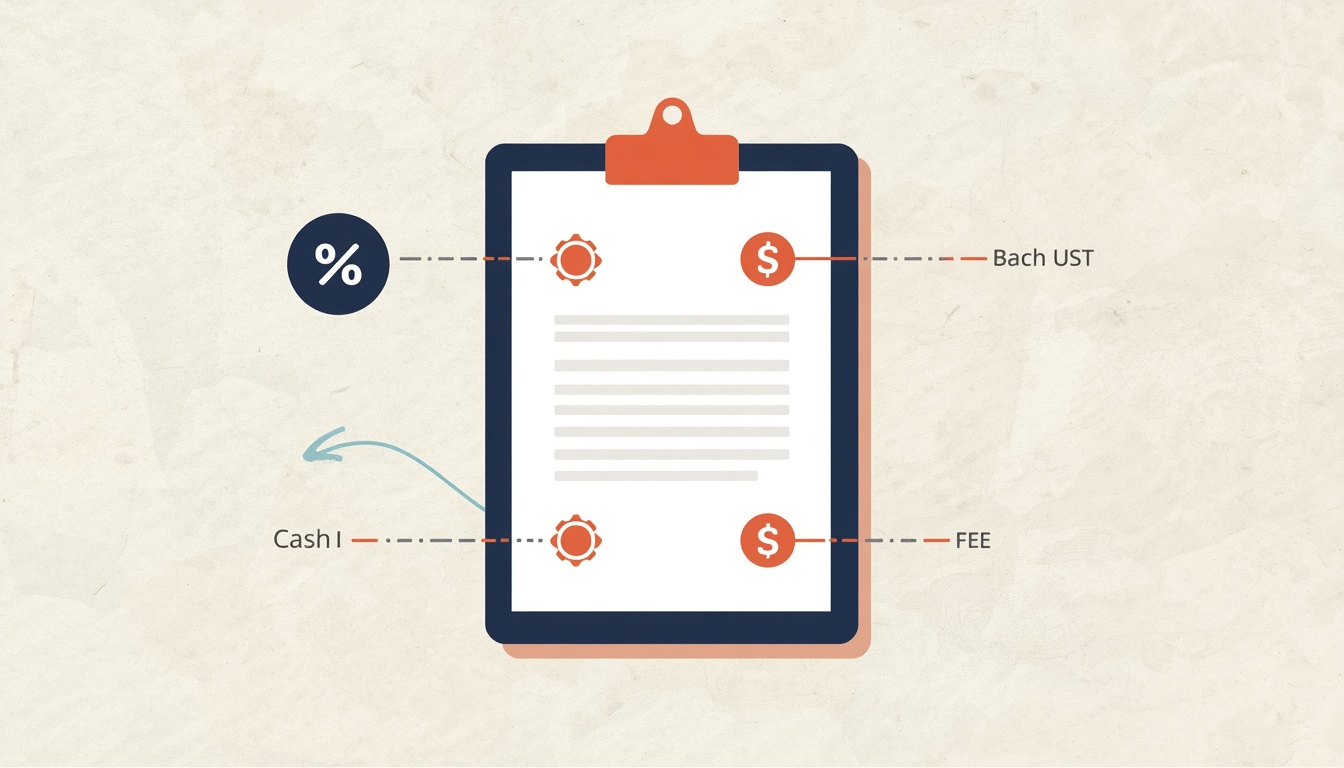
The three numbers worth circling on any first loan offer: APR, fees, and term length.
How to Read a Loan Offer, Line by Line
Start with the APR, not the interest rate printed at the top. The annual percentage rate folds in the interest rate plus most fees, so it’s the number that actually tells you what the loan costs over a year. A lender showing you a 9.9% “rate” next to a 14.2% APR is telling you the fees are doing a lot of the work.
Federal law requires this disclosure. Under the Truth in Lending Act, lenders must show the APR, the finance charge, and the total of payments before you sign. That’s specifically so offers from different lenders can be compared on equal footing.
- Check the APR first. This is the true annual cost of the loan, interest plus most fees combined into one percentage.
- Find the origination fee. Many first-time-borrower loans carry one, and it’s often deducted from the amount you actually receive rather than added to your balance.
- Confirm the term length. A longer term lowers the monthly payment but raises the total interest paid over the life of the loan.
- Look for a prepayment penalty. Most personal loans don’t have one, but it’s worth confirming before you plan to pay the loan off early.
- Read the total repayment amount. This single line, principal plus all interest and fees, tells you more than the monthly payment ever will.
A Worked Example of an Origination Fee
Say a lender approves a first-time borrower for $10,000 with a 6% origination fee. That fee, $600, gets subtracted before the money reaches the account, so the borrower receives $9,400 but still owes the full $10,000 plus interest. Borrowers who only look at the “amount approved” line miss this every time.
Personal Loans for First-Time Borrowers: What Actually Changes
Personal loans for first-time borrowers tend to come with higher APRs, smaller approved amounts, and shorter terms. Someone with three years of on-time payments behind them typically gets a better offer on the same loan. None of that is arbitrary. It’s the lender pricing in the uncertainty of an unproven repayment history.
According to the Federal Reserve’s G.19 Consumer Credit release, the average interest rate on a 24-month personal loan from commercial banks was 11.66% in the first quarter of 2025. That’s the baseline for an established borrower. A first-time borrower personal loan routinely lands several points above it, and sometimes well into the 20s. The exact gap depends on the lender and the strength of the applicant’s income documentation.
Credit unions and community banks tend to price first-time-borrower loans more gently than large online lenders. Part of the reason is that they weigh a local banking relationship alongside the credit file. A checking account held for two years at the same credit union can sometimes do more for an offer than a marginally higher income figure. It’s worth checking before assuming the biggest lender in a search result is the cheapest one.
Co-signed loans and secured loans, ones backed by savings or a vehicle, also open up better pricing for a first-time borrower. A co-signer with an established file effectively lends their credit history to the application. That’s why the terms often look closer to what an experienced borrower would get. Borrowers with a rocky credit history, rather than just a thin one, face a different set of trade-offs. This guide to personal loans for bad credit covers that case in more detail.
Two First-Time Borrowers, Two Very Different Offers
The numbers below are illustrative walkthroughs built with realistic figures and verified using standard amortization math, not records from an actual applicant.
Consider a borrower taking out $8,000 over 36 months. At a 14.5% APR, the monthly payment comes to $275.37, with $1,913.24 in total interest over the life of the loan. A first-time borrower with a thinner income file might see 19.9% APR instead on the same $8,000. That pushes the payment to $296.90 a month and the total interest to $2,688.44. It’s a $775 difference for identical principal and term, driven entirely by the rate the lender assigned based on file strength.
A second borrower needs $4,500 for a used car repair. She initially gets quoted 22.9% APR over 24 months by an online lender, working out to $235.46 a month and $1,150.96 in total interest. She then switches the application to a local credit union, where she’d held a savings account for a year. The rate drops to 11.5% APR on the same amount and term: $210.78 a month, $558.75 in total interest. The credit union relationship saved her $592.20 over the life of the loan, without changing her income or the amount she needed.
Neither borrower did anything unusual. They just applied in a different place, or accepted the first number they saw. The same comparison habit applies to a first auto loan. Dealership financing and a credit union quote can land far enough apart to matter.
Mistakes First-Time Borrowers Make With Their First Offer
Comparing monthly payments instead of APR tops the list. Two loans with the same $250 monthly payment can carry very different total costs. It depends on whether one stretches over 48 months and the other over 36. The payment looks identical; the total interest paid does not.
Applying to only one lender is another common one. A first-time borrower with no track record benefits most from getting a second or third quote. Pricing for thin files varies more between lenders than pricing for established credit histories does.
Skipping the origination fee line causes real confusion later. Borrowers plan around receiving the full approved amount, then see a smaller deposit hit their account because the fee came out upfront. Budgeting off the disbursed amount, not the approved amount, avoids the surprise.
Treating a co-signer request as an insult rather than a tool is a fourth mistake. A co-signer isn’t a sign the loan is a bad idea. It’s often the fastest route to a materially lower rate for someone without a file. It’s worth asking a family member directly rather than assuming the answer is no.
Ignoring loan entrance counseling or new-borrower disclosures rounds out the list. This is common with student loans and some credit-builder products. These sessions exist specifically to flag the terms first-time borrowers overlook. Skipping them means missing information the lender is legally required to provide.
⚠ Watch Out For This
A low advertised “starting rate” almost never applies to a first-time borrower. Ask the lender for the rate range that actually applies to applicants with no credit history before assuming you’ll qualify for the number in the ad.
Why Reading the Fine Print Actually Pays Off
A first-time borrower who compares APR instead of the advertised rate routinely saves money. Getting a second quote before signing adds even more savings, often several hundred dollars on a mid-sized personal loan. The Maria example above showed a $592.20 difference from switching lenders alone, on a loan most people would sign within minutes of approval.
There’s a longer-term payoff too. A first loan handled well, paid on time, kept at a reasonable balance, builds the exact repayment history that gets a borrower better terms the second time around. The first loan someone takes out often shapes their credit file more than any loan afterward. It’s simply the first data point a scoring model has to work with.
None of this guarantees approval at the best possible rate. Income, existing debt, and the specific lender’s underwriting model still decide the final number. What careful reading changes is whether a first-time borrower accepts the first offer on the table, or negotiates from an informed position.
Best Loans for First-Time Borrowers: A Side-by-Side Look
The best loans for first-time borrowers usually come from lenders willing to weigh factors beyond a credit score: income stability, banking history, education. There’s simply no score yet to lean on.
| Loan Type | Typical APR Range | Best Fit For a First-Time Borrower |
|---|---|---|
| Credit union personal loan | Roughly 10% to 18% | Anyone with an existing membership or checking relationship |
| Secured personal loan | Roughly 8% to 15% | Borrowers with savings to pledge as collateral |
| Co-signed personal loan | Close to the co-signer’s own rate tier | Applicants with a parent or relative willing to co-sign |
| Online lender, unsecured | Roughly 18% to 30%+ | Applicants needing fast funding with no collateral or co-signer |
| Credit-builder loan | Roughly 6% to 16% | Borrowers prioritizing a credit file over immediate cash access |
💡 Pro Tip
Ask the lender directly whether they check alternative data, rent payments, utility bills, bank cash flow, in addition to the credit file. Some do, and it can meaningfully improve an offer for a first-time borrower.
None of these categories is universally “best.” A secured loan beats a co-signed loan for someone without a willing co-signer. A credit union beats an online lender for someone who already banks locally. Running the actual numbers through a loan calculator for two or three real offers is what actually settles the question, not comparing advertised rate ranges.
It’s also worth checking a debt-to-income ratio before applying anywhere. Lenders weigh this number heavily for first-time borrowers. It substitutes for the payment history they can’t check.
Frequently Asked Questions About First-Time Borrowers
What qualifies someone as a first-time borrower?
Someone qualifies as a first-time borrower when they have no open or closed loan or credit card accounts reporting to a nationwide credit bureau. Age and income don’t factor into the definition; only the presence or absence of a credit file does.
Can a first-time borrower get approved without a credit score?
Approval is possible without a score, though the lender will rely more heavily on income documentation, employment history, and banking relationship. Credit unions, secured loans, and co-signed loans tend to have the most flexibility for applicants with no score at all.
Are personal loans for first-time borrowers more expensive?
Personal loans for first-time borrowers typically carry a higher APR than the same loan offered to an established borrower. The lender is pricing in the uncertainty of an unproven repayment history. The gap can range from a couple of percentage points to well over ten, depending on the lender.
What is the fastest way to build credit as a first-time borrower?
A small credit-builder loan or a secured credit card, paid on time every month, tends to build a usable credit file within six to twelve months. The loan amount matters far less than the consistency of on-time payments reported to the bureaus.
Does a co-signer help a first-time borrower personal loan?
A co-signer with an established credit history usually improves both the approval odds and the rate on a first-time borrower personal loan. The lender can rely on the co-signer’s file alongside the applicant’s income. The co-signer becomes equally responsible for repayment, which is worth discussing openly before signing.
What is loan entrance counseling and why does it matter?
Loan entrance counseling is a required disclosure session, most common with federal student loans, that walks first-time borrowers through repayment obligations, interest accrual, and default consequences before funds disburse. Skipping it doesn’t cancel the loan, but it does mean missing information lenders are required to provide.
Why does a loan offer sometimes get delayed for a first-time borrower?
A first-time borrower delay usually comes from manual income or identity verification, since automated underwriting has less data to confirm the application against. Providing pay stubs, bank statements, or proof of address quickly is the most common way to shorten the wait.
What are the best loans for first-time borrowers with no credit history?
Credit union personal loans, secured loans backed by savings, and co-signed loans are generally the best loans for first-time borrowers with no credit history. All three let the lender rely on something other than a score. Online unsecured lenders remain an option but usually carry the highest rates in this situation.
Content Researcher · AceCalculator
Amanda researches and verifies AceCalculator’s loan and finance tools before writing about them. She cross-checks figures against Federal Reserve and CFPB data rather than relying on advertised lender rates. She focuses on consumer credit topics, including how loan terms change for borrowers with little or no credit history.
The Bottom Line on Being a First-Time Borrower
Being a first-time borrower isn’t a red flag. It’s a data gap, and lenders fill that gap with income documentation, banking history, and sometimes a co-signer instead of a score. The offer in front of you reflects how a specific lender chose to fill that gap. It’s not some fixed rate every first-time borrower is stuck with.
Reading the APR instead of the headline rate, checking for an origination fee, and getting a second quote before signing are the three habits that make the biggest difference. None of them require good credit. They just require reading past the first number on the page.
None of this guarantees a specific rate or approval. That still comes down to income, existing debt, and each lender’s own underwriting standards. Those standards vary more than most comparison sites let on.
Compare My Loan Options →