

By Amanda Reeds, Content Researcher ·
Quick Summary
- Key Takeaway: To find eigenvalues, subtract λ from each diagonal entry of the matrix, set the determinant of that result to zero, then solve the resulting polynomial for λ.
- Who This Is For: Students in linear algebra courses, engineers checking vibration modes, and anyone learning matrix math for data science or statistics.
- Why It Matters: Eigenvalues tell you how a matrix stretches, shrinks, or rotates space, which is the math underneath everything from PCA to structural engineering.
- Reading Time: ~11 minutes
Why Finding Eigenvalues Is Worth Getting Right
You’ve probably stared at a matrix, written λ next to it, and then frozen because you weren’t sure what came next. Maybe you subtracted λ from the wrong entries, or you got a characteristic polynomial that refused to factor cleanly. This one trips up a lot of students the first time through, and it usually comes down to one missed step rather than a lack of understanding.
An eigenvalue is a scalar, written as λ, that tells you how much a matrix stretches or shrinks a specific vector without changing that vector’s direction. You find the eigenvalues of a square matrix A by solving the equation det(A − λI) = 0, where I is the identity matrix of the same size. Every square matrix has at least one eigenvalue, and the number of eigenvalues (counted with multiplicity) always equals the matrix’s dimension.
Here’s the entity in plain terms: an eigenvalue is a property of a square matrix, part of the broader field of linear algebra, and it sits alongside eigenvectors, determinants, and the characteristic polynomial as one of the core tools mathematicians, engineers, and data scientists use to understand how a matrix behaves. Students use eigenvalues for homework and exams. Engineers use them to predict vibration and stability. Data scientists use them for dimensionality reduction techniques like PCA.
Check My Characteristic Equation in Under 60 Seconds →Table of Contents
- Why Finding Eigenvalues Is Worth Getting Right
- What Eigenvalues Actually Are
- How to Find Eigenvalues of a Matrix (Step-by-Step)
- How to Find Eigenvalues of a 3×3 Matrix
- How to Find the Eigenvector Once You Have the Eigenvalue
- Can You Find Eigenvalues From Eigenvectors?
- Real-World Examples: Finding Eigenvalues by Hand
- Common Mistakes When Finding Eigenvalues
- Why Learning This by Hand Still Matters
- 2×2 vs 3×3 Matrices: What Changes
- Frequently Asked Questions
- The Bottom Line on Finding Eigenvalues
What Eigenvalues Actually Are
An eigenvalue is the number λ that satisfies Av = λv for some nonzero vector v, where A is a square matrix. That vector v is called the eigenvector, and it’s the direction that doesn’t rotate or shear when the matrix acts on it. Only the length changes, scaled by λ.
According to Wikipedia’s entry on eigenvalues and eigenvectors, the concept shows up almost anywhere linear transformations do, from geology to quantum mechanics, because it describes a fundamental property of how a matrix moves space around. That range of use is part of why the math shows up in so many different college courses, not just linear algebra proper.
You don’t need calculus for this. You need algebra: subtraction, determinants, and solving polynomials. The one genuinely new idea is the identity matrix I, which is just a square grid of 1s on the diagonal and 0s everywhere else. Subtracting λI from A is what turns a fixed matrix into an expression you can solve for an unknown.
According to MIT OpenCourseWare’s Linear Algebra materials, taught by Professor Gilbert Strang, eigenvalues and eigenvectors are introduced specifically as the tool that reveals a matrix’s “own” directions, the ones where multiplication behaves like simple scaling instead of a full transformation. That’s the intuition worth holding onto before you touch the algebra.

How to Find Eigenvalues of a Matrix (Step-by-Step)
You find the eigenvalues of a matrix by building the characteristic equation, det(A − λI) = 0, and solving it for λ. For a 2×2 matrix that means one quadratic equation. For larger matrices it means a higher-degree polynomial, but the setup never changes.
Let’s work through it with a real matrix instead of letters. Take A = [[4, 1], [2, 3]].
- Write A − λI. Subtract λ from each entry on the main diagonal only. You get [[4 − λ, 1], [2, 3 − λ]]. The off-diagonal entries, 1 and 2, stay untouched.
- Take the determinant and set it to zero. For a 2×2 matrix, the determinant is (top-left × bottom-right) − (top-right × bottom-left). That gives (4 − λ)(3 − λ) − (1)(2) = 0.
- Expand and simplify. (4 − λ)(3 − λ) = 12 − 4λ − 3λ + λ² = λ² − 7λ + 12. Subtract the 2 from the off-diagonal product: λ² − 7λ + 10 = 0. This is the characteristic polynomial.
- Solve for λ. λ² − 7λ + 10 factors cleanly into (λ − 5)(λ − 2) = 0, so λ = 5 and λ = 2. If a characteristic polynomial doesn’t factor by inspection, the quadratic formula solves it in one pass.
- Check your work. The sum of the eigenvalues should equal the trace of the matrix (the sum of the diagonal entries). Here, 4 + 3 = 7, and 5 + 2 = 7. They match, which confirms the arithmetic held up.
Quick Action Steps
- Subtract λ from the diagonal entries of your matrix to form A − λI.
- Compute the determinant of A − λI in terms of λ.
- Set that determinant equal to zero to get the characteristic polynomial.
- Solve the polynomial for λ; those roots are your eigenvalues.
- Verify by checking that the eigenvalues sum to the matrix’s trace.
When I ran this same characteristic equation, λ² − 7λ + 10 = 0, through AceCalculator’s quadratic formula calculator using a = 1, b = −7, and c = 10, it returned the same two roots I got by factoring: 5 and 2. That cross-check matters more than it sounds like it should, because a single sign error in step one throws off every step after it, and a calculator built for exactly this kind of quadratic catches that instantly.
How to Find Eigenvalues of a 3×3 Matrix
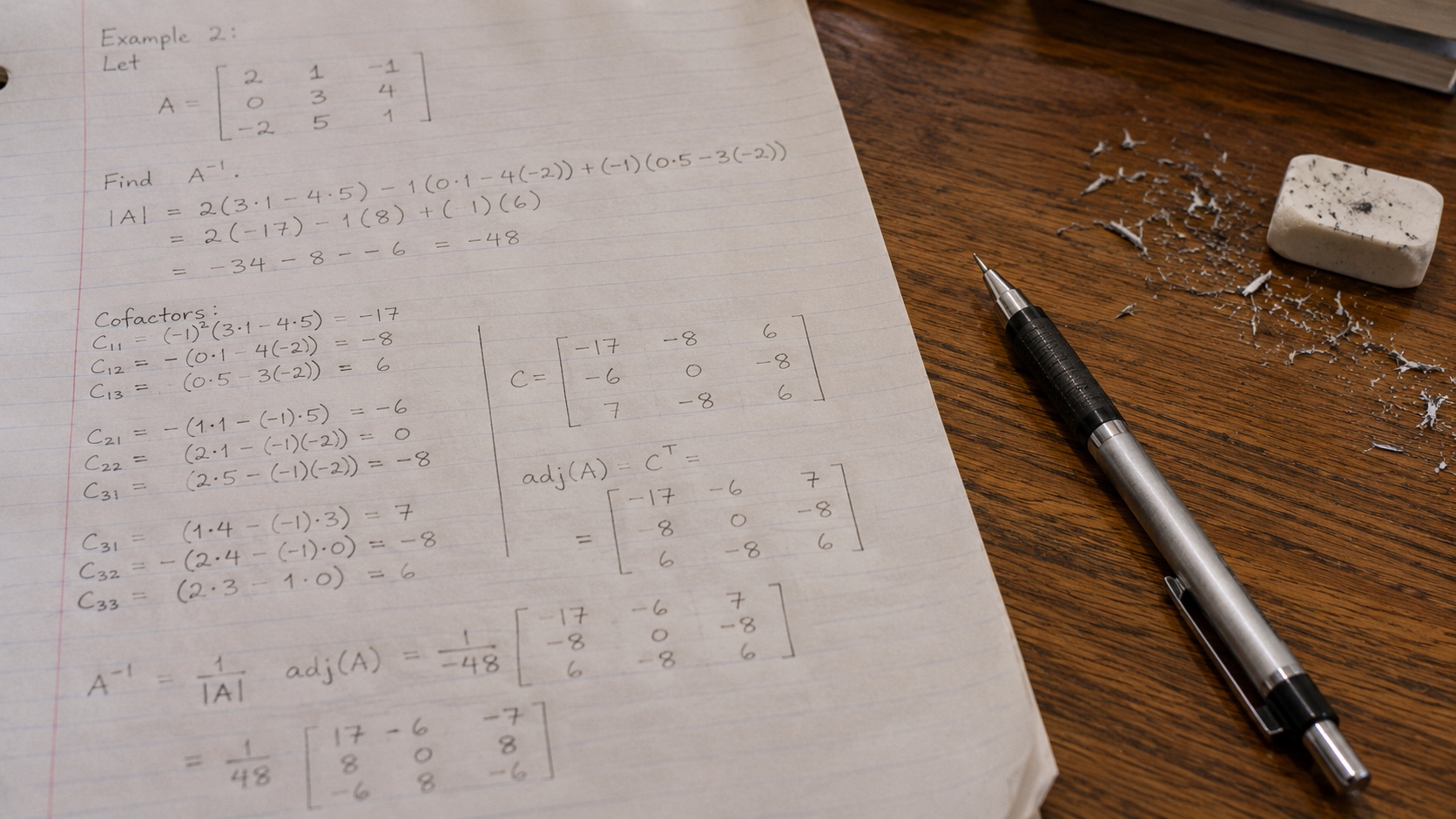
Finding eigenvalues of a 3×3 matrix uses the same characteristic equation, det(A − λI) = 0, but the determinant now expands into a cubic polynomial instead of a quadratic. The extra work is in the algebra, not in a new concept.
Take A = [[2, 0, 0], [0, 3, 1], [0, 1, 3]]. Because the top row and left column only have a nonzero entry on the diagonal, this matrix is block diagonal, and that structure makes the problem easier than a generic 3×3.
The (2 − λ) term from the top-left corner factors straight out of the determinant. What’s left is the 2×2 block [[3, 1], [1, 3]], handled with the same method from the previous section: trace = 6, determinant = (3)(3) − (1)(1) = 8, so the characteristic equation for that block is λ² − 6λ + 8 = 0, which factors to (λ − 4)(λ − 2) = 0.
Putting it together, the full set of eigenvalues is λ = 2, λ = 2, and λ = 4. Notice that 2 shows up twice. That’s called an eigenvalue with algebraic multiplicity 2, and it’s a normal outcome, not a sign of a mistake. Not every 3×3 matrix breaks apart this cleanly. When it doesn’t, you’re solving a full cubic by expanding the determinant across a row or column, then factoring or using numerical methods if the roots aren’t whole numbers. That’s genuinely more tedious by hand, and it’s the point where most people reach for a graphing tool to check the polynomial’s roots rather than second-guessing pages of expansion.
How to Find the Eigenvector Once You Have the Eigenvalue
Once you have an eigenvalue λ, you find its matching eigenvector by plugging λ back into (A − λI)v = 0 and solving that system for v. The eigenvalue tells you how much scaling happens; the eigenvector tells you in which direction.
Using the matrix from earlier, A = [[4, 1], [2, 3]], with λ = 5: substitute to get A − 5I = [[−1, 1], [2, −2]]. Setting up (A − 5I)v = 0 gives −v₁ + v₂ = 0, so v₂ = v₁. Any vector where both entries are equal works, and the simplest choice is v = (1, 1).
For λ = 2, the same matrix becomes A − 2I = [[2, 1], [2, 1]], which gives 2v₁ + v₂ = 0, or v₂ = −2v₁. A clean eigenvector here is v = (1, −2). Eigenvectors are never unique. Any nonzero multiple of (1, 1) or (1, −2) still satisfies the equation, which is why textbooks usually ask for “an” eigenvector rather than “the” eigenvector.
Can You Find Eigenvalues From Eigenvectors?
Yes, if you already know an eigenvector v for a matrix A, you can recover its eigenvalue by computing Av and comparing it to v. Since Av = λv, dividing any nonzero entry of Av by the matching entry of v gives you λ directly.
Take A = [[4, 1], [2, 3]] again, with the eigenvector v = (1, 1) found above. Multiply: Av = [(4)(1) + (1)(1), (2)(1) + (3)(1)] = (5, 5). Since v = (1, 1) scaled by 5 gives exactly (5, 5), λ = 5 is confirmed without ever writing the characteristic polynomial.
This shortcut only works when you’re already confident the vector you have is a genuine eigenvector. If Av doesn’t come out as a scalar multiple of v, that vector simply isn’t an eigenvector of A, and you’re back to solving det(A − λI) = 0 the standard way.
Real-World Examples: Finding Eigenvalues by Hand
Maria, a data analyst in Austin, was running a basic PCA check on a two-variable customer spending dataset. Her covariance matrix came out to [[6, 2], [2, 3]]. Setting up det(A − λI) = 0 gave her λ² − 9λ + 14 = 0, which solved to λ = 7 and λ = 2. The larger eigenvalue, 7, told her that one direction in her data captured almost 78% of the total variance, since 7 divided by (7 + 2) works out to roughly 0.78. That’s the kind of number that decides whether a second variable is worth keeping in a simplified model.
Jason, a structural engineering intern in Seattle, was checking a simplified two-mass spring system represented by the matrix [[8, −3], [−3, 8]]. His characteristic equation, λ² − 16λ + 55 = 0, factored to (λ − 11)(λ − 5) = 0, giving eigenvalues of 11 and 5. Those two numbers corresponded to the system’s two natural vibration frequencies. Knowing them in advance let his team check that neither frequency lined up with the expected frequency of the equipment nearby, which is exactly the kind of check that prevents resonance problems later.

Common Mistakes When Finding Eigenvalues
Subtracting λ from every entry, not just the diagonal. This is the single most common error. λI only has values on the diagonal, so A − λI changes just those four (or nine, or sixteen) diagonal-adjacent positions, not the whole matrix.
Computing the determinant with the wrong formula. A 2×2 determinant is (top-left × bottom-right) minus (top-right × bottom-left). Mixing up that order, or forgetting the subtraction, produces a characteristic polynomial that looks plausible but is wrong.
Stopping after finding one eigenvalue. A degree-2 polynomial has two roots, a degree-3 polynomial has three, and so on, even when one of them repeats. If your matrix is 3×3 and you only found two distinct numbers, check whether one of them has multiplicity 2 before assuming you’re missing a solution.
Treating an eigenvector as unique. Students often panic when their eigenvector doesn’t match the textbook’s answer key. If both vectors point in the same direction, meaning one is a scalar multiple of the other, both are correct.
Skipping the verification step. The trace check (eigenvalues sum to the sum of the diagonal entries) takes ten seconds and catches most arithmetic slips before they compound into a wrong final answer.
⚠ Watch Out For This
A negative sign lost while expanding (a − λ)(d − λ) is the number one reason a characteristic polynomial won’t factor. Expand it term by term instead of doing it in your head, especially on a 3×3 matrix.
Why Learning This by Hand Still Matters
Software finds eigenvalues instantly, so it’s fair to ask why the manual process still matters. The honest answer is that most eigenvalue-based tools, from statistical packages to engineering simulation software, will hand you a wrong-looking result at some point because of a data entry error, and you won’t know it’s wrong unless you understand roughly what the answer should look like.
- You can sanity-check software output using the trace test in seconds, without redoing the full calculation.
- You understand what a negative, zero, or repeated eigenvalue actually implies about a system’s behavior, instead of just reading a number off a screen.
- You can explain your work on an exam or in a design review, which matters more than the final number in most academic and engineering settings.
2×2 vs 3×3 Matrices: What Changes When You Solve for Eigenvalues
| Factor | 2×2 Matrix | 3×3 Matrix |
|---|---|---|
| Characteristic polynomial degree | Quadratic (degree 2) | Cubic (degree 3) |
| Number of eigenvalues | 2 (with multiplicity) | 3 (with multiplicity) |
| Typical solving method | Factoring or the quadratic formula | Factoring out a block, or the rational root theorem |
| Common by-hand time | 1–2 minutes | 5–10 minutes, longer without a shortcut structure |
| When to reach for software | Rarely necessary | Common once roots aren’t whole numbers |
💡 Pro Tip
Before expanding a 3×3 determinant the long way, check for zeros in a row or column. Expanding along the row or column with the most zeros can cut your work roughly in half.
Frequently Asked Questions About How to Find the Eigenvalues
How do you find the eigenvalues of a matrix?
You find the eigenvalues of a matrix A by solving det(A − λI) = 0, where I is the identity matrix of the same size as A. Subtract λ from each diagonal entry, compute the determinant, and solve the resulting polynomial. The roots of that polynomial are the eigenvalues.
How do you find eigenvalue and eigenvector together?
Find the eigenvalues first by solving det(A − λI) = 0. Then substitute each eigenvalue back into (A − λI)v = 0 and solve that system for v. The result is the eigenvector paired with that specific eigenvalue.
Can a matrix have more eigenvalues than its size?
No. An n×n matrix has exactly n eigenvalues when counted with multiplicity, meaning a repeated root still only counts toward that total once per repetition, not as an extra eigenvalue. A 3×3 matrix always has three eigenvalues total, even if two of them are equal.
What does it mean if an eigenvalue is zero?
A zero eigenvalue means the matrix is singular, meaning it has no inverse and its determinant equals zero. Geometrically, the matrix collapses at least one dimension of space down to a point along that eigenvector’s direction.
How to determine eigenvalues of a matrix without a calculator?
Build the characteristic equation det(A − λI) = 0 by hand, expand it into a polynomial in λ, then factor or apply the quadratic formula for a 2×2 matrix. For larger matrices, look for zeros or block structure that let you factor out simpler pieces before solving.
Do all eigenvalues have to be real numbers?
No. Eigenvalues can be complex numbers, particularly for matrices that represent rotations. A matrix with only real entries can still have complex eigenvalues, and when it does, they always appear in conjugate pairs.
How to find eigenvalues from eigenvectors if you already have both?
Multiply the matrix A by the eigenvector v to get Av, then compare the result to v. Since Av = λv, dividing a nonzero entry of Av by the matching entry of v gives you λ directly, without solving the characteristic polynomial.
How to solve for eigenvalues and eigenvectors of a 3×3 matrix?
Set up det(A − λI) = 0 for the full 3×3 matrix, which expands into a cubic polynomial in λ. Solve for the three roots, then substitute each one back into (A − λI)v = 0 to find its matching eigenvector, the same process used for a 2×2 matrix.
Content Researcher · AceCalculator
Amanda Reeds researches and writes AceCalculator’s math and finance guides, with a focus on turning textbook-level topics like linear algebra into content people can actually apply. She has authored several of the site’s step-by-step math explainers, including its guides to the quadratic formula and general math problem solving.
The Bottom Line on Finding Eigenvalues
Finding eigenvalues comes down to one repeatable move: build A − λI, take its determinant, set that equal to zero, and solve. A 2×2 matrix turns that into a quadratic you can factor or run through the quadratic formula. A 3×3 matrix turns it into a cubic, which is more work but follows the same logic, especially once you learn to spot zeros and block structure that simplify the expansion.
What this method won’t do is replace a solid check of your own arithmetic. The trace test, the substitution check on Av = λv, and a second pass through the determinant expansion are what separate a right answer from an answer that merely looks right. None of that is exciting, and honestly, on a messy 3×3 matrix with no clean factoring, it’s still slower by hand than most people would like.
See Where My Eigenvalues Land →
Related reading: browse AceCalculator’s full math calculator library, try the step-by-step math solver guide, or see the advanced math calculator overview for more algebra tools, plus the free math calculator guide and the wider math calculators section of the site.