
By Amanda Reeds, Content Researcher ·
Quick Summary
- Key Takeaway: One meter equals 3.28084 feet (3 feet, 3.37 inches), based on the NIST-defined international foot of exactly 0.3048 meter.
- Who This Is For: Anyone converting metric lengths to feet for construction, travel, AutoCAD drawings, Excel sheets, or homework.
- Why It Matters: One correct formula prevents the rounding errors that throw off a cut list, a floor plan, or a shipping spec.
- Reading Time: ~9 minutes
Why Getting Your Meter to Feet Conversion Right Matters
You’ve probably typed a meter measurement into your phone calculator and second-guessed the number it gave you back in feet. Maybe a spec sheet from an overseas supplier listed dimensions in meters, and your warehouse team only works in feet. Or maybe you’re staring at an AutoCAD floor plan drawn in metric, while your project is set up in imperial.
Converting meter to feet means turning a metric length into its imperial equivalent using one fixed ratio. One meter equals exactly 3.28084 feet, since a foot is officially defined as 0.3048 meter. You convert by dividing the meter value by 0.3048, or by multiplying it by 3.28084. Builders, students, and engineers use this daily wherever metric and imperial units overlap.
The meter is the base SI unit of length. Nearly every country outside the United States uses it for everyday measurement. The foot is the customary unit Americans still reach for. You’ll see it on job sites, in real estate listings, and on tape measures. Here’s the part most people get wrong: they round 3.28084 down to “about 3.3,” or even “about 3.” That shortcut quietly compounds the longer the measurement gets.
To be fair, rounding isn’t always a problem. If you’re eyeballing whether a couch fits through a doorway, rough math works fine. “A meter is roughly three and a quarter feet” is close enough. The trouble starts once that shortcut hits a structural beam length, a shipping spec, or a CAD drawing scale. There, a few extra decimal places are the difference between a clean fit and a costly mistake.
See My Exact Conversion Now →Table of Contents
- The Meter to Feet Formula, Explained Simply
- How to Convert Meters to Feet, Step by Step
- Converting Meters to Feet and Inches
- Is 1 Meter Exactly 3 Feet?
- How to Convert Meter to Feet in Excel
- How to Convert Meter to Feet in AutoCAD
- Real-World Examples
- Common Conversion Mistakes
- Where This Actually Matters
- Manual Formula vs. Online Calculator
- Frequently Asked Questions
The Meter to Feet Formula, Explained Simply
The meter to feet formula is feet = meters ÷ 0.3048. That’s the same as feet = meters × 3.280839895. Both versions land on the same answer. The multiplication version is just faster when you’re working from memory.
That 0.3048 figure isn’t a rounded estimate. According to the National Institute of Standards and Technology, the international foot equals exactly 0.3048 meter, fixed since 1959. The older “U.S. survey foot” was officially deprecated for general use on January 1, 2023. Every conversion in this guide uses that international foot. It’s the one your tape measure, your spreadsheet, and your CAD software all assume by default.
This relationship goes back further than most people realize. Per Wikipedia’s entry on the foot, the United States and Commonwealth countries agreed on the modern foot-to-meter ratio in 1959. The U.S. remains the only major industrialized country that still prefers the foot over the meter day to day. That history is exactly why this conversion still comes up so often.
Quick-Reference: Common Meter to Feet Conversions
Here’s a table for the values people look up most. Multiply by 3.28084 to recreate any of these yourself.
| Meters | Decimal Feet | Feet & Inches |
|---|---|---|
| 0.5 m | 1.6404 ft | 1 ft 7.69 in |
| 1 m | 3.2808 ft | 3 ft 3.37 in |
| 1.5 m | 4.9213 ft | 4 ft 11.06 in |
| 10 m | 32.8084 ft | 32 ft 9.70 in |
| 12 m | 39.3701 ft | 39 ft 4.44 in |

How to Convert Meters to Feet, Step by Step
You convert meters to feet by multiplying your meter value by 3.280839895, then rounding to whatever precision your task needs. Here’s the full process broken into steps you can repeat for any number.
- Write down your measurement in meters. Say it’s 7.5 meters.
- Multiply by 3.28084. For 7.5 meters, that’s 7.5 × 3.28084 = 24.61 feet.
- Decide how much precision you actually need. A contractor might round to 24.6 feet; a lab report might keep all four decimals.
- If you need feet and inches instead of decimal feet, see the breakdown below.
Turning Decimal Feet Into Feet and Inches
Take the whole number as your feet, then multiply only the decimal portion by 12 to get inches. For 24.61 feet, the whole number 24 is your feet. The 0.61 remainder times 12 gives 7.32 inches, so 7.5 meters is roughly 24 feet 7.3 inches.
Quick Action Steps
- Confirm your starting number is in meters, not centimeters or yards.
- Multiply by 3.28084, or divide by 0.3048.
- Round to match the precision your project requires.
- Split the decimal into feet and inches if your format calls for it.
- Sanity-check the result against the quick-reference table above if the number looks unusually large or small.
Converting Meters to Feet and Inches
To convert meters into feet and inches together, first get the decimal feet value. Then convert only the leftover fraction into inches. A height of 1.75 meters becomes 5.7415 decimal feet. That splits into 5 feet and 8.9 inches once you multiply the 0.7415 remainder by 12.
This two-step approach matters because feet and inches aren’t just feet with extra decimals tacked on. Inches are base-12, not base-10, so you can’t simply read the digits after the decimal point as inches. Skipping that conversion step is one of the most common errors for anyone new to working across both systems.
Is 1 Meter Exactly 3 Feet?
No, 1 meter is 3.28084 feet, not exactly 3 feet. Treating a meter as “about 3 feet” is a casual shortcut, about 9% short of the real number. That’s fine for a quick mental estimate, but risky for anything that needs to be accurate.
This one trips up more people than you’d expect, partly because 3 feet is such a round, memorable number. Over a single meter, that 9% gap is under four inches. Stretch that shortcut across a 20-meter fence line, though, and you’re suddenly almost six feet short.
How to Convert Meter to Feet in Excel
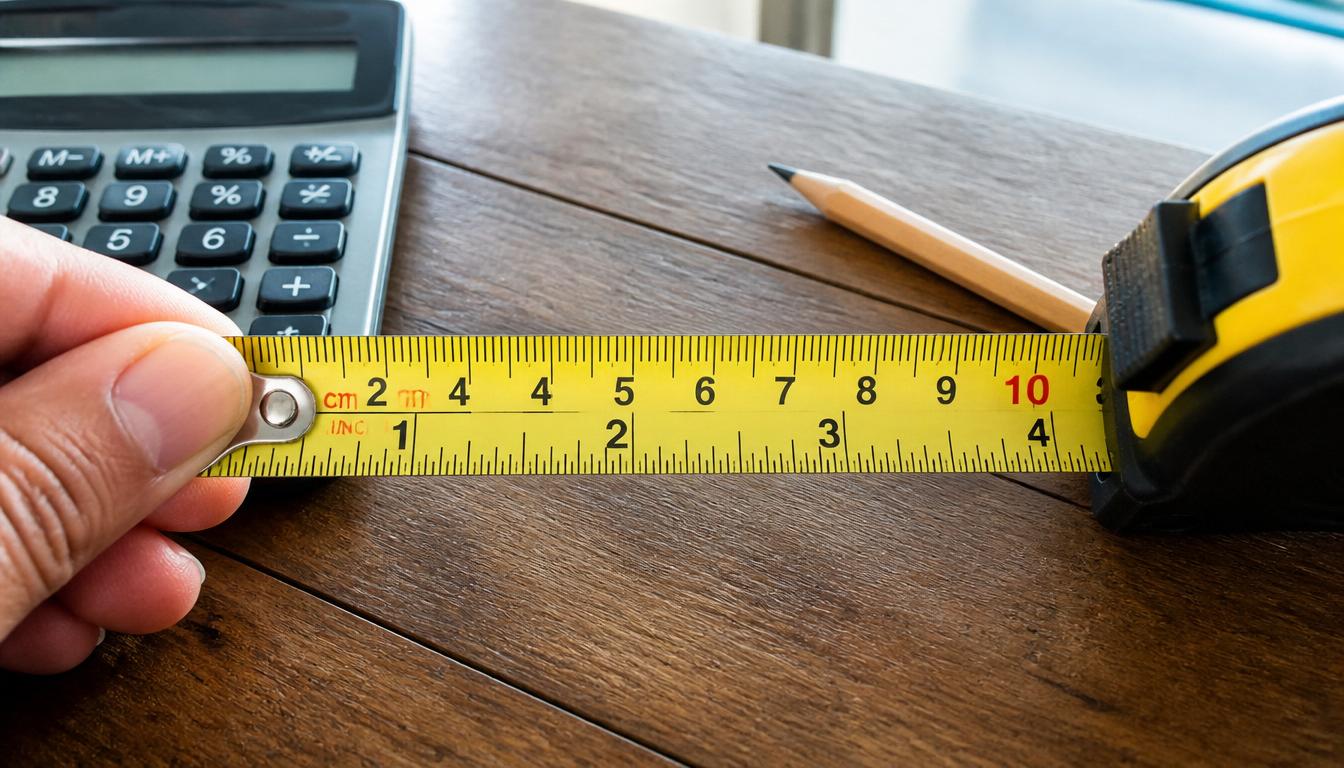
In Excel, convert meters to feet by entering =A1/0.3048 in a cell, where A1 holds your meter value. You can also use the built-in function =CONVERT(A1,"m","ft"). Both formulas return the same decimal feet result. Drag either one down a column to convert an entire list at once.
If you need feet and inches displayed separately, add two more columns. =INT(B1) pulls the whole feet, and =(B1-INT(B1))*12 calculates the leftover inches, where B1 is your decimal-feet column. This setup converts dozens of measurements from a metric spec sheet in seconds. You never have to retype the formula by hand.
How to Convert Meter to Feet in AutoCAD
In AutoCAD, the cleanest way to convert a metric drawing to feet is the -DWGUNITS command. It walks you through resetting the drawing unit and offers to scale existing geometry automatically. If you’re inserting a metric block into a feet-based drawing, check the INSUNITS system variable on both files first. A mismatch there is what causes blocks to come in at the wrong size.
For a manual fix, select your geometry, run the SCALE command, and pick a base point. Then enter 3.280839895 as the scale factor when you’re going from meters to feet. Going the other direction, feet to meters, the scale factor is 0.3048. Save a backup before scaling an entire drawing, since this changes the actual size of every object you select.

Real-World Examples: Meters to Feet in Action
The formula is simple, but the stakes around it usually aren’t. Here’s how it plays out for two different people.
Daniel, a contractor in Phoenix, Arizona, received a metric spec sheet calling for a 4.5-meter support beam. He multiplied 4.5 by 3.28084 and ordered a 14.76-foot beam. If he’d rounded to an even 15 feet, the beam would land almost 3 inches too long for the bay. On a structural piece, that gap means a return shipment and a delayed install date.
Priya, a high school student in Ohio, converted her 1.62-meter height for a science fair report on body proportions. She got 5.3148 decimal feet, then broke that into 5 feet and 3.78 inches. Her teacher wanted the answer in a format most American readers would recognize on sight. Doing the math herself, instead of trusting a half-remembered “about 5 foot 3,” paid off. It let her show her work for partial credit.
Common Meter to Feet Conversion Mistakes
Most conversion errors come from rounding too early or mixing up which unit you’re starting from. Here are the ones that show up most often.
Rounding the conversion factor too soon. Cutting 3.28084 down to 3.28, or further to 3, seems harmless on a single number. Repeated across a long measurement, that shortcut adds up fast.
Confusing meters with yards. A meter is about 1.09 yards, not exactly 1 yard. Assuming the two are interchangeable throws off any conversion that passes through yards first.
Reading the decimal remainder as inches directly. A result of 5.75 feet does not mean 5 feet 75 inches, or even 5 feet 7.5 inches. You have to multiply the 0.75 by 12 to get 9 inches.
Selecting the wrong unit in a calculator’s dropdown. Picking “yard” or “centimeter” instead of “meter” by mistake produces a confident-looking number that’s simply wrong from the first step. It’s worth a habit of glancing at both the input and output units before you trust the result.
Forgetting which foot definition a legacy document used. Old survey records sometimes relied on the now-deprecated U.S. survey foot rather than the international foot. The gap between the two is tiny, about two parts per million. It occasionally matters in geodetic or legal land-boundary work.
⚠ Watch Out For This
Rounding 3.28084 down to 3.28, or worse, down to 3, looks harmless on one measurement. Repeat that shortcut across a 30-meter wall and you’ve lost almost a full foot off the final number.
Where Accurate Meter to Feet Conversion Actually Matters
Getting this conversion right isn’t just a math exercise. It changes real outcomes across several fields.
- Construction and architecture: A wrong conversion on one beam or wall length can throw off load calculations or door clearances by inches. That’s often enough to fail an inspection or force a costly rework.
- International trade and shipping: Container and pallet specs frequently arrive in meters from overseas suppliers, while U.S. customs paperwork and warehouse racking run in feet. A consistent conversion process keeps your numbers matching what the receiving team expects.
- Travel and everyday planning: Hotel listings, hiking signage, and pool depths in most countries are posted in meters. Converting on the spot helps you picture distances and packing space in feet instead of guessing.
- Academic and lab work: Science and engineering coursework constantly mixes SI and customary units. NIST’s own documentation shows just how much legal and technical weight rests on the exact 0.3048 figure, which is why a careless rounding habit can cost you marks on a lab report.
Manual Formula vs. Online Calculator
| Factor | Manual Formula | Online Calculator |
|---|---|---|
| Speed for one value | A few seconds, if you remember 3.28084 | Instant, one click |
| Rounding error risk | Higher, if you truncate the factor | Minimal, full precision is stored |
| Feet-and-inches display | Needs a second manual step | Usually shown automatically |
| Best for | Learning the math, one-off checks | Batches, Excel imports, repeated work |
💡 Pro Tip
If you’re converting more than two or three numbers, paste them into a spreadsheet column and apply the formula once. It’s faster than retyping the math by hand for each measurement, and it leaves a record you can double-check later.
Frequently Asked Questions About Meter to Feet Conversion
How do you convert meters to feet?
Divide the meter value by 0.3048, or multiply it by 3.28084; both give the same result. For example, 5 meters divided by 0.3048 equals 16.4042 feet. This works because the foot is officially defined as exactly 0.3048 meter.
What size is 1 meter in feet?
One meter equals 3.28084 feet, which works out to 3 feet and roughly 3.37 inches. People often round this to “about 3.3 feet” for a quick estimate. The full figure matters when you need to be exact.
What is 12 meters in feet?
Twelve meters equals 39.3701 feet, or 39 feet and about 4.44 inches. You get this by multiplying 12 by 3.28084, the standard meters-to-feet conversion factor.
What is 1.5 metres in feet?
1.5 metres converts to 4.9213 feet, which is 4 feet and roughly 11.06 inches. That’s just under 5 feet, a gap people sometimes round away by mistake.
How many feet is 10 meters?
Ten meters equals 32.8084 feet, or 32 feet and about 9.7 inches. Multiply any meter value by 3.28084 to reach the same kind of result for other distances.
What is 0.5 metre in feet?
Half a metre equals 1.6404 feet, or 1 foot and roughly 7.69 inches. This conversion comes up often for small object dimensions and packaging specs.
Is 1 meter exactly 3 feet?
No, 1 meter is 3.28084 feet, about 9% more than an even 3 feet. Treating a meter as 3 feet flat works fine for casual estimates. It introduces real error in construction, shipping, or lab measurements.
What is 1 meter 5 centimeters in feet?
1 meter 5 centimeters equals 1.05 meters, which converts to 3.4449 feet, or 3 feet and about 5.34 inches. Add the centimeters to the meter value first, then apply the standard 0.3048 conversion factor.
Content Researcher · AceCalculator
Amanda Reeds researches and writes the calculator guides on AceCalculator, with a focus on measurement, finance, and health math that people actually use day to day. She has spent the past several years translating NIST and other federal measurement standards into plain-language guides for builders, students, and small business owners. Her work prioritizes verified formulas over rounded shortcuts.
The Bottom Line on Converting Meters to Feet
The whole conversion comes down to one number: 0.3048 meters per foot, set by NIST and used worldwide. Divide your meters by that figure, or multiply by 3.28084. Either way, you’ll land on the right answer in Excel, in AutoCAD, or just picturing how tall something is.
What this formula won’t do is account for measurement error on your end. Maybe your starting meter value was off, from a loose tape measure or a typo. The conversion will carry that mistake straight through, faithfully. Measure twice, convert once.
If your project involves square meters and square feet instead of straight-line length, the math is different. Our guide to converting square meters to square feet walks through that area-based version separately.
Calculate My Room’s Square Footage →Working in height measurements? Our BMI calculator accepts both metric and imperial inputs directly, so you can skip the manual conversion. And if you’re converting dimensions for a renovation, the length-width-height calculator handles room measurements once your numbers are already in feet. For other unit pairs, like cm to inches or kg to lbs, the full math calculators collection has you covered, and the related square-footage guide at how to calculate square feet is useful once your linear measurements are converted and you’re ready to find an area.