
By Amanda Reeds, Content Researcher ·
Quick Summary
- Key Takeaway: Body frame size is calculated by comparing your wrist circumference (or elbow breadth) to your height, sorting you into a small, medium, or large skeletal category.
- Who This Is For: Anyone trying to set a realistic weight goal, interpret a BMI result, or understand why they carry weight differently than someone else their height.
- Why It Matters: Two people can share the same height and weight and still have completely different builds because their bone structure differs.
- Reading Time: ~9 minutes
Why Getting Your Body Frame Size Right Matters
You’ve probably stood on a scale, checked a BMI chart, and felt like the number didn’t quite match what you see in the mirror. That mismatch is often frame size doing its quiet work in the background.
Body frame size is calculated by measuring your wrist circumference or elbow breadth. That number is then compared to your height on a standard reference chart, which sorts you into a small, medium, or large skeletal category. This classification reflects bone width, not fat or muscle, and it stays fairly constant throughout adulthood. Doctors, dietitians, and fitness professionals use it to adjust ideal weight ranges. Someone with a broader skeleton naturally carries more weight at the same body fat percentage.
Here’s the part most people get wrong: they assume frame size is about how “big” someone looks. It isn’t. It’s a specific, measurable ratio between bone width and height. That ratio doesn’t change no matter how much weight you gain or lose.
Check My BMI With Frame Size in Mind →Table of Contents
- What Body Frame Size Actually Means
- How to Calculate Body Frame Size, Step by Step
- How to Measure Body Frame Size With Your Wrist
- How to Measure Body Frame Size With Your Fingers
- Body Frame Size Formula: The Elbow Breadth Method
- Body Frame Size Table by Height and Gender
- Real Examples: Calculating Frame Size Step by Step
- Common Mistakes When Calculating Frame Size
- Why Your Frame Size Actually Matters
- Wrist Method vs. Elbow Method
- Frequently Asked Questions
- The Bottom Line
What Body Frame Size Actually Means
Body frame size is a classification of your skeletal width. It’s measured at a bony point with little fat or muscle covering it, most commonly the wrist or the elbow. According to MedlinePlus, a service of the U.S. National Library of Medicine, frame size is determined by comparing wrist circumference against height, sorting adults into small, medium, or large categories.
This matters because standard height-weight tables were never built for a single “ideal” number. Insurance companies used this three-column format for decades. They were built around three separate columns: small frame, medium frame, and large frame. Skipping that step and reading straight across the medium column is where most confusion starts.
The wrist and elbow are used specifically because they carry minimal soft tissue. A wrist with more fat on it will still measure close to the underlying bone width. Compare that to the upper arm or thigh, where fat can shift the number by inches. That’s what makes frame size a true skeletal measurement rather than a body composition one.
How to Calculate Body Frame Size, Step by Step
The fastest way to calculate body frame size is simple. Measure your wrist circumference, measure your height, then compare both against a reference chart split by gender and height band. No calculator or app is strictly required, just a flexible tape measure and two minutes.
- Measure your height in inches or centimeters, without shoes, standing against a flat wall.
- Wrap a soft measuring tape around your wrist, just below the wrist bone, at the narrowest point. Keep it snug but not compressed against the skin.
- Record the wrist circumference in inches or centimeters.
- Find your height band on a frame size chart (see the table further down this page).
- Compare your wrist measurement against the small, medium, and large cutoffs listed for your height and gender.
Here’s a real example of that math in action. A woman standing 5’6″ (168 cm) with a wrist circumference of 5.75 inches (14.6 cm) falls into the small frame category. For women over 5’5″, small frame is defined as anything under 6.25 inches. Change nothing but her wrist size to 6.4 inches, and she’d shift into medium.
Quick Action Steps
- Grab a flexible tape measure, not a rigid ruler.
- Measure your wrist just below the bony bump, not further up the forearm.
- Round to the nearest quarter inch or half centimeter.
- Match your height and gender to the frame size table below.
- Use the result to adjust your ideal weight range, not to judge your current weight.
How to Measure Body Frame Size With Your Wrist
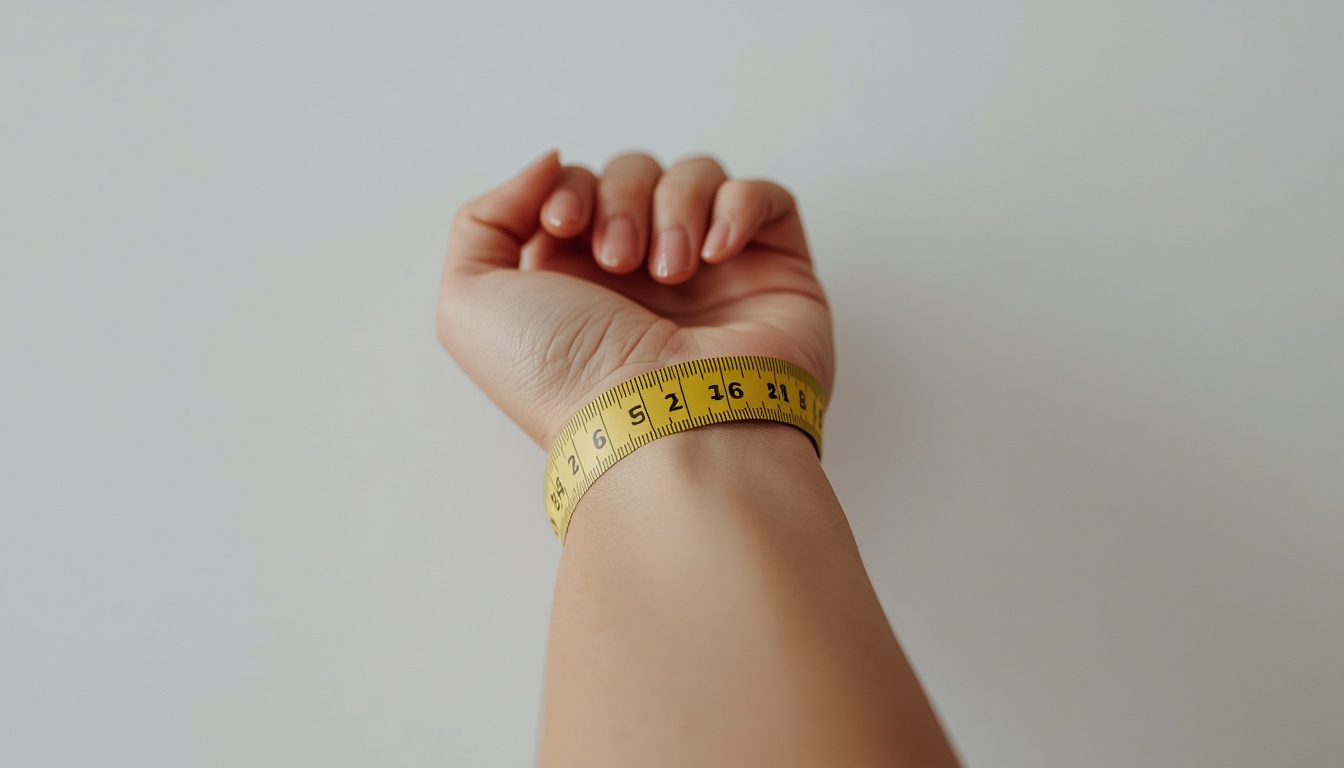
To measure body frame size with your wrist, wrap a flexible tape measure around the narrowest point of your wrist, just past the wrist bone. Record the circumference in inches or centimeters. This single number, compared against your height, is the most widely used frame size method. The wrist is easy to reach and measure without help.

A few details change the accuracy of this measurement more than people expect. Measuring over a shirt cuff, at the wrong spot on the forearm, or with the tape pulled too tight can shift your result by half an inch. That’s often enough to bump you into a different frame category entirely.
For the most consistent reading, measure your dominant wrist twice and average the two numbers. Wrist size can vary slightly between your left and right arm. This is especially true if you do repetitive gripping work or strength training that favors one side.
How to Measure Body Frame Size With Your Fingers
To measure body frame size with your fingers, wrap your thumb and middle finger around your opposite wrist at its narrowest point. See whether they overlap, touch, or leave a gap. This finger-and-thumb test is a rough, tape-free way to estimate frame size when you don’t have a measuring tape handy.
Reading the Finger Test Result
If your thumb and middle finger overlap around your wrist, that generally points to a small frame. If they just touch without overlapping, that suggests a medium frame. If a visible gap remains between your fingers, that typically indicates a large frame.
This one tripped me up too the first time I tried it. Finger length varies from person to person almost as much as wrist size does. Someone with unusually long fingers might overlap even with an average-sized wrist. Treat the finger test as a quick sanity check, not a replacement for an actual tape measurement.
Body Frame Size Formula: The Elbow Breadth Method
The body frame size formula for the elbow method divides elbow breadth by height and multiplies by 100. That produces a frame index, compared against age- and sex-specific reference tables. This method was developed from a large-scale NHANES dataset. It’s considered more precise than the wrist method because it isolates a single bone joint rather than a mix of bone, tendon, and skin.
According to research by A.R. Frisancho, published in the American Journal of Clinical Nutrition in 1984, elbow breadth reference standards were built from measurements of over 21,000 adults. Those subjects were sampled through the NHANES I and NHANES II national health surveys. That scale is a big reason the elbow method remains the academic gold standard for frame classification decades later.
How to Measure Elbow Breadth
- Extend your arm forward and bend it at a 90-degree angle, with the back of your hand facing you.
- Locate the two bony prominences on either side of your elbow joint.
- Using calipers, or your thumb and index finger as a rough substitute, measure the distance between those two points.
- Compare the result to reference values for your age and sex.
For adults aged 18 to 24, a medium frame typically falls around 6.6 to 7.7 cm for men and 5.6 to 6.5 cm for women. Measurements below that range indicate a small frame, and measurements above it indicate a large one. Because calipers aren’t something most people own, the wrist method remains the more practical option for a quick, at-home check.
Body Frame Size Table by Height and Gender
The body frame size table below sorts wrist circumference into small, medium, and large categories based on height and gender. It follows the reference ranges published by MedlinePlus. Find your height band, then compare your measured wrist size against the three columns.
| Height (Women) | Small Frame | Medium Frame | Large Frame |
|---|---|---|---|
| Under 5’2″ (under 157 cm) | Under 5.5 in (14 cm) | 5.5–5.75 in (14–14.6 cm) | Over 5.75 in (14.6 cm) |
| 5’2″–5’5″ (157–165 cm) | Under 6 in (15.2 cm) | 6–6.25 in (15.2–15.9 cm) | Over 6.25 in (15.9 cm) |
| Over 5’5″ (over 165 cm) | Under 6.25 in (15.9 cm) | 6.25–6.5 in (15.9–16.5 cm) | Over 6.5 in (16.5 cm) |
| Height (Men) | Small Frame | Medium Frame | Large Frame |
|---|---|---|---|
| Over 5’5″ (over 165 cm) | 5.5–6.5 in (14–16.5 cm) | 6.5–7.5 in (16.5–19 cm) | Over 7.5 in (19 cm) |
Men’s height bands under 5’5″ aren’t broken out separately in the standard reference. That height range is uncommon enough among adult men that most clinical charts group it with the closest available band. If you fall into that range, use the elbow breadth method instead for a more precise result.
Real Examples: Calculating Frame Size Step by Step
Sarah, a 34-year-old teacher who stands 5’6″ (168 cm), measured her wrist at 5.75 inches (14.6 cm) using a soft tape measure before breakfast. Checking the women’s table for her height band, over 5’5″, her wrist falls under the 6.25-inch small frame cutoff. That places her in the small frame category. That single data point explained why she’d always sat near the lower end of her healthy BMI range, even after months of strength training.

David, a 41-year-old warehouse supervisor at 6’1″ (185 cm), measured his wrist at 7.25 inches (18.4 cm). Against the men’s table for his height band, that falls squarely in the 6.5 to 7.5-inch medium frame range. David had assumed he was large-framed because of his height alone. The measurement told a different story, and it shifted how he read his own BMI results going forward.
Both examples use the same three-step process: measure height, measure wrist, compare against the correct table row. The only variable that changes the outcome is the actual number on the tape.
Common Mistakes When Calculating Frame Size
Most frame size errors come down to measurement technique rather than misunderstanding the concept itself.
⚠ Watch Out For This
Measuring your wrist over a jacket sleeve, watch, or bracelet is the single most common mistake. Even a thin layer of fabric can add a quarter inch, enough to shift you into the wrong frame category entirely.
Measuring too high on the forearm. People often measure an inch or two above the wrist bone, where the forearm naturally widens. This inflates the number and pushes results toward “large” even for people with naturally narrow bones.
Pulling the tape too tight. A snug measurement is correct, but a tightly cinched tape compresses soft tissue. That can shave off a quarter inch or more, skewing results toward “small.”
Confusing bicycle frame sizing with body frame size. Bike frame size is measured in centimeters, based on seat tube length. It’s a completely separate calculation, used for choosing a bicycle that fits your leg length and reach. It has nothing to do with your skeletal build, even though the terminology overlaps.
Treating frame size as fixed for life without remeasuring after major growth. Adult bone width is stable, but teenagers and young adults still growing should remeasure periodically rather than relying on a single childhood reading.
Assuming a large frame means overweight. Frame size and body fat are entirely separate measurements. A large-framed person at a healthy body fat percentage will naturally weigh more than a small-framed person at the same percentage. That’s expected, not a warning sign.
Why Your Frame Size Actually Matters
Frame size matters because it directly adjusts what counts as a healthy weight for your specific body, not just your height.
- Classic ideal body weight formulas adjust their baseline target by roughly plus or minus 10 percent depending on whether you fall into the small, medium, or large frame category, which can shift a target range by 10 to 20 pounds for a taller adult.
- It explains why two people at identical height and weight can look noticeably different, since bone mass alone accounts for a meaningful share of total body weight.
- It gives useful context to a BMI number, since BMI calculations don’t distinguish between bone, muscle, and fat on their own.
- It helps set realistic strength training and weight loss goals, since a large-framed person chasing a small-framed person’s target weight is working against their own skeleton.
💡 Pro Tip
Pair your frame size result with a body fat percentage check rather than relying on weight alone. Frame size tells you about bone width; body fat percentage tells you about composition. Together, they give a far more complete picture than either number on its own.
Wrist Method vs. Elbow Method
Both methods calculate the same underlying trait, skeletal width relative to height, but they differ in accuracy, convenience, and what equipment they require.
| Factor | Wrist Method | Elbow Method |
|---|---|---|
| Equipment needed | Flexible tape measure | Calipers, or an assistant |
| Can you measure it alone? | Yes, easily | Difficult without help |
| Scientific precision | Good for general use | Considered more precise (NHANES-based) |
| Affected by grip training | Slightly, over years of heavy grip work | Rarely |
| Best for | Quick at-home checks | Clinical or research-grade accuracy |
For most people checking their own frame size at home, the wrist method is the practical starting point. Reach for the elbow method only if your wrist result feels inconsistent with your build. It’s also useful if you simply want a second data point.
Frequently Asked Questions About Body Frame Size
How do you determine body frame size without a tape measure?
Use the finger-and-thumb test: wrap your thumb and middle finger around your opposite wrist. Overlapping fingers suggest a small frame, fingers that just touch suggest medium, and a visible gap suggests a large frame. It’s a rough estimate, so confirm with an actual tape measurement when possible.
How to measure body frame size for the most accurate result?
Measure your wrist circumference with a flexible tape at the narrowest point below the wrist bone, without a sleeve, watch, or bracelet in the way. Compare that number to a height-and-gender reference table. For extra confirmation, cross-check with the elbow breadth method if you have access to calipers.
What is the body frame size formula?
The elbow-based frame size formula divides elbow breadth by height and multiplies by 100 to produce a frame index. That index is then compared to age- and sex-specific reference values. The simpler wrist-based approach skips the formula entirely and compares wrist circumference directly to a height chart.
How to calculate body frame size using only height?
Height alone cannot determine frame size. You need a second skeletal measurement, either wrist circumference or elbow breadth, compared against your height on a reference chart. Height sets which row of the chart applies to you, but it isn’t the classifying measurement on its own.
How to find your body frame size if your wrist measurement falls right on a cutoff line?
If your measurement lands exactly on a boundary between two categories, treat your frame size as borderline. Lean toward the more conservative middle category for weight planning purposes. Remeasuring on a different day, and averaging two or three readings, usually resolves the ambiguity.
Does frame size change as you age or lose weight?
No. Frame size reflects bone structure, not muscle or fat, so it stays essentially constant throughout adulthood regardless of weight changes. That stability is exactly what makes it a useful, unchanging reference point for weight planning, unlike weight itself, which fluctuates.
Is bike frame size the same as body frame size?
No. Bike frame size measures a bicycle’s seat tube length in centimeters, matching a rider’s leg length and reach. Body frame size measures human skeletal width at the wrist or elbow instead. The two share terminology but serve entirely different purposes, so calculators and charts for one won’t apply to the other.
How to determine your body frame size if you’re not sure which height band to use?
Round to your actual measured height, without shoes. Use the closest height band on the table rather than rounding up or down for convenience. Reference charts are built around specific height ranges for a reason. Using the wrong band is one of the more common sources of misclassification.
Can frame size predict my ideal weight on its own?
Not entirely. Frame size adjusts a baseline weight target by roughly plus or minus 10 percent. It works best alongside other measures, like BMI, waist-to-height ratio, and body fat percentage, rather than as a standalone predictor.
Content Researcher · AceCalculator
Amanda Reeds holds a B.Sc. in Health Sciences and has spent six years researching and writing about nutrition, body composition, and preventive health. She specialises in translating clinical anthropometric data, including frame size and body weight standards, into practical guidance for everyday readers.
The Bottom Line on Calculating Body Frame Size
Calculating body frame size comes down to one comparison. A bone measurement, either wrist circumference or elbow breadth, gets checked against your height on a reference chart. The wrist method works well for a fast at-home check. The elbow method offers more precision if you want a second opinion on your result.

What frame size won’t do is tell you anything about your body fat, muscle mass, or overall fitness. It answers one narrow question, how wide is your skeleton relative to your height, and it answers that question well. Use it to add context to your weight goals, not as a judgment on your current body.
See My Full Body Composition Picture →Related reading: ideal weight for height charts, BMR calculator, healthy BMI ranges, and the full fitness and health calculator library.