
By Amanda Reeds, B.Sc. Health Sciences, Content Researcher at AceCalculator • Published
✓ Medically reviewed by Dr. Sarah Lim, MD — General Practitioner with 12 years of clinical experience in preventive health and metabolic conditions.
📋 Quick Summary
- Key takeaway: Ideal weight for height isn’t one fixed number — it’s a healthy range that depends on your age, gender, and body composition.
- Who this is for: Anyone trying to understand what they should weigh based on their height, whether male or female, teenager or adult.
- Why it matters: Staying within a healthy weight range reduces risk of heart disease, type 2 diabetes, and joint problems.
- Reading time: ~6 min
What Is the Ideal Weight for Your Height?
You’ve stepped on the scale and wondered: is this actually a healthy weight for someone my height? It’s a fair question, and the answer is more nuanced than a single number.
Featured answer: The ideal weight for height is a range, not a fixed number. For most adults, a Body Mass Index (BMI) of 18.5–24.9 indicates a healthy weight. A 5’6″ (168 cm) woman, for example, has a healthy weight range of roughly 115–154 lbs (52–70 kg). Your age, gender, muscle mass, and frame size all shift where you fall within that range.
The AceCalculator fitness and health tools are built for exactly this — they help adults and teens find their healthy weight range based on height, age, and gender in under a minute.
This guide breaks down height and weight charts for women and men, explains the role of BMI, waist-to-height ratio, and age, and shows you how to use the numbers in a way that’s actually useful.
See If My Weight Is in the Healthy Range →📋 Table of Contents
- What Is the Ideal Weight for Your Height?
- How Height and Weight Charts Work
- Height and Weight Charts for Women and Men
- How Age Changes Your Ideal Weight
- BMI vs. Waist-to-Height Ratio: Which Is Better?
- Common Mistakes When Reading Weight Charts
- Why Healthy Weight Range Matters
- Practical Tips for Reaching Your Goal Weight
- How Accurate Are These Charts?
- Frequently Asked Questions
- Conclusion
How Height and Weight Charts Work
A height and weight chart maps a range of healthy weights to each height. Most are based on BMI — a calculation that divides your weight in kilograms by the square of your height in metres. The CDC classifies BMI ranges as follows for adults:
| BMI Range | Weight Category |
|---|---|
| Below 18.5 | Underweight |
| 18.5 – 24.9 | Healthy weight |
| 25.0 – 29.9 | Overweight |
| 30.0 and above | Obese |
BMI doesn’t account for where you carry fat, your muscle mass, or your bone density. So charts are a starting point — not a verdict. A 5’10” man who is lean but muscular might show a BMI of 26 and be in excellent health. Use the chart to understand your range, then look at the full picture.
According to the National Heart, Lung, and Blood Institute (NHLBI), a BMI between 18.5 and 24.9 is associated with the lowest health risk for most adults. That’s the range most height and weight charts are built around.
Height and Weight Charts for Women and Men
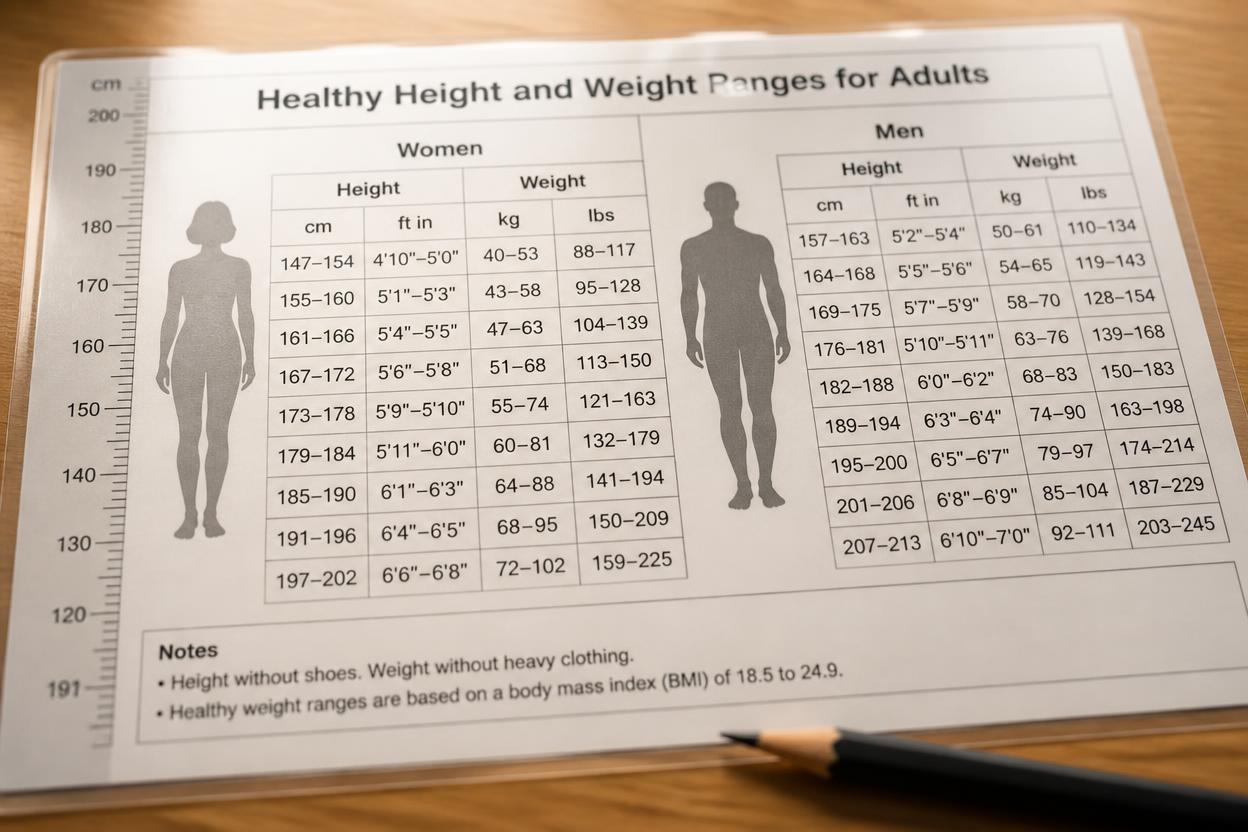
Here are the standard ideal weight ranges by height, covering both the female height weight chart and the height weight chart for males. These represent the healthy BMI range of 18.5–24.9.
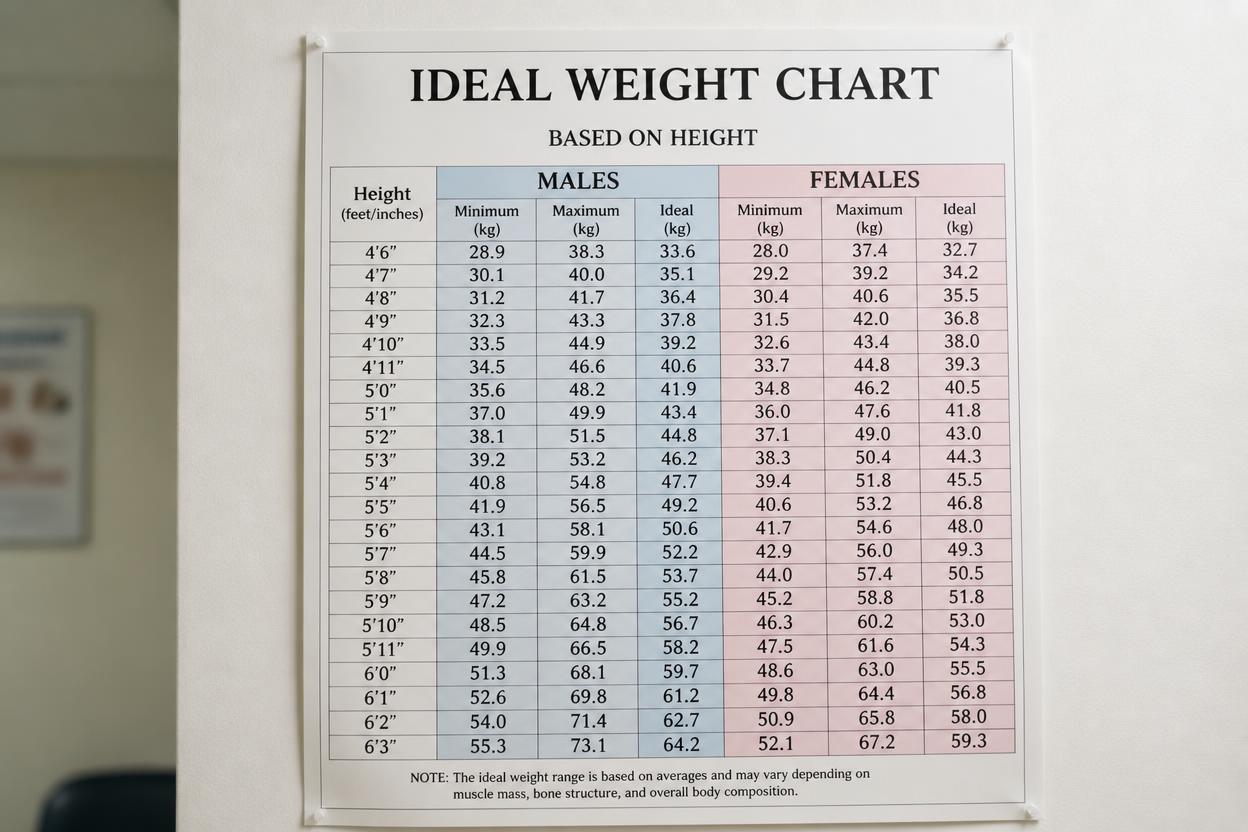
Ladies Height Weight Chart (Women)
| Height | Healthy Weight Range (lbs) | Healthy Weight Range (kg) |
|---|---|---|
| 4’10” (147 cm) | 91 – 119 lbs | 41 – 54 kg |
| 5’0″ (152 cm) | 97 – 127 lbs | 44 – 58 kg |
| 5’2″ (157 cm) | 104 – 135 lbs | 47 – 61 kg |
| 5’4″ (163 cm) | 110 – 144 lbs | 50 – 65 kg |
| 5’6″ (168 cm) | 115 – 154 lbs | 52 – 70 kg |
| 5’8″ (173 cm) | 122 – 164 lbs | 55 – 74 kg |
| 5’10” (178 cm) | 129 – 174 lbs | 59 – 79 kg |
| 6’0″ (183 cm) | 136 – 184 lbs | 62 – 83 kg |
Height Weight Chart for Men
| Height | Healthy Weight Range (lbs) | Healthy Weight Range (kg) |
|---|---|---|
| 5’4″ (163 cm) | 110 – 144 lbs | 50 – 65 kg |
| 5’6″ (168 cm) | 118 – 154 lbs | 53 – 70 kg |
| 5’8″ (173 cm) | 125 – 164 lbs | 57 – 74 kg |
| 5’10” (178 cm) | 132 – 174 lbs | 60 – 79 kg |
| 6’0″ (183 cm) | 140 – 184 lbs | 63 – 83 kg |
| 6’2″ (188 cm) | 148 – 194 lbs | 67 – 88 kg |
| 6’4″ (193 cm) | 156 – 205 lbs | 71 – 93 kg |
These ranges are derived from the standard BMI formula and apply to adults 18 and older. For teens, the correct tool is the age weight and height chart covered in the next section — pediatric ranges differ significantly.
How Age Changes Your Ideal Weight for Height
Age matters more than most people realise. A woman who is 5’4″ at age 25 has a different healthy weight range than the same height at age 60, mainly because body composition shifts with age — muscle decreases and fat distribution changes.
Below is a simplified female weight chart by age and height for a woman at 5’4″ (163 cm), showing how appropriate weight ranges shift across decades:
| Age Group | Suggested Weight Range (lbs) | Notes |
|---|---|---|
| 18–25 | 108 – 138 lbs | Peak lean mass period |
| 26–35 | 111 – 142 lbs | Slight upward shift acceptable |
| 36–50 | 116 – 148 lbs | Metabolism slows |
| 51–65 | 119 – 152 lbs | Maintain muscle mass actively |
| 65+ | 122 – 155 lbs | Higher end acceptable if muscle is preserved |
For children and teens, use age-specific BMI charts that account for growth stages. A BMI-for-age percentile, not a raw number, is the correct metric for anyone under 18.
Real-World Example: Finding Your Target Weight
Here’s how I used these charts with a specific case. Maria, a 38-year-old woman at 5’6″ (168 cm), weighed 162 lbs. She wasn’t sure if she was in a healthy range or not.
🛠 Quick Action Steps
- Find your height in the chart above. Maria is 5’6″.
- Locate the healthy weight range: 115–154 lbs for women at that height.
- Check where you fall: Maria at 162 lbs is slightly above the upper limit (BMI ≈ 26.1 — just into the overweight range).
- Calculate your goal weight by height: For Maria, a target weight of 145–150 lbs would bring her comfortably within the healthy range.
- Factor in age: At 38, a slightly higher weight is medically reasonable — her doctor confirmed she had no metabolic concerns.
The point: the chart gave Maria a target. Her doctor gave it context. Both matter.

BMI vs. Healthy Waist-to-Height Ratio: Which Is Better?
BMI is the standard, but the healthy waist-to-height ratio is gaining ground as a more accurate predictor of metabolic risk. Here’s a direct comparison:
| Method | What It Measures | Best For | Limitation |
|---|---|---|---|
| BMI | Weight relative to height | Population-level screening | Doesn’t distinguish fat from muscle |
| Waist-to-Height Ratio | Abdominal fat relative to height | Cardiovascular and metabolic risk | Less widely known; requires tape measure |
| Body Fat % | Actual fat tissue proportion | Athletes, detailed health monitoring | Requires special equipment |
The healthy waist-to-height ratio threshold is 0.5 — meaning your waist should be no more than half your height. A 5’8″ person (68 inches tall) should ideally have a waist of 34 inches or less. This is worth checking alongside your height weight BMI figure.
💡 Tip: Use both BMI and waist-to-height ratio together. If your BMI is in the healthy range but your waist-to-height ratio exceeds 0.5, that’s a signal to focus on reducing visceral (belly) fat through diet and exercise — even if your scale number looks fine.
You can also check your body fat percentage with the AceCalculator body fat tool to get a fuller picture of your composition beyond weight alone.
Common Mistakes When Reading a Weight by Height Chart
⚠ Watch Out For These Errors
- Treating the midpoint as your goal. The midpoint of the healthy range isn’t automatically the best weight for height. Athletes often sit at the upper end; petite-framed individuals at the lower end.
- Ignoring age when consulting a chart. A weight that’s ideal for a 25-year-old may be too low for a 55-year-old woman. Always cross-reference with an age weight and height chart.
- Using adult charts for teenagers. Teens need BMI-for-age percentile charts. The appropriate height and weight for age in a 15-year-old looks completely different from adult ranges.
- Confusing “average” with “healthy.” The average weight per height in many Western countries is technically in the overweight category. Average and optimal are not the same.
- Ignoring muscle mass. A 5’10” man who lifts weights regularly may be 185 lbs with very low body fat. His BMI (26.5) says overweight. His body composition says otherwise.
Why Your Ideal Body Weight for Height Actually Matters
Staying within a healthy weight range isn’t about appearance. It’s about reducing real, measurable health risks.
- Maintaining a healthy weight is associated with lower risk of type 2 diabetes, hypertension, and cardiovascular disease.
- According to the CDC, obesity increases the risk of at least 13 types of cancer.
- Joint pain and mobility issues are significantly more common at higher weights relative to height.
- Sleep quality and energy levels improve markedly when body weight is in the appropriate range for your height and age.
- Women who maintain their correct height and weight for age through their 40s and 50s show lower rates of osteoporosis-related fractures in later life.
The optimum weight for height also affects mental health. Research published by the NHLBI links weight management to improved mood, sleep, and cognitive function — particularly in adults over 40.
Practical Tips for Reaching Your Goal Weight by Height
Knowing your target is step one. Getting there is another matter. These tips are grounded in what actually works:
- Set a goal weight by height, not a timeline. Targeting a specific weight range for your height is more useful than “lose 20 pounds in a month.”
- Track calories relative to your desirable weight for height. Use a calorie calculator to find a realistic daily intake target based on your height, age, and goal weight.
- Preserve muscle while losing fat. Crash diets drop both fat and muscle. This moves the scale but doesn’t improve your height-to-weight ratio in a healthy way.
- Check your waist measurement monthly. The waist number often tells you more about fat loss than the scale, especially if you’re building muscle at the same time.
- Adjust for age. Your suitable weight for height shifts every decade. What worked at 30 may need adjusting at 50.
- Use a BMI calculator with height and weight inputs regularly — not just once. Track trends over 3–6 months, not week to week.
For ongoing tracking, the complete guide to checking BMI online walks through how to interpret your number in context.
How Accurate Are Height and Weight Charts, and What Are Their Limits?
These charts are population-level tools. They are accurate for most adults — but not all.
- Athletes and highly muscular individuals will often appear “overweight” on a standard weight chart by height despite having low body fat.
- Older adults may weigh within range but carry excess visceral fat due to age-related muscle loss (sarcopenia).
- Ethnic variation matters. Research suggests that East Asian and South Asian populations face health risks at lower BMI thresholds than charts based on Western populations suggest.
- Frame size isn’t factored in. A person with a naturally large skeletal frame will weigh more at a healthy composition than the chart’s midpoint suggests.
The bottom line: use the ideal body weight by age and height chart as a guide. Pair it with body fat percentage, waist circumference, and a conversation with your doctor for the most accurate picture.
Frequently Asked Questions
What is the ideal weight for height for a woman?
For women, the ideal weight for height falls within a BMI range of 18.5–24.9. A 5’4″ woman has a healthy weight range of about 110–144 lbs (50–65 kg). The right weight also depends on age and muscle mass — use the female height weight chart above for your specific height.
How much should I weigh for my height and age?
Divide your weight (kg) by your height squared (m²) to get your BMI. A healthy BMI is 18.5–24.9 for adults. Age shifts the ideal range slightly upward as you get older — particularly after 40 — because body composition naturally changes. Use the age weight and height chart in this article for decade-by-decade guidance.
What is a healthy waist-to-height ratio?
A healthy waist-to-height ratio is below 0.5. That means your waist should be less than half your height. This measure is considered a strong predictor of cardiovascular disease risk, sometimes more reliable than BMI alone for assessing abdominal fat.
What is the ideal weight for men by height?
Ideal weight for men follows the same BMI formula. A 5’10” man has a healthy weight range of roughly 132–174 lbs (60–79 kg). Men generally carry more muscle than women of the same height, so many healthy men sit in the upper half of their weight range. Refer to the height weight chart for males table above.
Is BMI the best way to check my ideal body weight?
BMI is a useful first check, but it has limits. It doesn’t account for muscle, bone density, or fat distribution. For a more complete assessment, use BMI alongside waist circumference, waist-to-height ratio, and — if possible — body fat percentage. No single number tells the whole story.
How do I calculate my ideal weight for height?
The simplest method: find your height in a standard height and weight chart (like the ones above) and note the healthy weight range. For a calculation, use the BMI formula: weight (kg) ÷ height² (m²). A result between 18.5 and 24.9 is the target. Or use the AceCalculator health tools to get your result instantly.
Does the proper weight for height differ by gender?
Yes. Men and women of the same height have different healthy weight ranges because of differences in muscle mass, bone density, and fat distribution. A man and a woman both 5’8″ will have overlapping but distinct ranges — men’s ranges typically sit slightly higher. Separate charts exist for each, as shown in this article.
What weight chart should I use for a teenager?
Teenagers should use BMI-for-age percentile charts, not standard adult weight charts. The appropriate weight chart for age and height in adolescents is determined by growth percentiles, not fixed ranges. The CDC provides age-specific charts for both boys and girls from age 2 to 20.
Amanda Reeds, B.Sc. Health Sciences
Content Researcher at AceCalculator
Amanda Reeds holds a B.Sc. in Health Sciences and has spent six years researching and writing about nutrition, body composition, and preventive health. She specialises in translating clinical data into practical guidance for everyday readers. Her work at AceCalculator focuses on fitness and metabolic health tools.
✓ Medically reviewed by Dr. Sarah Lim, MD, General Practitioner — 12 years of clinical experience in preventive health and metabolic conditions.
Conclusion: Your Healthy Weight Is a Range, Not a Number
A single number on the scale tells you surprisingly little. What matters is whether your weight falls within a healthy range for your height, age, and gender — and whether your waist measurement supports that picture.
The height and weight charts in this guide give you a clear starting point. The real-world examples show how to apply them. And the comparison between BMI and waist-to-height ratio gives you two tools that work better together than either does alone.
Check your range, track it over time, and — if anything seems off — talk to your doctor. That’s it. No complicated protocol required.
Check My Healthy Weight Range Now — It’s Free →
Disclaimer: This article is for informational purposes only and does not constitute professional medical advice. Always consult a qualified healthcare provider before making decisions about your weight or health.
24 thoughts on “Ideal Weight for Height: Your Complete Guide to Height & Weight Charts by Age and Gender”
I read through this piece completely and appreciated how it compares older BMI-only methods to more current approaches that factor in body composition. Really well explained
Thank you for reading it all the way through! You’re right, older methods leaned entirely on BMI, while more current approaches try to account for muscle mass, frame, and body composition too, that’s exactly the gap we wanted to bridge with this piece. Glad it came through clearly.
Hello, glad to see people actually discussing their real numbers in the comments here instead of just guessing — this ideal weight breakdown is a great reference point for that. Keep up the writing!
Thanks for the kind words! We love seeing readers compare notes and ask questions in the comments too, it makes this feel like more than just a one-way article. Appreciate you being part of it, and more content like this is on the way
I wasn’t sure where these height/weight ranges were sourced from at first, but great breakdown overall. I’d love to understand a bit more about the methodology behind the numbers
Great question! The ranges are based on established BMI standards and standard height/weight reference data, and the article was medically reviewed to make sure the methodology holds up. If you want the full technical breakdown, it’s outlined in the “how it’s calculated” section above, happy to clarify anything further here
This is such a well-organized blog, I really appreciate the straightforward height/weight tables. So many people I know are still guessing at their ideal weight range, this would honestly help them a lot.
Thank you, that’s very kind! You’re right, a lot of people are stuck guessing without a real reference point. Feel free to pass this along to anyone who could use it, and if they have questions about how their own numbers stack up, we’re happy to help here in the comments too
Hi there, after reading this breakdown of ideal weight for height, I feel confident enough to share it with my friends who’ve been asking me about this exact topic
That’s wonderful to hear, thank you! Sharing accurate info with friends is honestly one of the best things you can do, there’s so much conflicting advice out there about ideal weight. Glad this gave you something solid and easy to pass along. Feel free to send any questions their way too if they come up.
This is really well put together — the ideal weight breakdown by height finally gave me a clear benchmark instead of the usual vague ranges. I’ve subscribed for more like this, and already shared it with a couple of friends who were asking about the same thing
Thank you so much, that really means a lot! Glad the breakdown gave you a clear benchmark to work from, that’s exactly what we’re aiming for. And thank you for sharing it, word of mouth from readers like you is honestly the best kind. Welcome aboard, more health and calculator content is on the way.
Do you have any video that goes through this? I’d like to see some additional information on how it’s calculated
Great question — we don’t have a video version of this one yet, but it’s something we’re considering for the future. In the meantime, the article covers the full calculation method step by step, and our calculator tool above lets you plug in your own numbers to see it applied instantly. Let us know if anything’s unclear and we’re happy to explain further here.
This is excellent — I’ve read a lot of vague ‘ideal weight’ articles, but this one actually explains the reasoning with real numbers. Definitely bookmarking this, and I’ll be sharing it with a few friends who keep asking me about it.
Really glad it stood out! We tried hard to move past the vague ranges you see everywhere else and actually explain the “why” behind the numbers. Thank you for sharing it, that honestly helps more people find accurate info instead of guesswork. Let us know if any questions come up.
This gave me a solid framework I can actually apply — I’ve been eyeballing my weight goals with no real reference point, but seeing it broken down by height and frame size finally gives me something concrete to work from
That’s exactly the goal — having a concrete reference point makes it so much easier to set realistic targets instead of guessing. If you want to get even more specific, factoring in your activity level and body composition can refine things further. Good luck with your goals!
I’m impressed with how clearly this breaks down ideal weight by height — no fluff, just the numbers and context I needed. Also really like the clean layout, easy to read on mobile. Is this a custom design or a theme you customized?
Thank you! The site runs on a customized theme, tweaked quite a bit to keep things fast and easy to read, especially on mobile since that’s how most people check their results. Really appreciate you noticing — and glad the breakdown was actually useful, that’s always the goal over just throwing numbers at people.
My brother sent me this link after I’d spent hours searching for a proper ideal weight breakdown by height. This finally gave me a clear answer instead of the vague ranges I kept finding elsewhere. Thank you!
That means a lot, thank you (and thanks to your brother for the referral!). We built the calculator specifically because so many height/weight charts online are outdated or too generic — glad it gave you a clearer picture. Let us know if you have any questions about your results.
This really clarified things for me — I never realized BMI alone doesn’t tell the full story for people with more muscle mass. Explained in a way that’s easy to actually understand, thanks!
Thank you so much for reading — really glad it was helpful! You’re right, BMI is just one piece of the puzzle. Factors like muscle mass, frame size, and body composition all matter too, which is why we always recommend using it as a starting point rather than the final word. If you ever want to dig deeper into your own numbers, our calculator above can help.