

By Amanda Reeds, Content Researcher ·
Quick Summary
- Key Takeaway: UK-specific healthy body fat ranges run roughly 10–20% for men and 18–28% for women, and you can estimate yours at home in under two minutes.
- Who This Is For: Anyone in the UK who wants a body composition figure that’s more useful than the bathroom scales.
- Why It Matters: Two people with the same weight and height can carry very different amounts of fat, and that difference changes your real health risk.
- Reading Time: ~9 minutes
Why Body Fat Percentage Is Worth Getting Right
You step on the scales, same number as three weeks ago, and it tells you nothing about what’s actually going on, whether you’ve lost fat, gained muscle, or just drank more water that morning. Weight can’t separate those things out. Body fat percentage can. And if you’ve searched “what is my body fat percentage UK,” you’re asking something more useful than most calculators actually answer.
Plainly: body fat percentage is the portion of your total weight that’s fat, rather than muscle, bone, organs, or water. You can work out a rough figure at home with a tape measure, using the US Navy circumference method, the same one most UK calculators run on, ours too. Roughly speaking, a healthy range in the UK sits around 10–20% for men and 18–28% for women, and where you land in that range moves as you age.
Check My Body Fat Percentage in Under 2 Minutes →Body fat percentage matters because BMI can’t tell the difference between a kilogram of muscle and a kilogram of fat. Most GP surgeries still lean on BMI as the first check. A rugby prop and a sedentary office worker can share an identical BMI and have almost nothing in common underneath. This one trips a lot of people up: a “normal” BMI doesn’t guarantee a healthy body composition. An “overweight” BMI doesn’t automatically mean too much fat either.
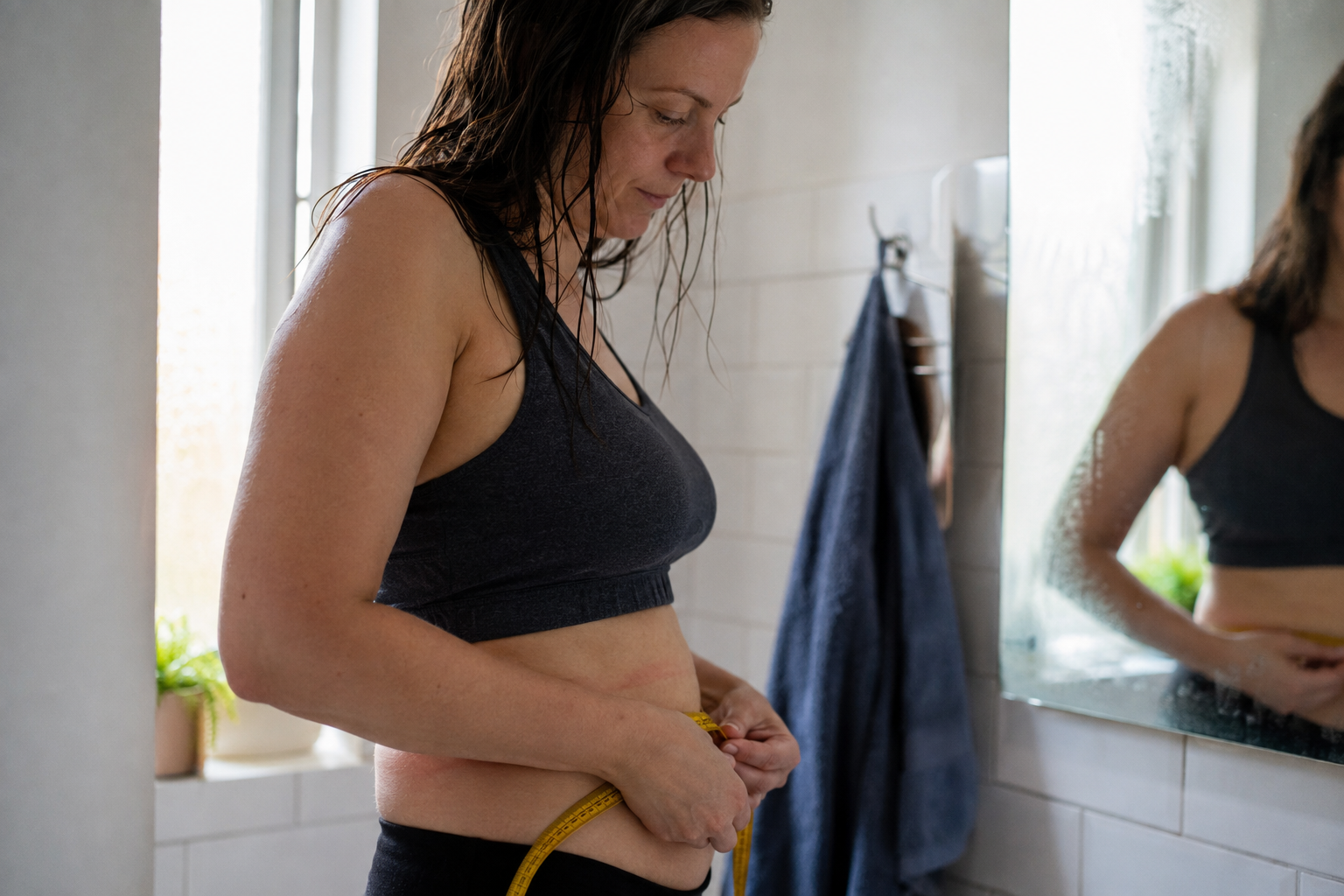
Table of Contents
- What Body Fat Percentage Actually Measures
- How to Measure Your Body Fat Percentage at Home
- What Is the Average Body Fat Percentage in the UK?
- What Should My Body Fat Percentage Be?
- How Do You Calculate Your Body Fat Percentage?
- Where Can I Find Out My Body Fat Percentage?
- Real Examples: Two UK Readers, Two Different Results
- Common Mistakes That Skew Your Result
- Why Knowing Your Body Fat Percentage Helps
- Body Fat % vs BMI vs Waist-to-Height Ratio
- Frequently Asked Questions
What Body Fat Percentage Actually Measures
Body fat percentage answers a question BMI can’t: how much of you is fat, and how much is everything else? The figure is expressed as a percentage of total body weight. A man weighing 85kg with 20% body fat is carrying roughly 17kg of fat and 68kg of lean mass, muscle, bone, organs, and water combined.
This matters because fat isn’t distributed evenly, and where it sits changes the risk. According to the British Heart Foundation, fat stored around the abdomen carries a higher risk of heart and circulatory disease and type 2 diabetes than fat carried elsewhere on the body, which is exactly why waist-based methods like the Navy formula give you more useful information than weight alone.
There’s genuine nuance here that’s worth sitting with rather than glossing over. Essential fat, the fat your body needs for hormone production, temperature regulation, and organ protection, means nobody should be aiming for the lowest number possible. Women in particular carry more essential fat than men for reproductive reasons, which is why the healthy ranges for the two sexes don’t overlap much. A woman at 15% body fat isn’t “doing better” than a woman at 22%; she may simply be under-fuelled.
How to Measure Your Body Fat Percentage at Home
You don’t need a DEXA scan or a gym membership to get a workable estimate. The US Navy circumference method uses your waist, neck, height, and (for women) hip measurement, plugged into a validated formula. It carries a margin of error of roughly 3–4% against clinical scanning, which is close enough to track real progress over weeks and months.
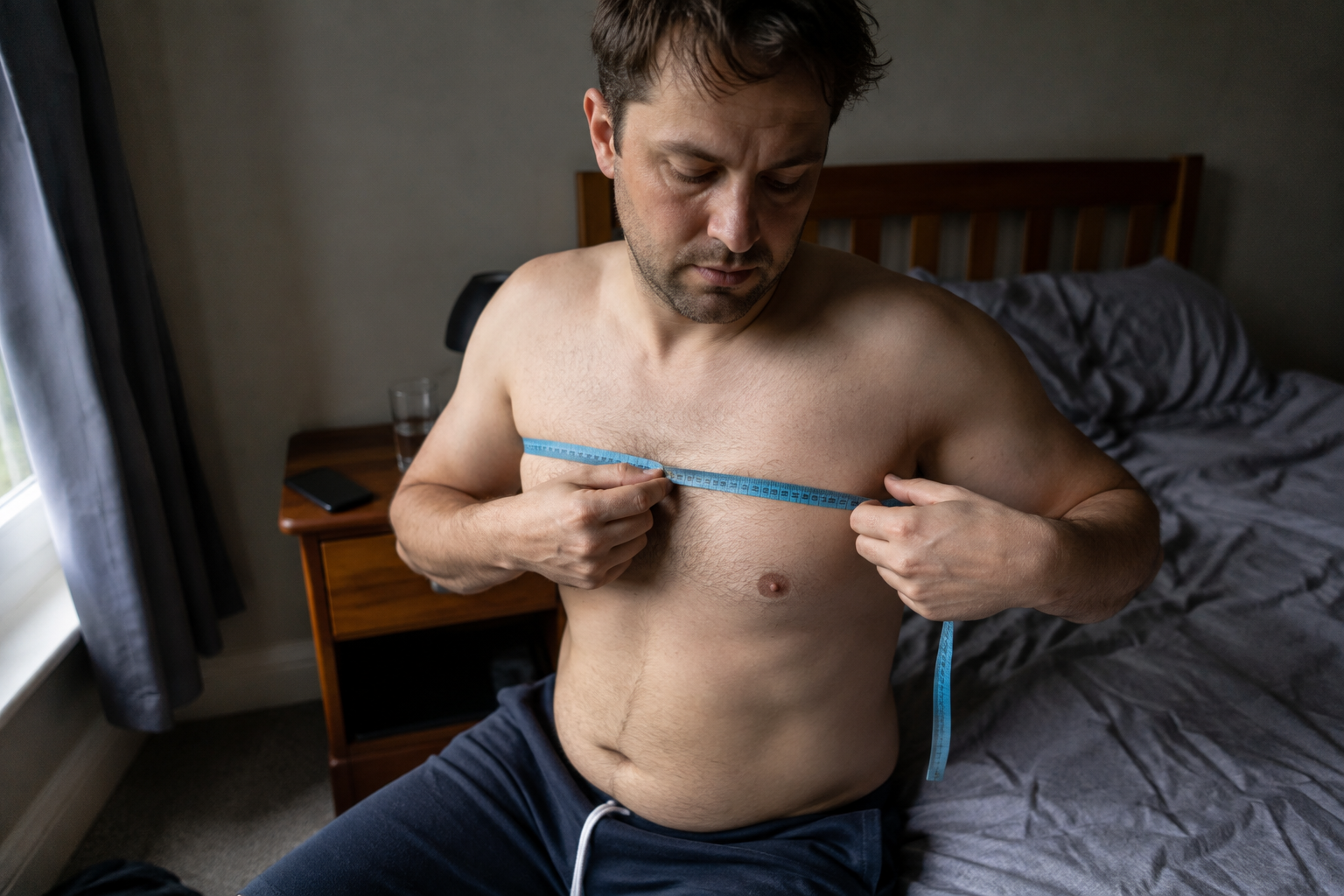
- Measure your neck circumference just below the larynx, keeping the tape level and snug but not tight.
- Measure your waist at the narrowest point, usually just above the belly button, after breathing out naturally.
- If you’re a woman, also measure your hips at the widest point.
- Measure your height without shoes, standing straight against a wall.
- Enter the figures into a Navy-method calculator to get your estimated percentage.
Here’s a worked example so the numbers mean something. A man measuring a 92cm waist, 39cm neck, and 179cm height comes out at roughly 20.7% body fat using the Navy formula, comfortably inside the healthy-to-average UK range for adult men. Change any one measurement by a couple of centimetres and the estimate shifts, which is exactly why consistency in how and when you measure matters more than chasing precision to a decimal point.
Quick Action Steps
- Measure first thing in the morning, before food or water.
- Use a soft fabric tape, not a metal one, and keep it level.
- Record the raw measurements, not just the percentage, so you can spot input errors later.
- Retest no more than once every two to four weeks.
What Is the Average Body Fat Percentage in the UK?
There’s no single official NHS threshold for average body fat percentage, but data pooled from UK DEXA scanning and public health research gives a reasonably clear picture. Adult UK men typically sit somewhere in the low-to-mid 20s percent, and adult UK women typically sit in the low-to-mid 30s percent, with both figures climbing gradually with age as muscle mass naturally declines.
Average Male Body Fat Percentage UK
For adult men in the UK, body fat percentage in the low 20s is common, with a healthy range generally cited as 10–20% and an “average, non-athletic” range extending into the low-to-mid 20s. Men over 60 tend to sit a few points higher even at a stable weight, largely because ageing reduces lean muscle mass while fat mass holds steady or increases.
Average Female Body Fat Percentage UK
For adult women in the UK, average body fat percentage is meaningfully higher than for men at the same fitness level, typically landing in the low-to-mid 30s percent for the general population, with a healthy range often cited as 18–28%. This gap exists because oestrogen promotes fat storage that supports reproductive function, not because women are somehow less fit. If you want the fuller picture for women specifically, including how the range shifts across life stages, our female body fat percentage guide goes deeper than this section can.
What Should My Body Fat Percentage Be?
Your target depends on your age, sex, and goals, not a single ideal number pulled from a magazine. For most adult men in the UK, a body fat percentage of 10–20% sits in the healthy range, with the lower end suiting younger, more athletic men and the upper end still perfectly reasonable for a fit man in his 50s or 60s. For most adult women, 18–28% covers the same healthy spread.
Going meaningfully below these ranges isn’t automatically better. Very low body fat in women can disrupt menstrual cycles and fertility, and in men it can affect hormone production and energy levels. The honest answer is that “healthy” is a range, not a single target, and where you sit within it should reflect how you actually feel and perform, not just the number on a chart.
Age shifts the picture too, and it’s worth being upfront about that rather than pretending everyone should chase the same number at 25 and at 65. A man in his 60s carrying 22% body fat isn’t automatically less healthy than a man in his 20s at 15%; some of that difference is simply the natural, expected loss of muscle mass that comes with ageing, sometimes called sarcopenia. What matters more at that stage is whether the trend is stable or climbing sharply, not the raw figure on its own.
How Do You Calculate Your Body Fat Percentage?
The fastest, most accessible way to calculate your body fat percentage UK-wide is the Navy circumference method, using waist, neck, height, and (for women) hip measurements run through a validated formula. Plug your numbers into our Body Fat Calculator, linked at the top of this guide, and you’ll get an instant estimate without any manual maths.
If you’d rather understand the formula itself, or want to compare it against skinfold callipers and bioelectrical impedance scales, our separate guide on how to calculate body fat percentage, linked in the conclusion below, breaks down each method’s accuracy and when to use it. For a UK-specific search, the calculation itself doesn’t change; what changes is which healthy range you compare your result against, and that’s the part most generic calculators get lazy about. Worth noting too: the formula only needs a handful of inputs, so the maths itself was never the hard part. Consistent, honest measurement is.
Where Can I Find Out My Body Fat Percentage?
You have four realistic options in the UK, ranging from free and instant to accurate but paid. A tape measure and an online Navy-method calculator, like the one on this page, gets you a free estimate in under two minutes. Smart bathroom scales with bioelectrical impedance sensors, widely available on the high street, give you a slightly different estimate based on how electrical current passes through your body.
Some gyms and private health clinics offer skinfold calliper testing or bioimpedance body composition scans as part of a membership or one-off assessment. For the most accurate figure, a DEXA scan, available at some NHS hospitals for clinical reasons and at private clinics for a fee, remains the gold standard, separating fat mass, lean mass, and bone density with medical-grade precision. Your GP is unlikely to order one just out of curiosity, so private clinics are the realistic route if you want that level of detail.
None of this means you need to spend money to get a useful answer. For most people tracking general health or a fitness goal, the free tape-measure method gives you enough accuracy to see whether you’re moving in the right direction. Save the paid options for when you want a precise baseline before a specific training block, or when a health professional has recommended one for clinical reasons.
Real Examples: Two UK Readers, Two Different Results
Numbers land better with real context, so here are two realistic scenarios built from the Navy method formula rather than invented round figures.
Daniel, a 34-year-old teacher in Leeds, measured a 92cm waist, 39cm neck, and stands 179cm tall. Running those numbers through the Navy formula puts him at 20.7% body fat, right at the upper edge of the healthy male range and squarely inside the UK average band for his age. His waist-to-height ratio comes out at 0.51, just over the 0.5 threshold the British Heart Foundation flags as the point where health risk starts climbing.
Priya, a 29-year-old nurse in Manchester, measured a 76cm waist, 99cm hip, 31cm neck, and stands 163cm tall. Her result comes out at 31.0% body fat, which sits inside the average-to-fitness UK band for women her age rather than the higher end some people assume “31%” implies. Her waist-to-height ratio of 0.47 is comfortably under the 0.5 risk threshold, which is a useful reminder that a body fat percentage in the low 30s for a woman isn’t a red flag on its own.

Common Mistakes That Skew Your Result
Most bad readings come from measurement technique, not the formula itself. Pulling the tape too tight is the single most common error; it shaves centimetres off your waist reading and makes your body fat percentage look artificially low. The fix is simple: the tape should sit snug against the skin without compressing it.
Measuring at inconsistent times of day is the second big one. Waist size fluctuates by a centimetre or two across a single day depending on food, fluid, and even how you’re standing, so comparing a morning measurement to an evening one will make your “progress” look noisier than it actually is. Posture plays a part too. Slouching or arching your back while you measure can shift the reading enough to matter, so stand naturally, look straight ahead, and relax your stomach rather than pulling it in.
Hydration status throws off more than just tape measurements. Bioelectrical impedance scales, in particular, are sensitive to how much water is in your system, and being noticeably dehydrated or having just finished a big meal can shift the reading by several percentage points. Our water intake guide is worth a look if you’re trying to keep your hydration consistent between measurements.
Finally, people often measure their waist and hips inconsistently between sessions, sometimes an inch higher or lower than last time. If you’re tracking waist-to-hip changes alongside body fat, our waist-to-hip ratio calculator uses the same landmark points every time, which removes one more source of noise from your results.
⚠ Watch Out For This
A single body fat reading is a snapshot, not a verdict. One high or low result, especially right after a big meal or a heavy training session, doesn’t mean anything on its own. Track the trend over several weeks before drawing conclusions.
Why Knowing Your Body Fat Percentage Helps
A body fat percentage gives you something weight alone can’t: a way to tell muscle gain from fat gain when the scale isn’t moving. Plenty of people start strength training, see their weight stay flat or even tick up, and assume it isn’t working. Body fat percentage explains what’s actually happening underneath.
It’s also a more honest early-warning system than BMI for people carrying visceral fat around the middle. According to NHS Digital, waist measurements above 94cm for men and 80cm for women already indicate raised health risk, well before BMI alone would flag a problem, which is exactly the kind of signal a circumference-based body fat estimate captures.
- It separates fat loss from muscle loss during a diet, so you know if you’re losing the right thing.
- It flags abdominal fat risk earlier than BMI, which can’t see where weight is carried.
- It gives you a consistent number to compare against your own baseline, not a stranger’s.
Body Fat % vs BMI vs Waist-to-Height Ratio
Each of these three measurements answers a slightly different question, and leaning on just one can mislead you. BMI tells you whether your weight is proportionate to your height. Body fat percentage tells you what that weight is actually made of. Waist-to-height ratio tells you specifically about abdominal fat, which carries the sharpest health risk of the three. None of them is wrong exactly; they’re just answering different questions, and the mistake most people make is treating one number as the whole story.
| Factor | Body Fat % | BMI | Waist-to-Height Ratio |
|---|---|---|---|
| What it measures | Fat as a share of total weight | Weight relative to height | Abdominal fat specifically |
| What it needs | Tape measure, height | Height and weight only | Tape measure, height |
| Main weakness | 3–4% margin of error | Can’t distinguish muscle from fat | Doesn’t give a full-body figure |
💡 Pro Tip
Use all three together rather than picking one. Check your BMI on our BMI Calculator, then use body fat percentage and waist-to-height ratio to see what that BMI number is actually made of.
Frequently Asked Questions About Body Fat Percentage UK
What is my body fat percentage UK, and how is it calculated?
Your body fat percentage is the proportion of your total weight made up of fat tissue, most commonly estimated in the UK using the Navy circumference method with waist, neck, height, and hip (for women) measurements. It’s a quick, free way to get an estimate accurate to within roughly 3–4% of clinical scanning.
What is the average body fat percentage UK for adults?
UK adult men typically average in the low-to-mid 20s percent, while UK adult women typically average in the low-to-mid 30s percent, with both figures rising gradually with age as muscle mass naturally declines over time.
What should my body fat percentage be UK?
A healthy range for UK men is generally 10–20%, and for UK women it’s generally 18–28%. Where you sit within that range should reflect age, activity level, and how you feel, not a single fixed target.
Can I calculate my body fat percentage UK without special equipment?
Yes. A soft tape measure and a Navy-method calculator, like the one on this page, is all you need for a workable home estimate. No gym membership or clinical equipment is required.
Where can I find out my body fat percentage most accurately?
A DEXA scan, available at some NHS hospitals and many private clinics, gives the most accurate reading by separating fat mass, lean mass, and bone density. For everyday tracking, a home tape-measure calculation is accurate enough to spot real trends.
Does body fat percentage differ between men and women in the UK?
Yes, meaningfully. Women naturally carry more essential fat than men because of oestrogen’s role in reproductive function, which is why healthy ranges for women run several percentage points higher than for men at the same fitness level.
Why is my body fat percentage high even though my BMI is normal?
BMI can’t distinguish muscle from fat, so someone with low muscle mass and a sedentary lifestyle can land in the “normal” BMI band while still carrying a higher-than-healthy body fat percentage, sometimes called “skinny fat.”
How often should I recheck my body fat percentage?
Every two to four weeks is enough to see a genuine trend without chasing daily noise from hydration and food intake. Measure at the same time of day, ideally first thing in the morning, for the most reliable comparison.
Content Researcher · AceCalculator
Amanda Reeds is a Content Researcher at AceCalculator, focusing on health and fitness calculator guides. She has covered body composition, BMI, and metabolic health topics for the site, working from NHS and British Heart Foundation guidance to keep the calculators grounded in current UK public health data.
The Bottom Line on Your Body Fat Percentage
If you take one thing from this guide, make it this: body fat percentage tells you what your weight is made of, not just how much of it there is. A tape measure and the Navy method get you a useful, UK-relevant estimate in a couple of minutes, and healthy ranges of roughly 10–20% for men and 18–28% for women give you something concrete to compare against.
What this estimate won’t do is replace a clinical assessment if you have specific health concerns, and it won’t account for every individual variation in how your body stores fat. Treat it as a useful tracking tool rather than a diagnosis, and recheck it every few weeks rather than obsessing over a single reading.
See the Full Calculation Method →